1992issue C011-9
Multi-year evaluation of MAE-bounded mechanical rules
A first-window mechanical procedure is unfinished evaluation, not a finished edge. Keep maximum-adverse-excursion stops as the pre-placed loss bound, walk the same entry, exit, and abstention rules through contrasting years of one market, and refuse to retune a filter just because a later year still produces losers.
- Treat a first-window mechanical procedure as unfinished when the trade count sits below a conventional reliability threshold, and prioritize further calendar windows over refining the logic on that short sample.
- Keep maximum-adverse-excursion stops as the pre-placed loss bound after rerunning the same rules with and without those stops on a later year of the same market.
- Do not retune a filter threshold for later one-day anomalies, and log a repeating whipsaw cluster only after several years can be inspected together.
- A per-trade capital bound does not measure consecutive-loss drawdown, and transfer to other instruments stays deferred until the original market's observed behavior is re-established.
The first window stayed unfinished
The evaluated procedure was a mechanical trading system: a complete, testable procedure that turned rule inputs and market state into entry, exit, or abstention without discretionary rewriting during the test. It combined a small set of mechanical entry and exit rules with two stops.
Those stops were chosen with maximum-adverse-excursion analysis, a trade-level map of how far price moved against the position, so large adverse moves were cut while winning trades still had room.
The first test window produced fewer than 30 trades, treated as below a conventional reliability threshold. Further calendar windows were prioritized over refining the logic on that short sample.
Stops stayed as a pre-placed bound
On a second year of the same bond-futures market, the procedure was rerun with and without the MAE-selected stops. The with-stops version was kept after that comparison.
A 700-unit stop, later observed as 765 after slippage and costs, truncated most large and many mid-sized losses, except on two gap days when the stop could not be filled as placed.
Stops were judged against a per-trade bound of 2 percent of capital. That check addressed individual losses but not consecutive-loss drawdown, the equity path created by a run of losers, which a per-trade stop does not measure by itself.
Closed P&L of the 1986 T-bond walk-forward test
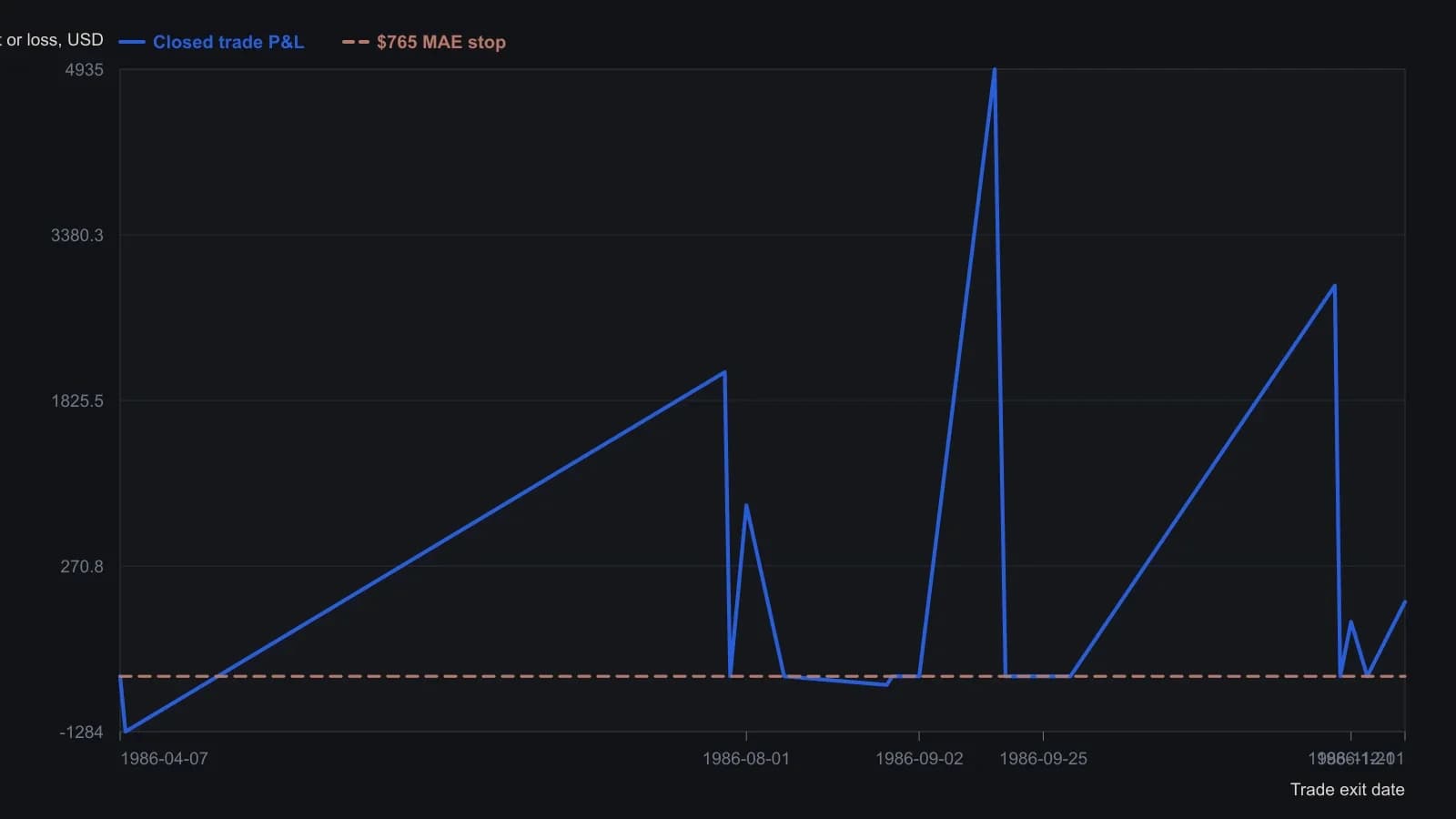
Figure 5 totals 24 trades: 5 winners for 20082 dollars, 19 losers for -13160, net 6922, average trade 288, win rate 20.83 percent. Only 19 rows are readable in the scan, so missing trades were not filled in. The 765-dollar stop is the 700-dollar MAE bound plus costs. Same entry, exit, and abstention rules as the 1989 development window; not retuned.
Filters were not retuned for later noise
Indicator plots were treated as untrustworthy because of display artifacts, so trades were checked against the numerical indicator values rather than the charts alone.
A filter threshold is a small logic gate meant to ignore one-day indicator noise, and it should come from inspecting raw behavior, not from searching for a later-sample profit maximum. One-day indicator anomalies of about 0.003 and 0.016 after an existing 0.005 filter were not used as a reason to retune that filter, because the 0.005 value had already been chosen by inspecting raw no-stop results.
A whipsaw cluster is a patch of too-frequent trades that suggests the rules are flipping in quiet or two-sided action. Clusters of extra trades and possible whipsaw appeared in more than one year and were logged as a candidate filter re-estimate only after those years could be inspected together.
A multi-day buy that matched the indicators but still failed in a decline was left unchanged. Rewriting rules to erase a few misses can also distort trades that already fit the concept.
Later years still left work open
Robustness testing means rerunning the same mechanical procedure on additional windows of similar length but different activity to see which problems repeat before any rule is changed. After that walk through several additional years, unfinished work still included consecutive-loss drawdown, pyramiding, and a pooled filter re-estimate.
Period transfer asks whether the same rules, stops, and filters still produce a coherent trade set when the calendar window changes but the instrument does not. That was the evaluation that was actually done. Transfer to other instruments was deferred because the rules were built on one market's observed behavior. Instrument specificity is the limit that this behavior should not be assumed to apply to unrelated markets until it is re-established.
All readings on this track · 15 readings
- 1987Evaluating a black-box pyramiding routine with adverse excursion
- 1991Set the first stop from a capital-scaled MAE histogram
- 1991Opening gap fades bounded by excursion and time stops
- 1991Stop bounds versus added system parameters
- 1991Bound losses with MAE, stops, and drawdown limits
- 1992Multi-year evaluation of MAE-bounded mechanical rules
- 1992Moving-average add-ons could not be separated by maximum adverse excursion
- 1992Evaluating maximum-adverse-excursion stop reversals with short time stops
- 1992Failed range trades as breakout-system tests
- 1998Fitted moving averages for trend add-on entries
- 1998Monthly changer rules specified as one mechanical procedure
- 2002An excursion cutoff test for stops and profit exits
- 2006Constructing peak-excursion filters for stops and size
- 2006Cost-aware excursion filters for stops and holding period
- 2017Staged stops, drawdown limits, and mechanical risk survival