2002issue C081-5
An excursion cutoff test for stops and profit exits
A per-trade scatter of final profit or loss against runup or drawdown is used to test a candidate stop-loss or profit cutoff before the next order, by comparing only the trades whose excursion exceeds that level.
- Excursion analysis plots each trade's final profit or loss against that trade's largest unrealized runup or largest unrealized drawdown.
- The cutoff-balance-test ignores the count of winning trades and, using only trades whose excursion exceeds a candidate level, compares the summed distances of points below a matching horizontal line with those above it.
- A stop-loss is accepted only after the drawdown-side test shows forced exits remove more unfinished loss than they forfeit from trades that later recovered.
- When the chart shows excessive giveback, a trailing-stop can replace a fixed level and the excursion plot can be redrawn to check whether giveback shrank.
Reading both exits on one scatter
Excursion analysis plots each trade's final profit or loss against that trade's largest unrealized runup or largest unrealized drawdown. On the favorable side, maximum-favorable-excursion is that per-trade plot of final profit or loss against the largest unrealized runup while the position was open. It is used to test whether a planned profit cutoff locks leftover giveback or clips trades that still had more to run.
On the adverse side, maximum-adverse-excursion is the matching plot against the worst unrealized drawdown while the position was open. It is used to test whether a planned loss bound cuts unfinished damage or merely removes trades that would have recovered. Runup is the largest unrealized open profit recorded during a single trade. Drawdown is the largest unrealized open loss recorded during a single trade.
How the cutoff-balance-test is scored
The cutoff-balance-test is a visual check that draws matching horizontal and vertical lines at a candidate level. For a profit-taking level, only trades whose runup exceeds that level are used. The summed distances of points below the horizontal line are compared with those above it.
The count of winning trades is the wrong score for a profit cutoff. The test is aimed at the net effect on total profit, and some large-runup trades keep only a fraction of their peak open gain.
When a report plots losing trades above the zero line, above and below must be swapped. Favorable-excursion work is read mainly on winners and adverse-excursion work mainly on losers.
A grid of fixed-dollar runup or drawdown cutoffs can be scored by summing, for each trade whose excursion exceeds the cutoff, the difference between the cutoff and that trade's final profit or loss.
The drawdown-side stop-loss check
The same line-balance test applies to a stop-loss. Only trades whose drawdown exceeds the candidate level are compared, to see whether forced exits remove more unfinished loss than they forfeit from trades that later recovered. A stop-loss is a pre-set exit that closes the position once adverse excursion reaches a chosen level, and it is accepted only after that drawdown-side balance test.
In the worked adverse-excursion example, a 140-dollar drawdown cutoff left trades that stayed down outweighing those that later recovered, while tightening inside 100 dollars began to remove too many trades that finished better.
Scale-choice and a trailing-stop rewrite
Scale-choice is the unit used for profit, runup, and drawdown on the scatter. Those series can be expressed in dollars, percent, or a volatility measure such as the standard deviation of closes or average true range. Percent is a poor common scale across unlike markets, while a dollar scale is more consistent when each trade is sized to similar dollar risk.
After the chart shows excessive giveback, the exit can be replaced with another rule, including a trailing-stop. A trailing-stop follows price after the trade moves in the intended direction and can replace a fixed-dollar stop or limit once the excursion chart shows static levels are leaking giveback or clipping the wrong trades. The same scatter is then redrawn to recheck the bound and to check whether giveback shrank.
Net gain from each runup profit-taking cutoff
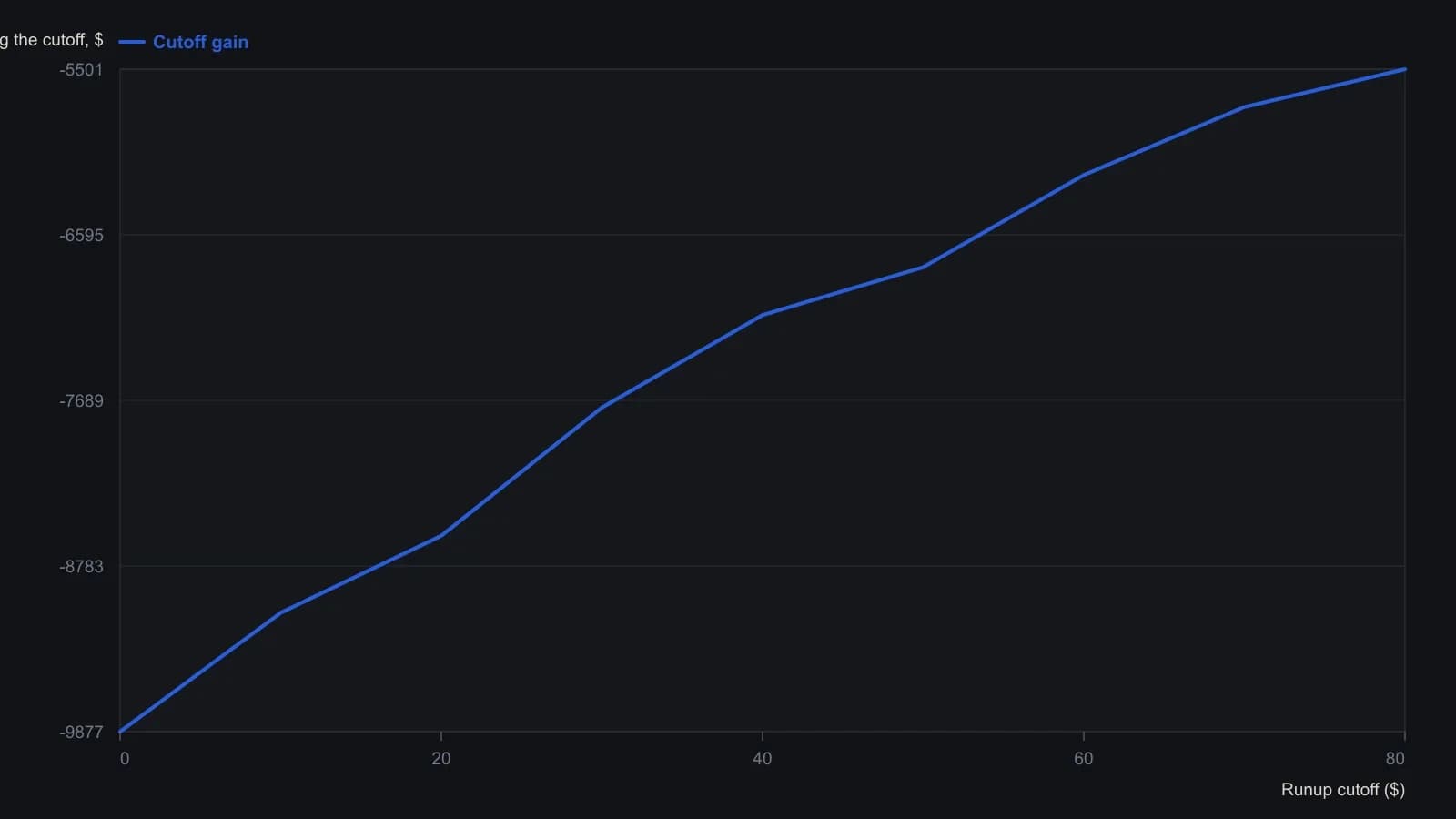
Only cutoffs 0 through 80 in steps of 10 are readable on the screenshot. The sheet’s max-cutoff input is 2000, so the article’s $600 balance region is off this slice.
All readings on this track · 15 readings
- 1987Evaluating a black-box pyramiding routine with adverse excursion
- 1991Set the first stop from a capital-scaled MAE histogram
- 1991Opening gap fades bounded by excursion and time stops
- 1991Stop bounds versus added system parameters
- 1991Bound losses with MAE, stops, and drawdown limits
- 1992Multi-year evaluation of MAE-bounded mechanical rules
- 1992Moving-average add-ons could not be separated by maximum adverse excursion
- 1992Evaluating maximum-adverse-excursion stop reversals with short time stops
- 1992Failed range trades as breakout-system tests
- 1998Fitted moving averages for trend add-on entries
- 1998Monthly changer rules specified as one mechanical procedure
- 2002An excursion cutoff test for stops and profit exits
- 2006Constructing peak-excursion filters for stops and size
- 2006Cost-aware excursion filters for stops and holding period
- 2017Staged stops, drawdown limits, and mechanical risk survival