1992issue C021-10
Moving-average add-ons could not be separated by maximum adverse excursion
Extra same-direction units were independently capitalized add-ons, not pyramiding financed by parent profit. A 10-day moving-average touch was rejected after winning and losing add-ons kept the same maximum-adverse-excursion range.
- An add-on is a fully capitalized extra unit that needs its own entry, exit and adverse-excursion decision rather than inheriting the parent trade.
- The tested fill was a same-direction 10-day simple moving-average touch, using an eight-to-ten-day length already in use so the test would not become an in-sample optimization contest.
- Winning add-ons outnumbered losing ones, but the maximum-adverse-excursion distributions were not distinct, and a 0.5-point cutoff would have discarded later winners.
- Profit-financed pyramiding lifts the parent break-even as later fills worsen, while cash-backed add-ons keep a separate break-even and stop on each unit.
Add-ons are independently capitalized
Extra same-direction units were defined as independently capitalized add-ons, not as pyramiding that reused parent profit for margin.
Each add-on used the same joint entry-and-exit definition and the same worst-against-the-position measurement as the parent trade.
An add-on is a fully capitalized extra unit that must stand as its own entry, exit and adverse-excursion decision rather than inherit the parent trade's evaluation.
The moving-average trigger
The tested trigger filled at a 10-day simple moving average when price already pointed the same way and that session's extreme crossed the average, then exited when the parent system stopped or reversed.
The average length was taken from an eight-to-ten-day range already in use so the add-on test would not become an in-sample optimization contest.
The moving average here is a lagged mean of recent prices used as an explicit touch-and-fill level for extra entries inside an already open directional stance.
Winning and losing add-ons shared the same adverse range
On the first sample, winning add-ons outnumbered losing ones, yet their maximum-adverse-excursion distributions were not distinct.
Maximum adverse excursion is the largest price move against an open trade, compared across winning and losing groups to test whether a rule can bound risk before the exit.
No reviewed add-on showed adverse excursion beyond 1.5 points, so a 0.5-point cutoff would have discarded later winning trades rather than isolate losers.
Most losing add-ons recorded an adverse excursion equal to the closed loss, showing risk was inherited from the parent exit because the extra unit had no separate stop.
The same overlap returned on later samples
A second, visually target-rich year still produced failed add-ons: missed parent trends, entries opposite the average's direction, and entries too late in the move.
Across additional years the same maximum-adverse-excursion overlap persisted, so the moving-average add-on was rejected as unable to distinguish good trades from bad ones.
Add-on winners and losers sit in the same MAE bins
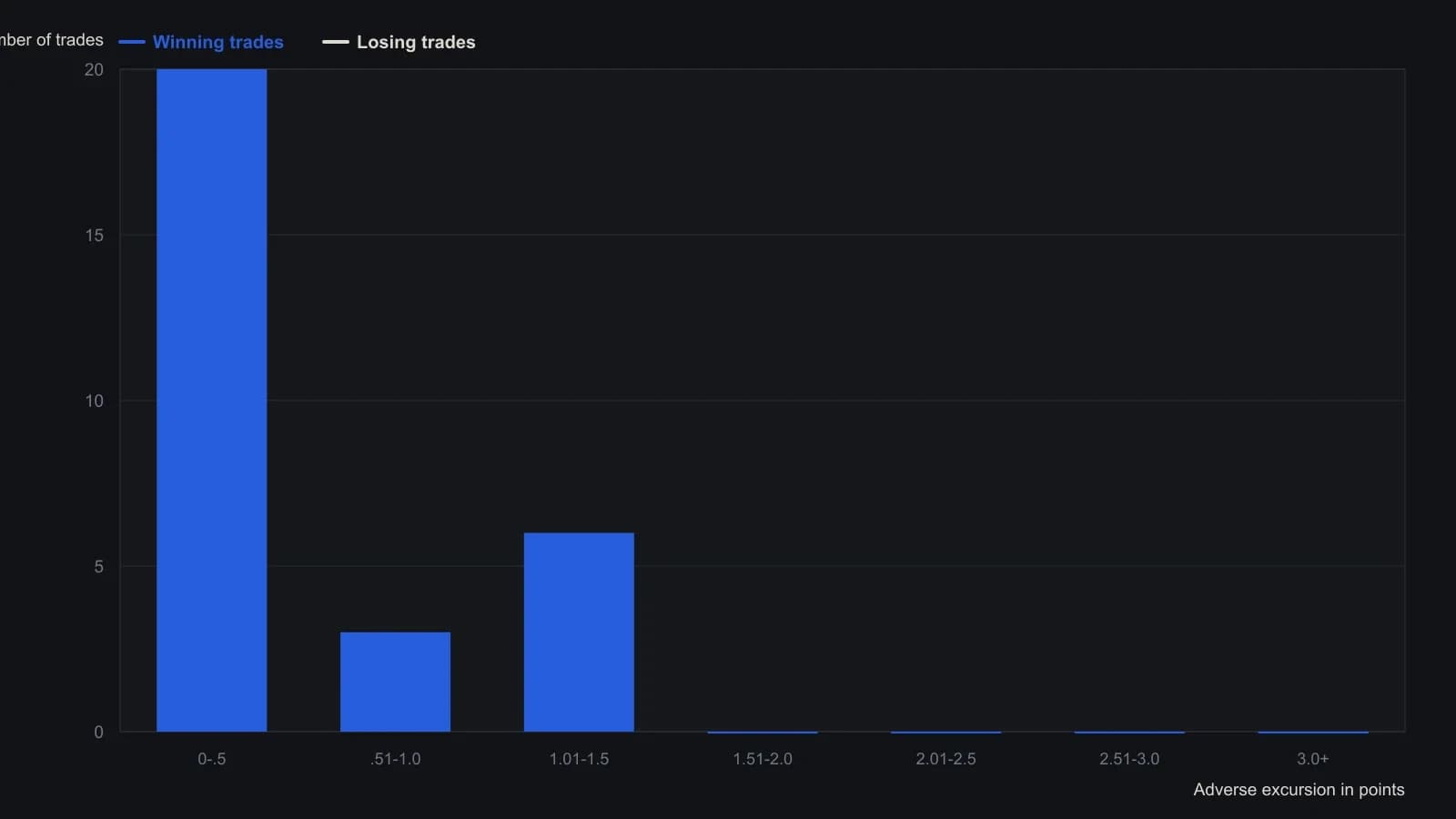
Add-on rule: if already long (short), enter at the 10-day simple moving average when that day’s low (high) crosses it; exit with the underlying system. No add-on in this sample showed MAE above 1.5 points.
Pyramiding changes a different break-even
Profit-financed pyramiding lifts the parent break-even as later fills worsen, while cash-backed add-ons keep a separate break-even and stop on each unit.
Pyramiding finances later same-direction units with open profit from the parent position, which raises the original break-even as later fills move farther from the first entry.
All readings on this track · 15 readings
- 1987Evaluating a black-box pyramiding routine with adverse excursion
- 1991Set the first stop from a capital-scaled MAE histogram
- 1991Opening gap fades bounded by excursion and time stops
- 1991Stop bounds versus added system parameters
- 1991Bound losses with MAE, stops, and drawdown limits
- 1992Multi-year evaluation of MAE-bounded mechanical rules
- 1992Moving-average add-ons could not be separated by maximum adverse excursion
- 1992Evaluating maximum-adverse-excursion stop reversals with short time stops
- 1992Failed range trades as breakout-system tests
- 1998Fitted moving averages for trend add-on entries
- 1998Monthly changer rules specified as one mechanical procedure
- 2002An excursion cutoff test for stops and profit exits
- 2006Constructing peak-excursion filters for stops and size
- 2006Cost-aware excursion filters for stops and holding period
- 2017Staged stops, drawdown limits, and mechanical risk survival