1998issue C041-3
Fitted moving averages for trend add-on entries
A fitted average is treated as a printed mid-range price for same-direction add-on entries rather than as a forecast of an unseen turn. Nearby lookbacks show whether the fit holds, the session close ends the trade, and maximum adverse excursion places the stop where failed add-ons typically appear.
- A moving-average can rise or fall only after price has already done so, so it confirms a completed move and then serves as a mid-range reference for add-on entries.
- Visual-fit starts from a short starter length, and a parameter-bracket of nearby averages shows whether the same extremes, and therefore the same entries, survive small lookback changes.
- The rule-based-entry buys or sells at the value of a rising or falling average, exits on that session's close, and uses range-suspend once price leaves the trend.
- Maximum-adverse-excursion sets the stop at the distance where failed add-ons historically declare themselves, and a tighter fit produces more excursion beyond the average than a looser fit.
A confirmation, not an unseen turn
A moving-average is a fitted average of ordered prices that can rise or fall only after price has already done so. It cannot rise unless price has already risen, and it cannot fall unless price has already fallen, so it confirms a completed move rather than anticipating an unseen one.
Once a trend is identified, the average functions as an adaptive mid-range level for same-direction add-on entries. The same level can also mark fade points when price stretches away from it.
Starter lengths and a visible bracket
Visual-fit can begin with about 20 or 21 daily observations for stocks and about 9 or 10 for futures. Nearby averages are then placed around those starter lengths so the fit can be seen rather than treated as a default length that is already definitive.
When eight-, 10-, and 12-day averages are shown together, the space between the lines indicates how sensitive those skim-the-extreme entries are to the chosen lookback. A parameter-bracket of this kind shows whether the same extremes, and therefore the same entries, survive small length changes.
The same-session add-on rule
The rule-based-entry is a closed procedure that enters at the value of a rising or falling average, exits on that session's close, and suspends add-ons once price leaves the trend. The stated rule is to buy at the value of a rising average and exit on the close, or to sell at the value of a falling average and exit on the close.
These add-on-entry trades are same-direction placements at the average after a trend is already identified, rather than a first attempt to catch the turn. In the illustrated decline, the middle 10-day average marked at least three short attempts that were followed by limited adverse movement after entry.
Fitted 8-, 10- and 12-day averages on T-bond futures
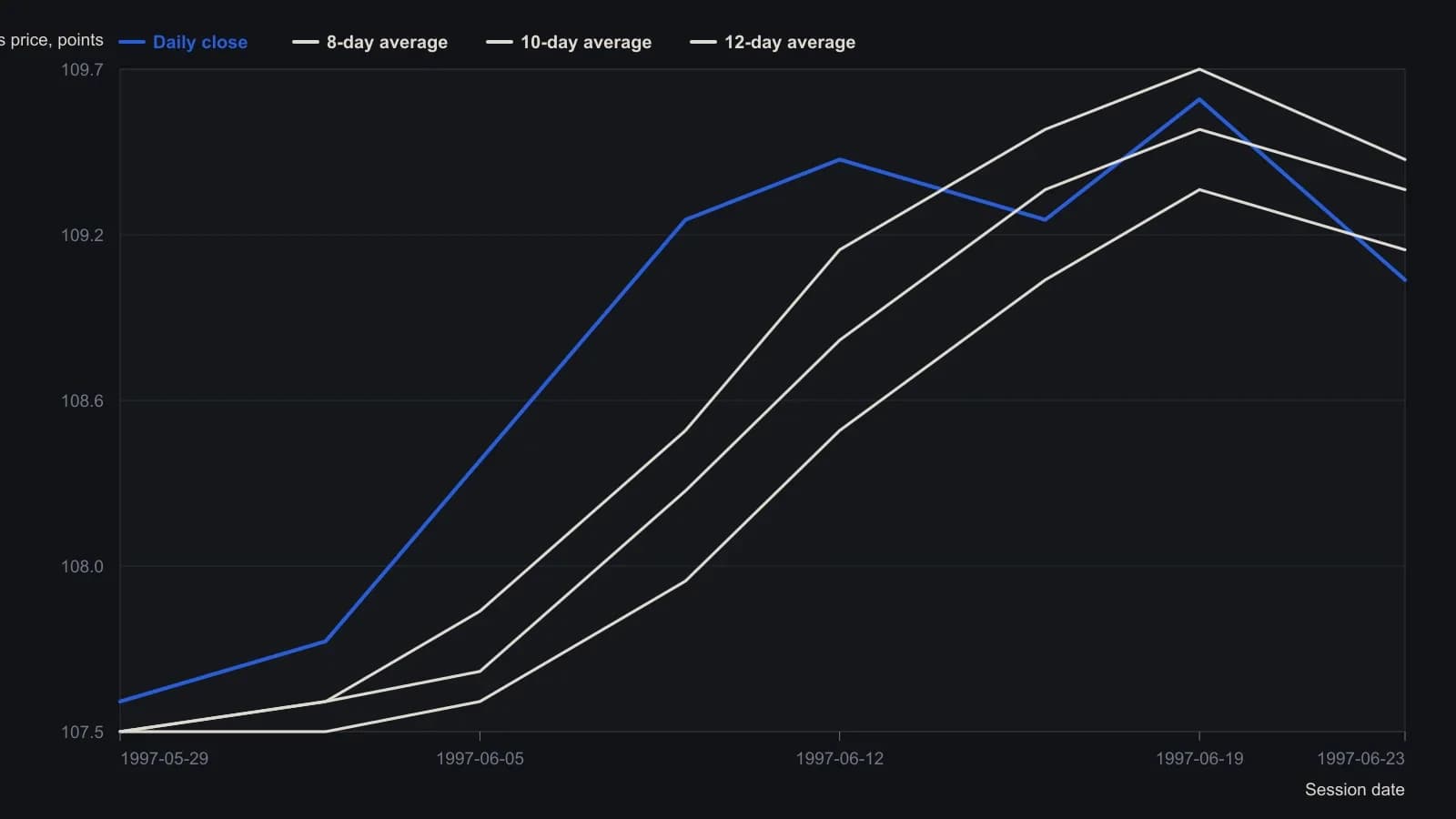
Lookbacks are the 8-, 10- and 12-day set used to bracket a nine- or 10-day futures starter. Readings come from the raster and are rounded to 0.1 point; they are not exchange prints. Calendar dates follow the May–June window on this zoom, consistent with the February–January overview captured in the same TradeStation workspace.
When the trend add-on is suspended
When a declining average is crossed and price remains above it, same-session trend add-ons are suspended because a trading range is forming. That range-suspend step treats the opposite-side hold as a developing range rather than a continuation.
Stops from maximum adverse excursion
Maximum-adverse-excursion is the unfavorable move after entry, summarized so a stop can be placed where failed add-ons typically declare themselves. A stop belongs at the adverse-excursion distance that historically marks a failed add-on, and a tighter average fit produces more excursion beyond the average than a looser fit.
In the illustrated comparison, an eight-day average showed about eight to 12 ticks more adverse excursion than a 10-day average.
Decisions made before the session
Entry price, stop, and same-session close exit can be specified before the session, so the procedure does not require discretionary decisions during the day.
All readings on this track · 15 readings
- 1987Evaluating a black-box pyramiding routine with adverse excursion
- 1991Set the first stop from a capital-scaled MAE histogram
- 1991Opening gap fades bounded by excursion and time stops
- 1991Stop bounds versus added system parameters
- 1991Bound losses with MAE, stops, and drawdown limits
- 1992Multi-year evaluation of MAE-bounded mechanical rules
- 1992Moving-average add-ons could not be separated by maximum adverse excursion
- 1992Evaluating maximum-adverse-excursion stop reversals with short time stops
- 1992Failed range trades as breakout-system tests
- 1998Fitted moving averages for trend add-on entries
- 1998Monthly changer rules specified as one mechanical procedure
- 2002An excursion cutoff test for stops and profit exits
- 2006Constructing peak-excursion filters for stops and size
- 2006Cost-aware excursion filters for stops and holding period
- 2017Staged stops, drawdown limits, and mechanical risk survival