2020issue C0616-20
Dividend early assignment risk for short calls
A pending dividend raises early assignment risk on a short in-the-money call unless remaining time value exceeds the dividend. Pre-dividend call quotes can cheapen, so same-strike put time value and open-interest drops are the practical gauges.
- Early assignment risk rises when a short call is in the money and remaining time value is low, and a pending dividend raises that risk further unless remaining time value exceeds the dividend.
- A call with 30 or more days to expiration often still has time value larger than a typical dividend, while that comparison becomes much tighter in the final weeks or days.
- Pre-dividend quoted call time value is not a reliable assignment gauge; same-strike out-of-the-money put time value is the cleaner read of true in-the-money call time value.
- If remaining call time value is not above the dividend, the practical choices are to close, roll to a higher strike, or roll farther in time.
A checkpoint for short-call sizing
Editorial: TradersWeek treats an approaching ex-dividend date as a risk-and-sizing checkpoint for covered-call writers. The question is whether a short in-the-money call still has enough remaining premium relative to the dividend to keep, reduce, or roll the position, using option prices, implied volatility, and position context to place that single trade inside a broader market and dividend regime.
When early assignment risk rises
When a short call is in the money and remaining time value is low, early assignment risk rises. A pending dividend raises that risk further unless remaining time value exceeds the dividend.
Reading days to expiration, moneyness, and the ex-dividend date versus expiration is how that rise is judged. A call with 30 or more days to expiration often still has time value larger than a typical dividend, while that comparison becomes much tighter in the final weeks or days.
Quoted call time value can mislead
On the ex-dividend date the stock is marked down by the dividend. In one 2019 case a 1.17 cash amount corresponded to an overnight mark from 85.95 to 84.78.
Because market makers price in the coming markdown, calls that expire after the ex-date tend to cheapen and puts tend to richen. Pre-dividend quoted call time value is not a reliable assignment gauge.
Away from a dividend, same-strike call and put time values line up. With a pending ex-date, same-strike out-of-the-money put time value is the cleaner read of true in-the-money call time value.
After the dividend adjustment
After the dividend adjustment, in-the-money call time values normalize and option prices reflect the lower stock level. At-the-money prices need not fall in line with delta because implied volatility can rise.
Implied volatility around the dividend event is how to interpret that gap. In one post-ex-date example, an 85-strike call with 31 days left moved from 1.54 at 11.54% implied volatility to 1.61 at 18.08% implied volatility.
Open interest around the ex-date
Open interest in in-the-money calls dropped sharply after recent ex-dividend dates, consistent with widespread exercise or closing. Not every contract with time value below the dividend disappeared.
Changes in call open interest around an ex-dividend date serve as a filter for whether holders exercised or closed in-the-money contracts.
Philip Morris call open interest before and after the $1.17 dividend
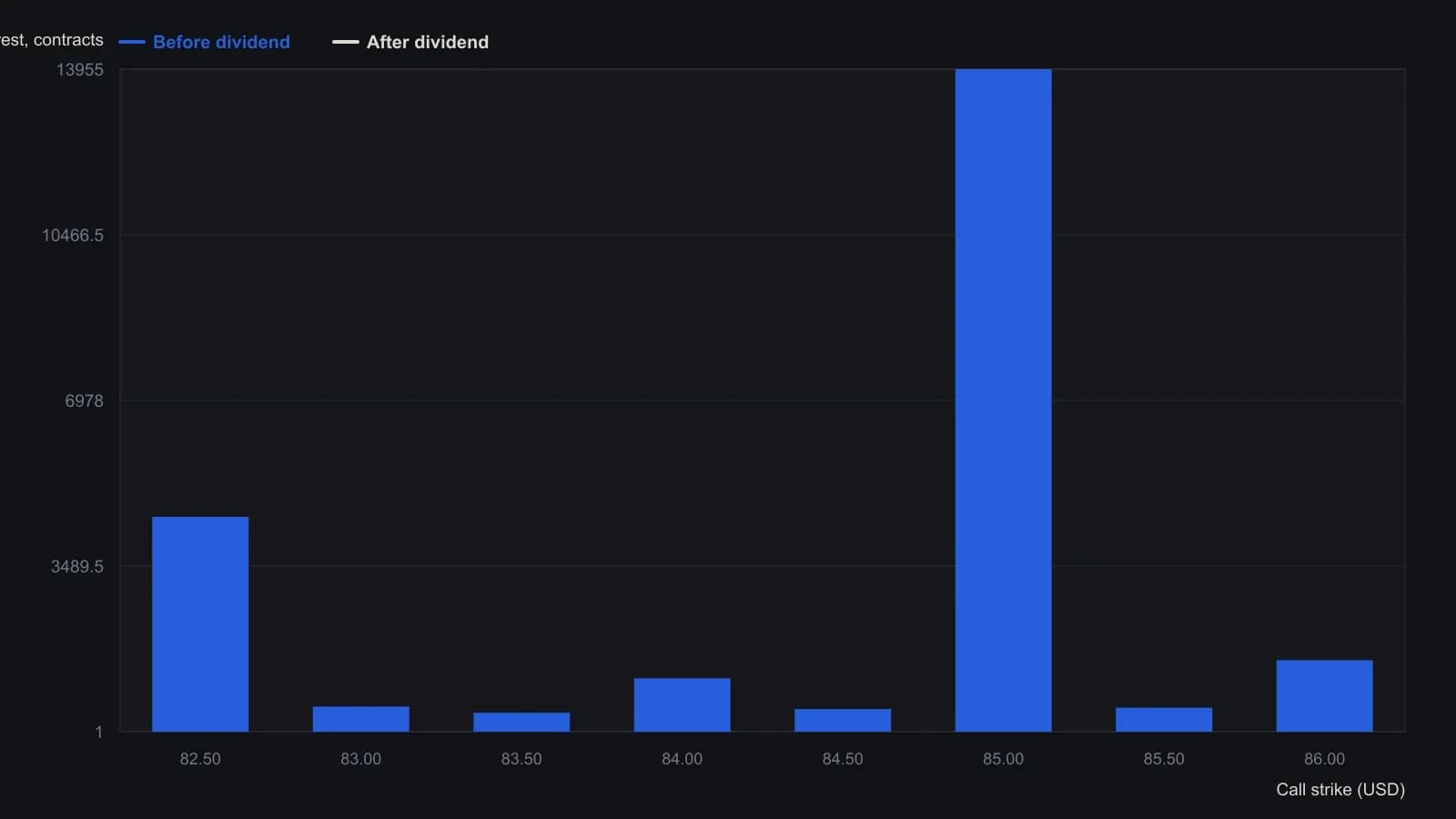
The same table also lists AbbVie January 2020 calls, which show the same in-the-money collapse; only Philip Morris is plotted so the strike axis stays on one name. The article’s prose quotes an opening adjustment of $84.78; the table uses $84.76.
Keep, reduce, or roll
Keeping short-call assignment risk down requires remaining call time value above the dividend. If it is not, the practical choices are to close, roll to a higher strike, or roll farther in time.
Editorial: those choices are the historical workflow for cutting assignment risk, not a ranking of later outcomes.
All readings on this track · 23 readings
- 1994Selecting option expiration and strike by expected value
- 1994Evaluating DJIA weakness inside the quarterly futures cycle
- 1995Evaluating option-expiration weeks as index regimes
- 2004Index option execution through expiration and volatility context
- 2005Constructing credit spreads around settlement and implied volatility
- 2006Call credit spread execution, leftover premium and expiration decay
- 2006Expiration-aware call construction and automatic exercise
- 2007Expiration, leftover premium, and seasonal context for option construction
- 2007Seven option mistakes in premium, expiration, and implied volatility
- 2008Long straddle construction around implied volatility and expiration
- 2008Option income critiqued through volatility and expiration
- 2011Covered call writing as income holding or buy-write turnover
- 2011A five-day Treasury bond option sale as a market-regime choice
- 2011Session-access gaps, expiration exercise, and spread coverage
- 2011Weekly option tenor construction and premium drivers
- 2012PM-settled index expiration in a defensive sector regime
- 2014Weekly covered-call income and the expiration hold test
- 2016Weekday option expirations as a catalyst-timing overlay
- 2017Overlapping condors and expiration windows
- 2017Small-cap index futures listing change as a margin and options checkpoint
- 2017Pin risk as an expiration-day execution problem
- 2019Stock, index, and futures options as a capital and expiration filter
- 2020Dividend early assignment risk for short calls