2008issue C031-6
Long straddle construction around implied volatility and expiration
A long straddle is assembled by buying a call and a put on the same underlying so a large move in either direction can matter. Construction then checks implied volatility, remaining life to expiration, and whether a consolidation or event setup makes that travel plausible.
- A long straddle buys a call and a put on the same underlying so the position can respond to a large move in either direction and cannot be copied by holding only the stock or futures contract.
- Low implied volatility is treated as a prerequisite, because a higher premium paid, and a later drop in implied volatility, can reduce option prices beyond time decay alone.
- Expiration is built as a 30-to-60-day window when an announcement is the catalyst, and a 90-to-180-day window otherwise, so the underlying has time to travel as breakevens widen.
- Strike filters buy calls with delta of +35 to +60 and puts with delta of -35 to -60, and timing looks for a significant announcement or a trend after an obvious consolidation.
A two-sided position rather than a stock substitute
A long straddle is constructed by buying a call and a put on the same underlying. The position can profit from a large move in either direction and cannot be replicated by holding only the stock or futures contract itself.
In this construction, an options straddle is a same-strike, same-expiration long call and long put used to profit from a large move in either direction rather than from a single forecast. Construction means selecting strike, expiration window, and volatility regime so the combined call-plus-put position is built for a two-way break rather than a directional bet.
Editorial: TradersWeek reads the assembled straddle as a two-sided market-regime position. Implied volatility sets the premium budget, remaining life until expiration sets how far the underlying must travel, and a consolidation or event setup decides whether that travel is even plausible.
Implied volatility as the premium budget
Low implied volatility is treated as a prerequisite for buying a straddle. Implied volatility is the market-priced volatility embedded in option premiums. When it is low relative to a security's own history, the time premium paid for a long straddle is cheaper.
Higher implied volatility raises the premium paid. A later drop in implied volatility can reduce option prices beyond time decay alone.
Remaining life and widening breakevens
The main construction risk is that the underlying fails to move far enough before expiration to offset time decay, so anything less than an above-average price move may not produce a profit. Option expiration analysis maps remaining days to expiration against time decay and widening breakevens to judge whether a straddle has enough life for a meaningful price move.
Expiration construction uses a shorter 30-to-60-day window when an earnings or other announcement is the catalyst, and a 90-to-180-day window otherwise so the underlying has time to travel.
In the illustrated October 47.50 example, the call was priced at 3.70 and the put at 4.00, for a combined premium of 7.70, with 126 days remaining until expiration treated as enough time for a meaningful move.
Risk curves for that long straddle show time decay enlarging potential loss and widening the upper and lower breakeven prices as expiration approaches, with decay accelerating in the final month.
Strike filters and timing setups
Probability filters for this construction buy calls with delta of +35 to +60 and puts with delta of -35 to -60. Skew is treated as not relevant when buying a straddle.
Timing construction looks either for a significant upcoming announcement or for a meaningful trend after an obvious consolidation, such as a test of a repeatedly failed resistance level.
SNDK October 47.50 long straddle strike and breakevens
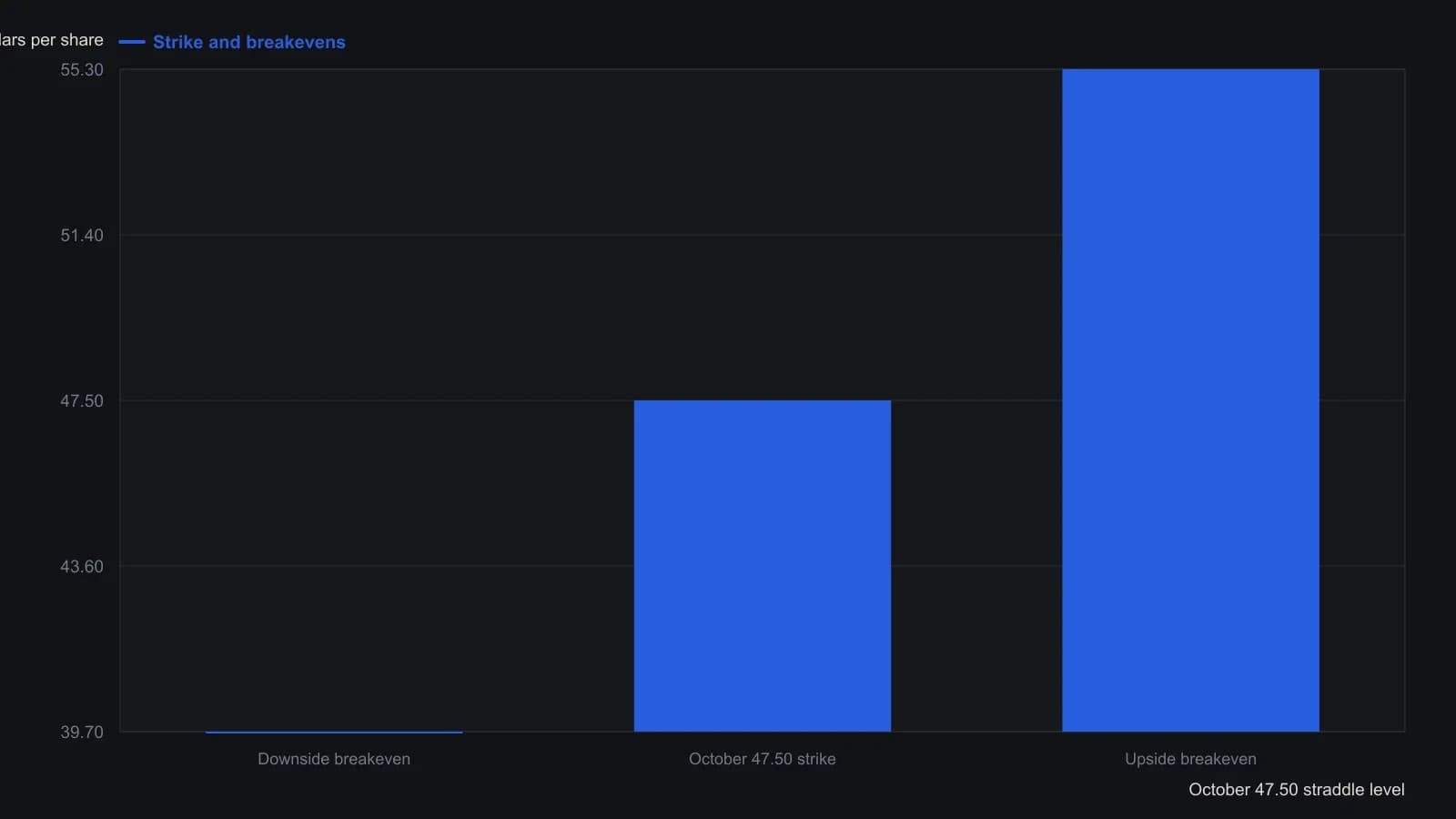
The blotter prices the put at 4.10 and the one-lot debit at 780 dollars; the article prose rounds those to 4.00 and 770. Ticket implied volatility is 36.5 percent on the call and 35.5 percent on the put.
All readings on this track · 23 readings
- 1994Selecting option expiration and strike by expected value
- 1994Evaluating DJIA weakness inside the quarterly futures cycle
- 1995Evaluating option-expiration weeks as index regimes
- 2004Index option execution through expiration and volatility context
- 2005Constructing credit spreads around settlement and implied volatility
- 2006Call credit spread execution, leftover premium and expiration decay
- 2006Expiration-aware call construction and automatic exercise
- 2007Expiration, leftover premium, and seasonal context for option construction
- 2007Seven option mistakes in premium, expiration, and implied volatility
- 2008Long straddle construction around implied volatility and expiration
- 2008Option income critiqued through volatility and expiration
- 2011Covered call writing as income holding or buy-write turnover
- 2011A five-day Treasury bond option sale as a market-regime choice
- 2011Session-access gaps, expiration exercise, and spread coverage
- 2011Weekly option tenor construction and premium drivers
- 2012PM-settled index expiration in a defensive sector regime
- 2014Weekly covered-call income and the expiration hold test
- 2016Weekday option expirations as a catalyst-timing overlay
- 2017Overlapping condors and expiration windows
- 2017Small-cap index futures listing change as a margin and options checkpoint
- 2017Pin risk as an expiration-day execution problem
- 2019Stock, index, and futures options as a capital and expiration filter
- 2020Dividend early assignment risk for short calls