1994issue C101-7
Selecting option expiration and strike by expected value
Editorial reading: expiration-month and strike-price belong to one expected-value design, not two separate hunches. The archive workflow locked the shortest month that still covered the charted move, then shifted moneyness as remaining life and directional accuracy changed.
- Use the shortest expiration-month that still falls after the charted duration of the anticipated move, with only a modest extra buffer.
- With that month fixed, the archive rules set strike-price by remaining life: near month at or slightly in the money, one month out slightly out of the money, and two months out slightly to moderately out of the money.
- When modeled directional accuracy rose from 65 percent to 75 percent, expected-value peaks shifted toward less in-the-money and more out-of-the-money strikes.
- Bid-asked-spread and commission belong in the comparison. A rollover extends time but adds another layer of those costs.
What the premium contains
An American call conveys the right, not the obligation, to buy a stated quantity of the underlying at a fixed strike-price on or before expiration. The premium paid is the sum of intrinsic-value and time-value.
Call intrinsic-value equals the underlying price minus the strike-price when that difference is positive. An out-of-the-money option has no intrinsic-value, so its entire premium is time-value. Moneyness is how far the strike-price sits from the current underlying price, ranging from deep in the money to deep out of the money.
Four directional templates
Four simple directional templates are specified. Buy a call if the underlying is expected to rise. Buy a put if it is expected to fall. Write a call if it is not expected to rise. Write a put if it is not expected to fall.
The buyer's loss is limited to the premium. The writer takes the opposite exposure and faces theoretically unbounded loss unless the position is offset. Time-value declines toward expiration, and that time-decay favors the writer if other factors are unchanged.
Costs that enter the comparison
Option trading costs include the bid-asked-spread and brokerage commission. The spread can be about one-quarter point, or 25 dollars per contract. Contracts with high volume and high open-interest are preferred because dealers may accept a narrower spread.
Lock the expiration-month first
The expiration-month is the listed contract month whose remaining life must cover, and preferably slightly exceed, the expected duration of the anticipated price move. Expiration should fall after the charted duration of that move, with a modest extra buffer.
A rollover closes an expiring option and opens a later-dated contract to extend holding time. Rolling into a later month extends time but adds another layer of transaction costs.
How expected-value ranked the combinations
Expected-value is a probability-weighted payoff used to compare expiration and strike combinations before a trade is placed. A short-horizon case study priced 30-day, 60-day, and 90-day index calls with a Black-Scholes model, assumed a five-point underlying move over 10 days, ignored constant transaction costs, and scored expected-value at 65 percent and 75 percent directional accuracy.
At 65 percent directional accuracy, modeled expected-value peaks sat at near-month strikes five to 10 points in the money, one-month-out strikes from five points out of the money to five points in the money, and two-month-out strikes five to 15 points out of the money. Raising accuracy to 75 percent shifted those peaks toward less in-the-money and more out-of-the-money strikes.
Selection rules from that ranking
The resulting selection rules are to use the shortest expiration consistent with the expected holding period. If that is the near month, choose a strike-price at or slightly in the money. If it is one month out, choose slightly out of the money. If it is two months out, choose slightly to moderately out of the money.
10-day expected return by moneyness, 65% directional accuracy
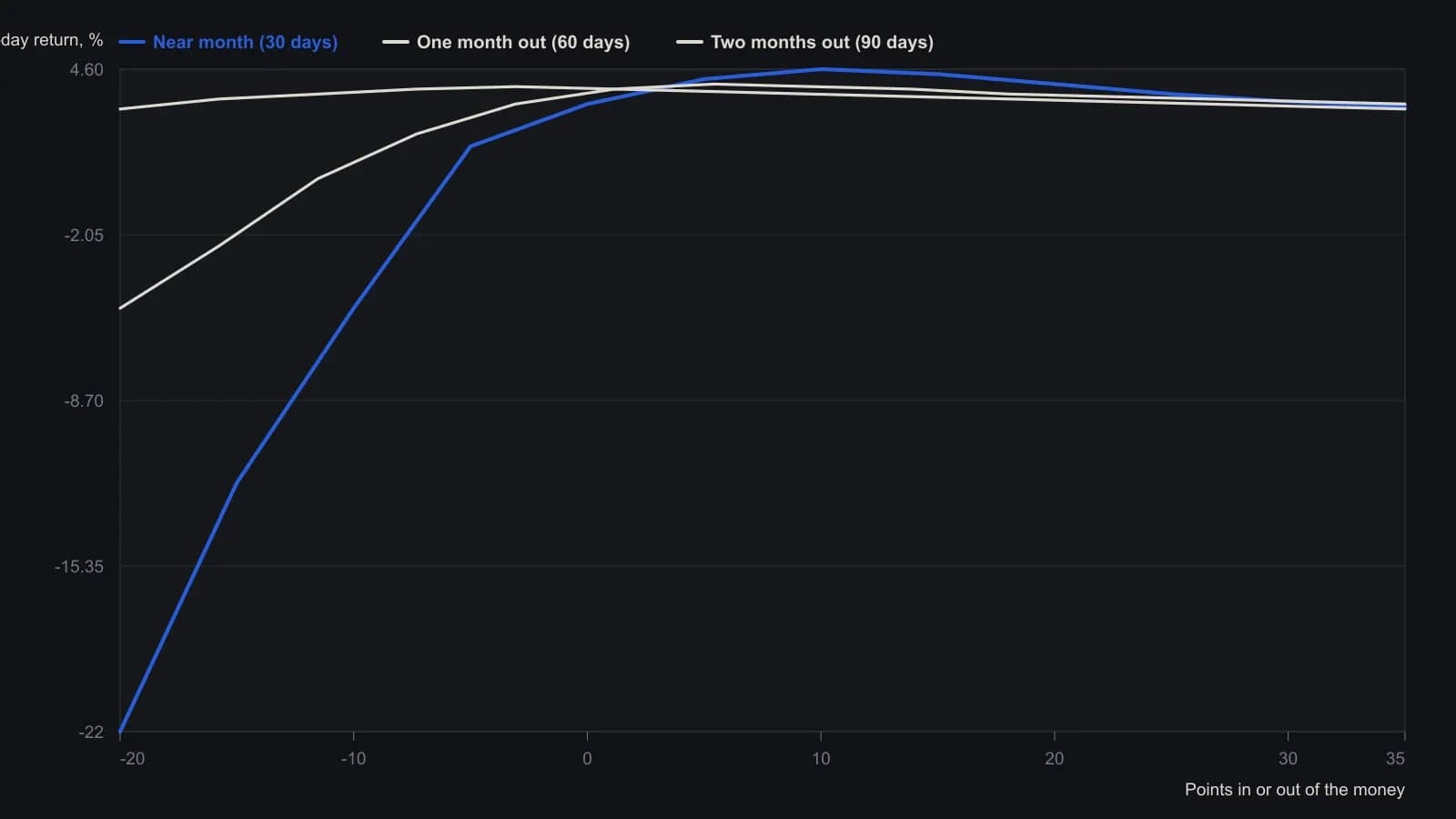
Black-Scholes prices, no bid-ask or commission; 30/60/90 days to expiration at purchase; index moves five points in 10 days, then the position is closed. Directed at short, modest swings, not low-probability blow-offs.
All readings on this track · 23 readings
- 1994Selecting option expiration and strike by expected value
- 1994Evaluating DJIA weakness inside the quarterly futures cycle
- 1995Evaluating option-expiration weeks as index regimes
- 2004Index option execution through expiration and volatility context
- 2005Constructing credit spreads around settlement and implied volatility
- 2006Call credit spread execution, leftover premium and expiration decay
- 2006Expiration-aware call construction and automatic exercise
- 2007Expiration, leftover premium, and seasonal context for option construction
- 2007Seven option mistakes in premium, expiration, and implied volatility
- 2008Long straddle construction around implied volatility and expiration
- 2008Option income critiqued through volatility and expiration
- 2011Covered call writing as income holding or buy-write turnover
- 2011A five-day Treasury bond option sale as a market-regime choice
- 2011Session-access gaps, expiration exercise, and spread coverage
- 2011Weekly option tenor construction and premium drivers
- 2012PM-settled index expiration in a defensive sector regime
- 2014Weekly covered-call income and the expiration hold test
- 2016Weekday option expirations as a catalyst-timing overlay
- 2017Overlapping condors and expiration windows
- 2017Small-cap index futures listing change as a margin and options checkpoint
- 2017Pin risk as an expiration-day execution problem
- 2019Stock, index, and futures options as a capital and expiration filter
- 2020Dividend early assignment risk for short calls