2012issue C0868-70
PM-settled index expiration in a defensive sector regime
A mid-June 2012 snapshot specified a European-style, cash-settled, PM-settled large-cap index option and treated consumer staples and utilities leadership as confirmation of a still-defensive market.
- The archive specified a cash-settled-index-option with european-exercise and PM-settlement: exercise only at expiration, and a final value taken from the Friday afternoon close.
- On 14 June 2012, consumer staples and utilities were the three-month sector leaders, and that sector-leadership was treated as confirmation of a still-defensive market.
- Financials and consumer discretionary still had to lead together before the broader market could be called bullish, with a moving-average-map used to locate that test.
- Editorial reading: expiration design is the clock and sector leadership is the weather. After-hours index access changes when a hedge is marked, not whether cyclicals have taken the lead.
A mid-June workflow
The archive records two parallel readings from mid-June 2012. One specified how a PM-settled large-cap index option is marked. The other asked whether consumer staples and utilities still confirmed a defensive market.
Option expiration analysis, as used here, puts that single contract into a regime-aware context. Settlement design locates the hedge on the calendar. It does not replace the sector test.
How the PM-settled contract was marked
The PM-settled large-cap index option was specified as European-style and cash-settled, with exercise only at expiration. That pairing is european-exercise on a cash-settled-index-option: the contract can be exercised only at expiration, and it pays a cash difference instead of delivering shares.
PM-settlement fixes the option’s final value from the underlying close on expiration Friday rather than from an opening print. Expiration fell on the Saturday after the third Friday of the expiration month. The last trading day was the preceding Friday, and settlement used the afternoon close.
The PM-settled contract was sized at 10 times a large-cap equity ETF option, used a 100 multiplier, and was quoted in decimals. Nearby expirations extended about 12 months forward. Longer-dated PM-settled series were listed with terms as long as five years and initial December expirations for 2012 through 2016. Those longer tenors are long-dated-expiration: listed index option terms measured in years rather than nearby months.
What sector leadership was saying
On 14 June 2012, consumer staples and utilities were identified as the three-month sector leaders. That leadership was treated as confirmation of a still-defensive market. In this workflow, sector-leadership is relative strength among industry groups used as a market-regime signal.
The pattern matches a defensive-rotation: staples, health care, or utilities outpace cyclicals such as financials and discretionary. The June snapshot named staples and utilities as the leaders. It did not name health care as a leader.
Financials and consumer discretionary were named as the sectors that needed to lead before the broader market could be called bullish. A joint advance in the financials and consumer discretionary sector ETFs was framed as the condition for a broader bullish shift.
The moving-average map on the missing leaders
As of that mid-June snapshot, the financials sector ETF was described as range-bound above its 200-day average, with 17.30 cited as both a breakout confirmation level and longer-term resistance.
The consumer discretionary sector ETF was described as holding well above its 200-day average, while a down-sloping 50-day average was treated as nearby resistance. A moving-average-map uses the slope and price position of the 50-day and 200-day averages to locate support, resistance, and trend confirmation in a sector fund.
Holding the two readings apart
Editorial reading: place the index option on the expiration clock first, then ask whether staples and utilities leadership still marks a defensive regime. Afternoon settlement and european-exercise tell you when the hedge is marked. They do not decide whether financials and discretionary have taken the lead together.
Three-month sector SPDR returns vs S&P 500, mid-June 2012
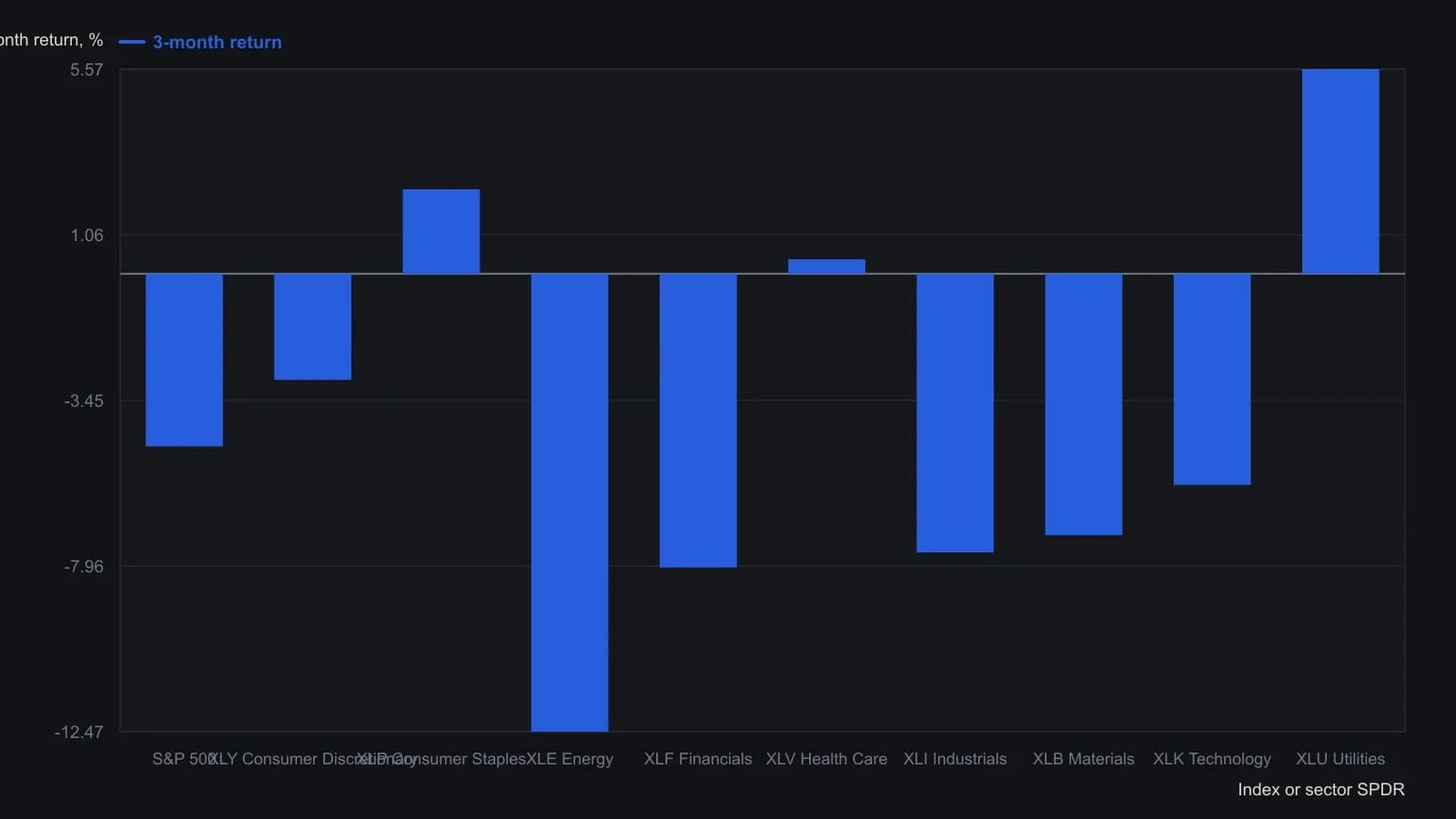
Snapshot labeled Sector Components as of 6/13/12; time period set to 3 months. Watchlist last prices on the same page are contemporaneous quotes, not the plotted returns.
All readings on this track · 23 readings
- 1994Selecting option expiration and strike by expected value
- 1994Evaluating DJIA weakness inside the quarterly futures cycle
- 1995Evaluating option-expiration weeks as index regimes
- 2004Index option execution through expiration and volatility context
- 2005Constructing credit spreads around settlement and implied volatility
- 2006Call credit spread execution, leftover premium and expiration decay
- 2006Expiration-aware call construction and automatic exercise
- 2007Expiration, leftover premium, and seasonal context for option construction
- 2007Seven option mistakes in premium, expiration, and implied volatility
- 2008Long straddle construction around implied volatility and expiration
- 2008Option income critiqued through volatility and expiration
- 2011Covered call writing as income holding or buy-write turnover
- 2011A five-day Treasury bond option sale as a market-regime choice
- 2011Session-access gaps, expiration exercise, and spread coverage
- 2011Weekly option tenor construction and premium drivers
- 2012PM-settled index expiration in a defensive sector regime
- 2014Weekly covered-call income and the expiration hold test
- 2016Weekday option expirations as a catalyst-timing overlay
- 2017Overlapping condors and expiration windows
- 2017Small-cap index futures listing change as a margin and options checkpoint
- 2017Pin risk as an expiration-day execution problem
- 2019Stock, index, and futures options as a capital and expiration filter
- 2020Dividend early assignment risk for short calls