2011issue C0248-53
A five-day Treasury bond option sale as a market-regime choice
A historical expiration-week-sale into November 2010 US Treasury bond options treated slightly out-of-the-money premium as time value that would vanish if a chosen boundary held. The December futures path and the November 131 call’s stochastic-of-option-price framed whether that premium was already depressed.
- All out-of-the-money options expire worthless, so the practical problem is locating an out-of-the-money-boundary that will still be out of the money at expiration.
- The case used a five-day-holding-limit into the November 2010 US Treasury bond option expiration on Friday, October 22, 2010, which settled against December futures.
- Slightly out-of-the-money options were treated as time-value-only-premium expected to go to zero by Friday if that boundary held.
- The December T-bond chart showed seven lower closes and a close near 131.00, while the November 131 call’s 10-day stochastic-of-option-price reached 2.22 and was read as an already depressed premium.
The boundary problem
All out-of-the-money options expire worthless. The practical problem is locating the strike that will remain out of the money. In this workflow that strike is the out-of-the-money-boundary: the price the market is judged unlikely to reach before expiration.
The archive facts describe a historical expiration-week workflow. Where TradersWeek draws a regime lesson from that workflow, the reading is labelled editorial.
The five-day sale
The case limited the sale to a maximum five-day hold into the November 2010 US Treasury bond option expiration on Friday, October 22, 2010, which settled against December futures. That five-day-holding-limit keeps the expiration-week-sale inside the remaining calendar week, so remaining time value is the main source of profit if the strike stays out of the money.
Slightly out-of-the-money options were treated as time-value-only-premium expected to go to zero by Friday if the boundary held.
Price path into the week
The December T-bond daily chart showed a short-term selloff with seven lower closes and a close near 131.00 entering expiration week. A four-point selloff in a short span left open a rebound scenario as well as continued weakness during the following week.
The at-the-money premium reading
The November 131 call was the at-the-money contract. Its 10-day stochastic-of-option-price reached as low as 2.22 and was read as an oversold premium that might stay depressed until expiration.
That stochastic-of-option-price applies a momentum reading to the option’s own price path rather than to the underlying, and was used here to judge whether the premium is already depressed.
10-day stochastic of the November 131 put
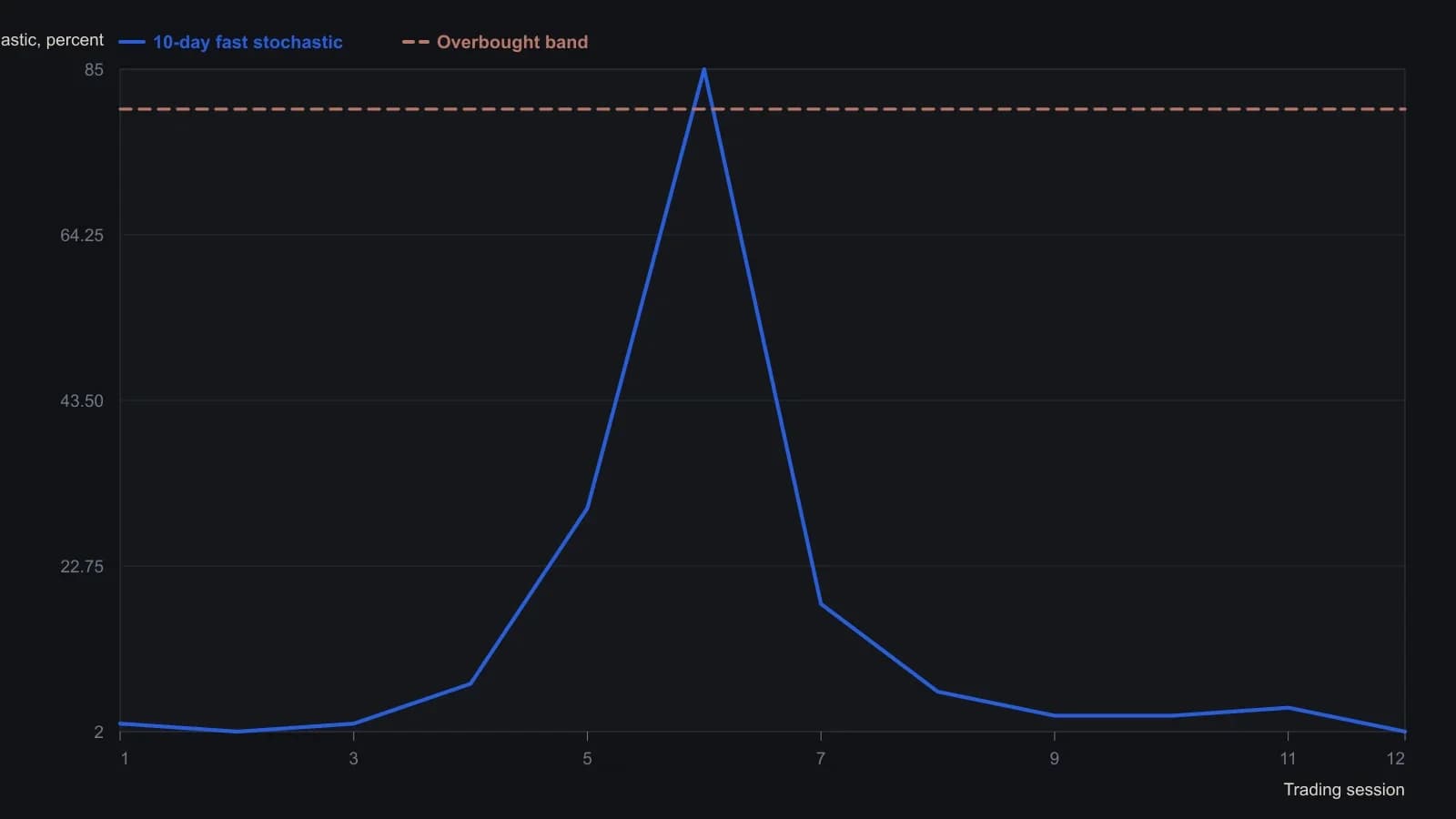
TradeStation Stochastic Fast on the option price itself (High, Low, Close; lookback 10, smoothing 3), not on the underlying future. Points other than the stated 85 peak are read from the raster and rounded to whole oscillator points. November T-bond options expired 22 October 2010.
All readings on this track · 23 readings
- 1994Selecting option expiration and strike by expected value
- 1994Evaluating DJIA weakness inside the quarterly futures cycle
- 1995Evaluating option-expiration weeks as index regimes
- 2004Index option execution through expiration and volatility context
- 2005Constructing credit spreads around settlement and implied volatility
- 2006Call credit spread execution, leftover premium and expiration decay
- 2006Expiration-aware call construction and automatic exercise
- 2007Expiration, leftover premium, and seasonal context for option construction
- 2007Seven option mistakes in premium, expiration, and implied volatility
- 2008Long straddle construction around implied volatility and expiration
- 2008Option income critiqued through volatility and expiration
- 2011Covered call writing as income holding or buy-write turnover
- 2011A five-day Treasury bond option sale as a market-regime choice
- 2011Session-access gaps, expiration exercise, and spread coverage
- 2011Weekly option tenor construction and premium drivers
- 2012PM-settled index expiration in a defensive sector regime
- 2014Weekly covered-call income and the expiration hold test
- 2016Weekday option expirations as a catalyst-timing overlay
- 2017Overlapping condors and expiration windows
- 2017Small-cap index futures listing change as a margin and options checkpoint
- 2017Pin risk as an expiration-day execution problem
- 2019Stock, index, and futures options as a capital and expiration filter
- 2020Dividend early assignment risk for short calls