1995issue C101-10
Evaluating option-expiration weeks as index regimes
The monthly index-option calendar can be marked as three weekly states. This article follows a historical evaluation of those states with average point changes, up-week rates, and variance tests, then a later-sample repeat, before the tag is used as a seasonal rule or model input.
- An option-expiration-week, the post-expiration-week that follows it, and every nonexpiration-affected-week form a three-state calendar tag rather than a fixed-length seasonal clock.
- Full-sample tests of weekly-point-change and up-week-frequency separated expiration weeks from post-expiration weeks more clearly than they separated expiration weeks from other weeks.
- A sample-split-check did not preserve every full-sample contrast, and variance tests did not show expiration and post-expiration weeks as systematically more volatile.
- Editorial view: encode week type first, then repeat the mean, frequency, and variance tests before treating the tag as a seasonal rule or model input.
Three week types on the option calendar
Listed index options stopped trading on the third Friday of each month. The calendar week that contains that close is the option-expiration-week. The week immediately after it is the post-expiration-week. Any week that is neither of those is a nonexpiration-affected-week.
That expiration week was framed as often stronger, with the following week often reversing lower. Successive expirations are not a fixed interval, and the spacing can change from year to year. A seasonal or model input therefore needs week-type-encoding: a categorical mark for the three states, rather than a constant lag.
What was compared
The evaluation used weekly-point-change, the index move measured in points rather than percent, because listed strikes are set on absolute index levels. A two-tailed-mean-test compared average weekly point changes without assuming which week type was larger. Up-week-frequency compared the share of weeks whose index change was positive. The same questions were asked of medians and of weekly variance.
A sample-split-check then repeated the mean, frequency, and variance tests on a later window to see whether an earlier contrast still held.
Means, medians, and up weeks
In the full sample, the average weekly-point-change was positive overall, larger in option-expiration weeks, and negative in post-expiration weeks. The two-tailed-mean-test rejected equal average weekly changes for expiration versus post-expiration weeks. A comparison of medians matched that mean test.
Expiration weeks finished higher more often than post-expiration weeks. Nonexpiration-affected-weeks sat between those two rates. A two-proportion comparison flagged the expiration versus post-expiration frequency gap as the significant contrast.
Expiration weeks were not significantly stronger than other weeks in the full sample. Post-expiration weeks were significantly weaker than other weeks in the full sample. A crash week in the sample was noted as a possible skew.
Of the sample's cumulative rise, expiration weeks accounted for most of the total, while the week after expiration contributed a cumulative decline.
S&P 100 up-week rate by option-expiration week type
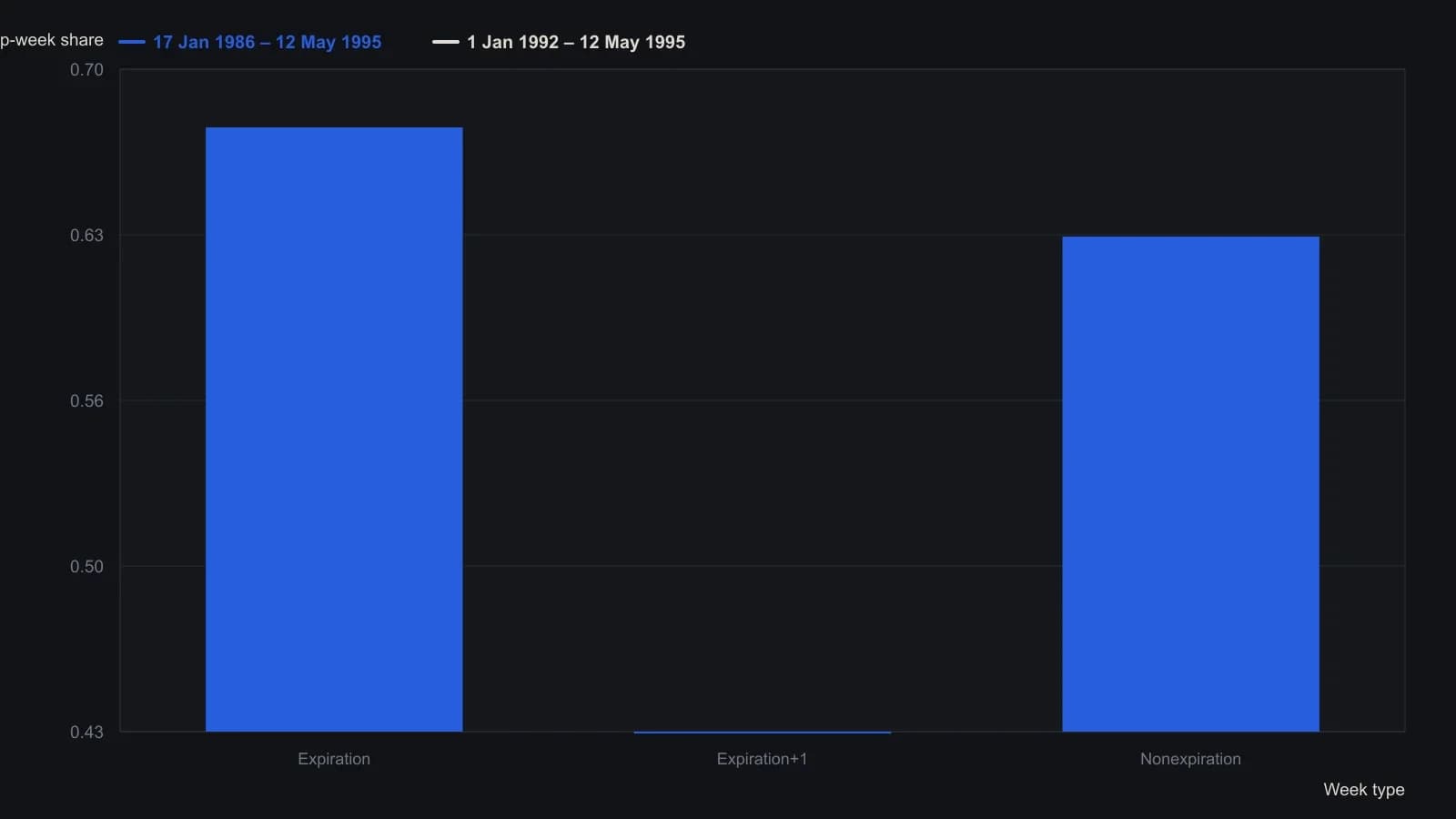
The source compared the rates with a two-proportion Z-test against a two-tailed 1.96 cutoff. Expiration versus the following week cleared that bar over 1986–95 (Z = 3.713) but not over 1992–95 (Z = 1.626). The 1992–95 nonexpiration rate 0.615 is the same window’s figure in the companion proportion table and in the text (61.5 percent).
The later window and variance
In the later window, expiration weeks still finished higher more often than the following week, and other weeks remained in between. That more recent frequency gap fell below conventional statistical significance.
Expiration weeks were stronger than other weeks in the later window. Post-expiration weeks were not significantly weaker than other weeks in that window.
Tests of weekly variance did not confirm the expected pattern that expiration and post-expiration weeks were systematically more volatile than other weeks. The only significant volatility contrast was post-expiration versus other weeks, and only in the later sample.
Using the tag without a fixed clock
Because successive expirations can sit at different spacings from year to year, a rule that assumes a constant week lag will mislabel some weeks. Week-type-encoding keeps the three states as categories.
Editorial conclusion: the historical workflow supports treating option expiration as a weekly regime mark, then testing that mark. It does not, on its own, establish a trading rule. Mean, up-week-frequency, and variance still need to be rechecked on the window under study, and volatility should not be assumed from the calendar label.
All readings on this track · 23 readings
- 1994Selecting option expiration and strike by expected value
- 1994Evaluating DJIA weakness inside the quarterly futures cycle
- 1995Evaluating option-expiration weeks as index regimes
- 2004Index option execution through expiration and volatility context
- 2005Constructing credit spreads around settlement and implied volatility
- 2006Call credit spread execution, leftover premium and expiration decay
- 2006Expiration-aware call construction and automatic exercise
- 2007Expiration, leftover premium, and seasonal context for option construction
- 2007Seven option mistakes in premium, expiration, and implied volatility
- 2008Long straddle construction around implied volatility and expiration
- 2008Option income critiqued through volatility and expiration
- 2011Covered call writing as income holding or buy-write turnover
- 2011A five-day Treasury bond option sale as a market-regime choice
- 2011Session-access gaps, expiration exercise, and spread coverage
- 2011Weekly option tenor construction and premium drivers
- 2012PM-settled index expiration in a defensive sector regime
- 2014Weekly covered-call income and the expiration hold test
- 2016Weekday option expirations as a catalyst-timing overlay
- 2017Overlapping condors and expiration windows
- 2017Small-cap index futures listing change as a margin and options checkpoint
- 2017Pin risk as an expiration-day execution problem
- 2019Stock, index, and futures options as a capital and expiration filter
- 2020Dividend early assignment risk for short calls