2019issue C0136-37
A directional put calendar after a failed resistance breakout
Calendar-spreads are typically framed as neutral structures with defined dollar risk. This archive case shows one stock recast as a directional-calendar after a multiyear resistance failed-breakout, while implied-volatility at entry was still treated as relatively low.
- A calendar-spread can remain a defined-dollar-risk structure even when it is positioned as a directional-calendar rather than a stay-unchanged trade.
- After an upside failed-breakout and a fall back below a key level, the archive example placed the calendar on the bearish side.
- Relatively low implied-volatility at entry is treated as favorable for a long-premium calendar, because a later rise typically helps the far-dated long option more than the near-dated short option.
- On individual stocks, implied-volatility spikes tend to coincide with price declines, so a later spike is described as more likely to help a put calendar than a call calendar.
A calendar can be neutral or directional
A calendar-spread is a same-strike structure that is long a later-dated option and short a nearer-dated option so time decay and implied-volatility changes can dominate the result. Calendar-spreads are typically framed as neutral structures that can profit when the underlying stays relatively unchanged, but they can also be positioned as directional trades with defined dollar risk.
When the same structure is aimed with the rejection rather than against a quiet range, it is a directional-calendar: a calendar positioned after a failed-breakout so it can benefit if price continues in the rejection direction rather than remaining unchanged.
The failed-breakout that opened a bearish calendar
Support-resistance refers to well-watched price ceilings and floors used either to frame a range or to mark the invalidation of a directional-calendar. A failed-breakout is a push through a major resistance or support level that is quickly reversed and often followed by sideways-to-lower trade.
After an upside breakout fails and price falls back below a key support level, a calendar can be positioned on the bearish side.
In August 2018 the illustrated stock attempted to clear multiyear resistance, briefly traded above it, then quickly fell back below that level.
Why relatively low implied-volatility mattered at entry
Implied-volatility is the options market's priced expectation of future movement. Calendars are typically initiated when this reading is relatively low so a later rise can add value.
A rise in implied-volatility typically helps a calendar because the longer-dated long option gains more time premium than the shorter-dated short option. The illustrated setup treats relatively low implied-volatility at entry as favorable for a long-premium calendar, with a later rise in implied-volatility described as helpful.
Long-premium here means a net long far-dated options stance that can gain if implied-volatility rises after entry.
Why the example used puts rather than calls
On individual stocks, implied-volatility spikes tend to coincide with price declines and sharp implied-volatility drops with price advances, so a volatility spike is described as more likely to help a put calendar than a call calendar.
Kohl's longer-dated implied volatility into the calendar entry
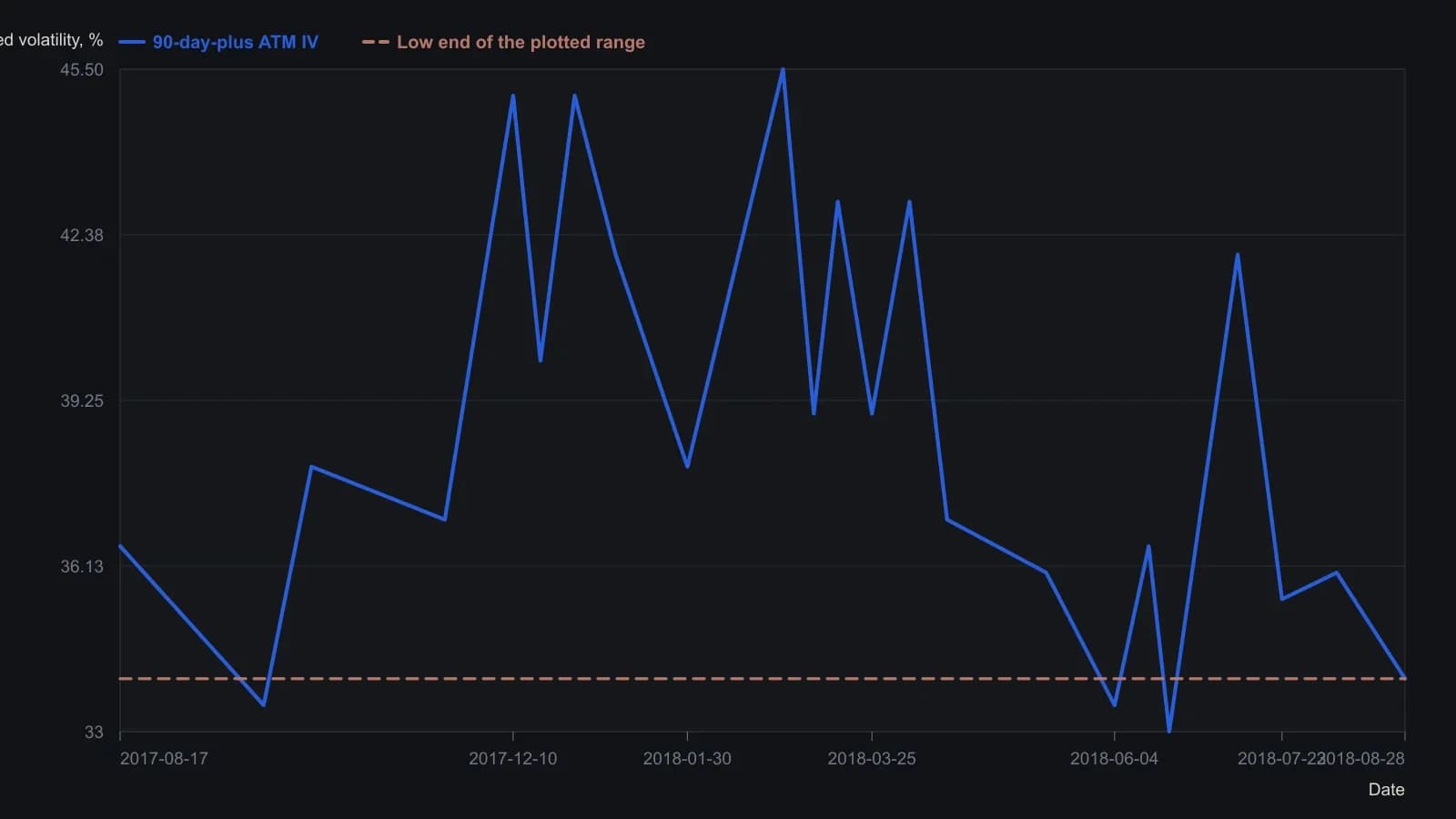
The source plots greater-than-90-day at-the-money implied volatility on the right-hand scale. Readings are approximate to the nearest half-volatility point. The 34 percent line is the low-end range marked on that chart, not a computed quantile.
The illustrated January-October put calendar
The worked example bought 10 January 2019 65-strike puts and sold 10 October 2018 65-strike puts for a $1,570 debit, stated as the maximum risk.
That is a calendar-spread at one strike: long the later-dated January puts and short the nearer-dated October puts. The debit is the defined dollar risk of the structure.
Assigned greeks at entry
At entry the example position was assigned a delta of -79, a vega of $76 per implied-volatility point, and a theta of $2.80.
Delta is the approximate share-equivalent exposure of the options position. The negative reading matches a bearish directional-calendar. Vega is the sensitivity of the position to a one-point change in implied-volatility. Theta is the sensitivity of the position to the passage of time; a positive reading means the structure can earn from decay.
How the risk curves were described
The example risk curves were described as making money if price declined, with profits increasing until $65 and then rolling over, and a renewed break above recent highs treated as the point to consider exiting.
Editorial note: that description uses the 65-strike as the peak of the directional path and treats a renewed break of recent highs as the support-resistance invalidation of the directional-calendar.
Editorial synthesis of the two filters
This editorial reading does not add a new rule set. It only groups the archive workflow into two checks: first confirm that a resistance failed-breakout has already reversed, then require implied-volatility still low enough that a later rise would help the long-premium side.
The archive itself does not present those checks as a standing system. They are an editorial way to remember when a typically range-bound calendar-spread was morphed into a directional put.
All readings on this track · 21 readings
- 1994Competing-bid calendar spreads and implied volatility
- 2001Calendar spreads as range overlays with wing repairs
- 2002Covered-call premium budgets and calendar-style rolls
- 2002Calendar-spread construction from time decay and implied volatility
- 2003Calendar ratio backspread construction for range and breakout regimes
- 2005Read the implied-volatility regime before calendar-spread assignment
- 2005Constructing calendars and straddles around implied volatility
- 2005Short option coverage through calendars, rolls, and expiration
- 2006Calendar spread expiration, assignment and time skew
- 2008The two clocks that close a calendar or a stock-plus-put
- 2010Cheap back-month implied volatility is a regime question, not a shopping rule
- 2010Calendar-spread assignment as a volatility regime shift
- 2010Uncapped collar overlays and earnings-week short calendars
- 2011Sequencing verticals, straddles, and calendars as construction tests
- 2012Executing conversion and ratio calendar option packages
- 2015Near-expiry options on new-crop grain futures
- 2018Calendar spreads as range and volatility regime trades
- 2019A directional put calendar after a failed resistance breakout
- 2019Sizing short-option risk with calendar puts
- 2019Limited-risk reversal construction
- 2020Covered-call writing versus a calendar call diagonal