1994issue C011-7
Competing-bid calendar spreads and implied volatility
A contested stock-for-stock-bid can be read as a weeks-to-months implied-volatility regime. The archive uses the term structure to date a decision-window, then checks whether a calendar-spread-options or diagonal-call-spread still has width if the deal prices the target and still has residual time value if the contest outlasts the front expiration.
- Near-dated target options were richer than later December and January expirations, which was read as a decision-window for naming a winning bid by October or November, not as a legal closing date.
- A same-strike calendar-spread-options debit of 1.25 could collapse toward flat if an 82 cash bid priced both 75 calls near 5, or widen toward 3 or more if October expired with the target still near 77 and no bid completed.
- A diagonal-call-spread sold the richer 50 percent implied-volatility October 80 call against a cheaper 40 percent November 75 call and still had a 5-point intrinsic width if the target was above 80 at October expiration.
- Short puts and stock-for-stock residual risk remained if the deal failed, if a fallback package was worth about 65, or if a winning bidder itself fell and the target inherited that equity risk.
A competing bid as a volatility regime
This TradersWeek editorial uses an archive contested stock-for-stock-bid as a weeks-to-months implied-volatility case. The aim is to date the market's expected decision-window, then test whether a calendar-spread-options or diagonal-call-spread still has width if the deal prices the target and still has residual time value if the contest outlasts the front expiration.
A competing bid of about 0.9 acquirer shares plus 30 cash, with the acquirer near 56, implied a package near 80.40. The target had already rallied to 76, so it was trading unusually close to that package early in the process.
Relative weakness in one bidder versus the other was treated as a market ranking of which bidder was more likely to prevail. That ranking reversed after financing developments.
Implied volatility as a timing map
Near-dated target options were richer than later December and January expirations. That volatility-term-skew, with event risk concentrated in a nearer month, was read as a view that a winning bid would be identified by October or November rather than that the merger would necessarily close then.
Month-to-month implied-volatility differences are treated as the market's timing and intensity map for a takeover decision. The decision-window they mark is the likely interval for naming a winning bid, which need not be the same as legal closing. Takeover-implied-volatility is the elevated option pricing that appears once a company is in play and can compress once the contest is decided or that window passes.
A same-strike calendar under two paths
With the target near 77, a calendar-spread-options position could be opened by selling the October 75 call at 5.25 and buying the December 75 call at 6.5, for a debit of 1.25. It is a same-strike structure that is short a nearer-dated option and long a later-dated option, used here to express a view on when a bid contest may be resolved.
If a cash bid of 82 were accepted before October expiration, both the October and December 75 calls could converge near 5, collapsing the calendar because upside optionality in the longer-dated call would disappear.
If the front month expired with the target still near 77 and no bid completed, the October 75 call would expire near 2 while the December 75 call could retain most of its value, allowing the calendar to widen toward 3 or more.
What still breaks after the package is known
Short puts on the target remained exposed if the deal failed, if a surviving package were worth less than the current price (about 65 in one fallback case), or if a stock-for-stock winner itself fell, because the target then inherited the acquirer's equity risk.
A stock-for-stock-bid is paid mainly in the bidder's shares, so the target's residual risk includes dilution and moves in the surviving bidder. A stock-for-stock risk hedge was described as long the target via stock or calls and short the acquirer via stock or long puts.
A three-name long-call overlay was a non-arbitrage alternative. Its main risks were takeover-implied-volatility compressing, expiration arriving before resolution, or a completed deal that left all three stocks near then-current levels.
A diagonal that keeps intrinsic width
A diagonal-call-spread bought the November 75 call at 6 and sold the October 80 call at 2.25. It sold the richer 50 percent implied-volatility October against a cheaper 40 percent November and still had a 5-point intrinsic width if the target was above 80 at October expiration, even after a finalized bid stripped time premium from the long call.
TradersWeek editorial reading: the calendar and the diagonal are both option-spread checks of the same regime. One asks whether leftover time value remains if the contest outlasts the front expiration. The other asks whether width remains if a finalized bid strips time premium from the long call.
Diagonal call spread P/L versus Paramount price
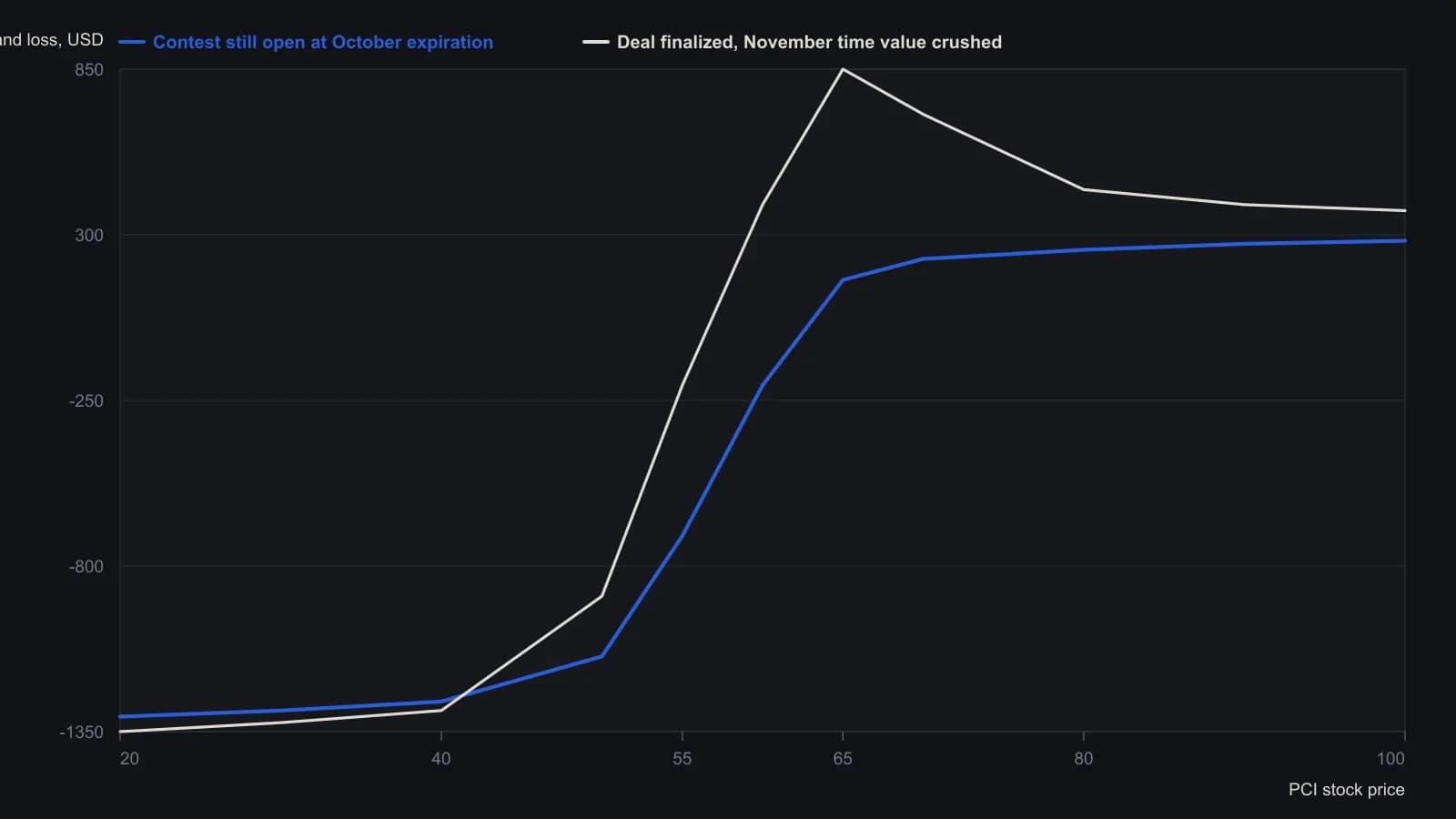
Raster is a scanned magazine figure; dollar P/L is approximate. Source prices the package as November 75s bought at 6 and October 80s sold at 2-1/4 (net debit 3-3/4) on the day QVC bid, with October implied volatility 50 percent versus November 40 percent.
All readings on this track · 21 readings
- 1994Competing-bid calendar spreads and implied volatility
- 2001Calendar spreads as range overlays with wing repairs
- 2002Covered-call premium budgets and calendar-style rolls
- 2002Calendar-spread construction from time decay and implied volatility
- 2003Calendar ratio backspread construction for range and breakout regimes
- 2005Read the implied-volatility regime before calendar-spread assignment
- 2005Constructing calendars and straddles around implied volatility
- 2005Short option coverage through calendars, rolls, and expiration
- 2006Calendar spread expiration, assignment and time skew
- 2008The two clocks that close a calendar or a stock-plus-put
- 2010Cheap back-month implied volatility is a regime question, not a shopping rule
- 2010Calendar-spread assignment as a volatility regime shift
- 2010Uncapped collar overlays and earnings-week short calendars
- 2011Sequencing verticals, straddles, and calendars as construction tests
- 2012Executing conversion and ratio calendar option packages
- 2015Near-expiry options on new-crop grain futures
- 2018Calendar spreads as range and volatility regime trades
- 2019A directional put calendar after a failed resistance breakout
- 2019Sizing short-option risk with calendar puts
- 2019Limited-risk reversal construction
- 2020Covered-call writing versus a calendar call diagonal