2005issue C081-5
A mid-life payoff chart is a volatility-regime assumption
The Black-Scholes model can make the same combination look early-profitable or still dead money depending on whether implied volatility snaps back to one underlying-linked value or stays sticky. Editorial: that choice matters most when a calendar spread is judged against a short straddle after a near-term volatility shock.
- Option pricing formulas take five inputs, and the volatility input is treated as a statistic of daily price variability, not as a trend in the underlying.
- A naive Black-Scholes forecast that applies one underlying-linked volatility assumes initially rich options cheapen toward theoretical fair value at every future date before expiration.
- Persistent-volatility forecasting carries each option's own current implied volatility forward, so any initial richness remains until time decay near expiration.
- Editorial: the same engine can change how a calendar spread looks against a short straddle after a near-term volatility shock, because forcing a jump in near-term implied volatility to persist can hide a later chance that those options cheapen.
The chart is already a forecast
Option pricing formulas take five inputs, and one of those inputs is volatility. Volatility is presented as a statistic of daily price variability that is independent of any trend in the underlying.
The Black-Scholes model is a closed-form pricing engine that maps contract terms and a volatility input into a theoretical value and into forecasted mid-life payoffs. Theoretical fair value is the model price obtained when that engine is run with a chosen volatility input rather than the price observed in the listed chain.
A short straddle still carries its premium
A short straddle is a combination that sells a put and a call sharing one strike and one expiration. In the theoretical expiration illustration, the short combination was profitable only if the underlying finished inside a limited range.
Shortly after entry, both legs still carry nearly the premiums received, so early profitability is small unless the underlying has already moved a long way.
Mid-life P/L of a short MSFT 25 straddle
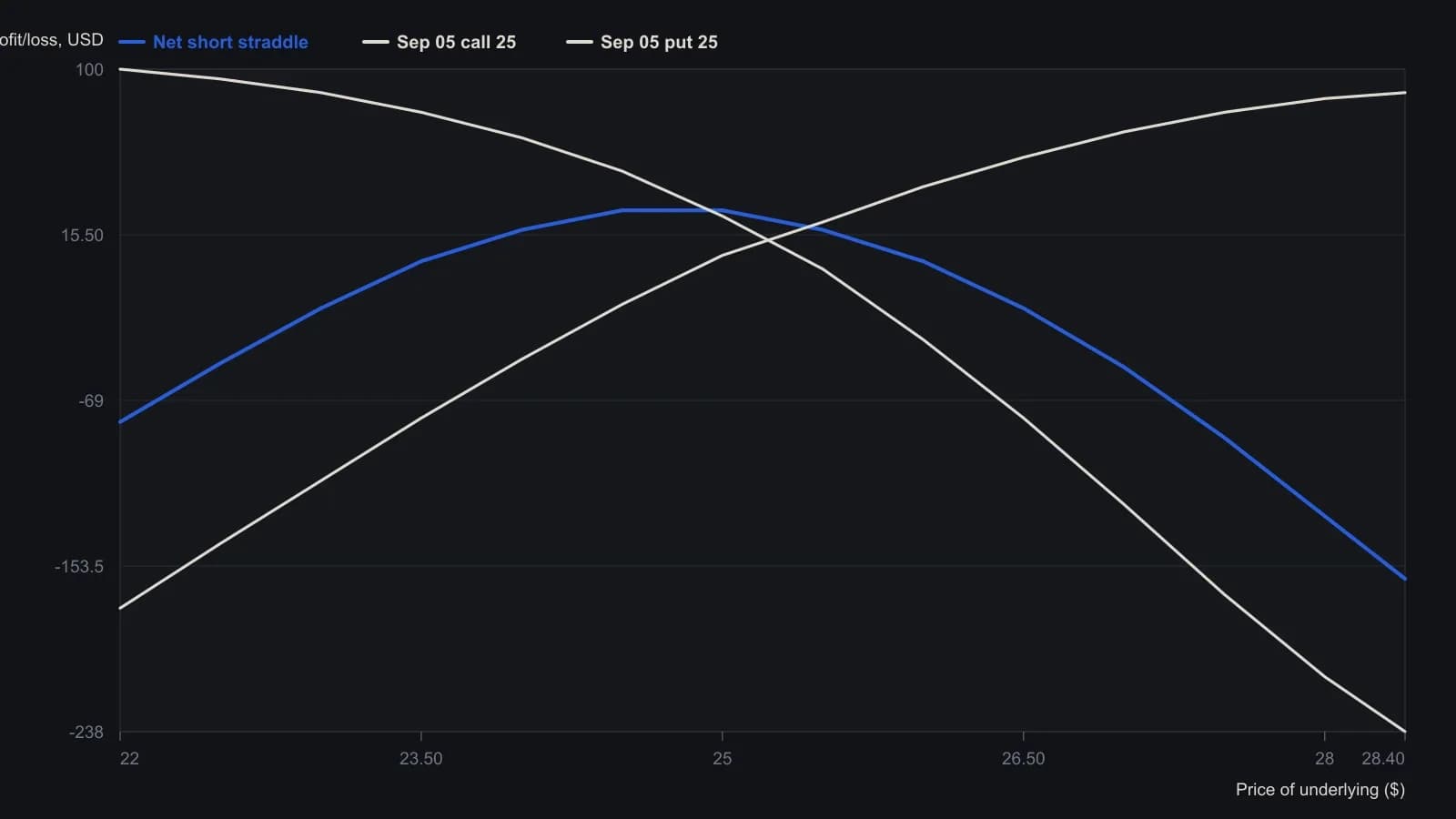
Digitized from the mid-life screenshot. Axes are $ profit/loss versus underlying price; y-values are approximate to the nearest 5 dollars. The source held volatility at 0.182 with implied vol 0.191 and a 2% rate, so the hump is a sticky-vol Black-Scholes mark, not a guaranteed payoff.
Two rules for implied volatility
Implied volatility is the unique volatility input that makes a pricing model reproduce an option's observed market price. A naive Black-Scholes forecast that applies one underlying-linked volatility then assumes initially rich options cheapen toward that model value at every future date before expiration.
Persistent-volatility is a forecasting rule that carries each listed option's current implied volatility forward instead of forcing prices back to a single underlying-linked fair value. Under that rule, any initial richness remains until time decay near expiration.
A calendar spread is judged on a different carry rule
A calendar spread is a same-strike structure that buys a longer-dated option and sells a nearer-dated option. A typical calendar spread buys a longer-dated call and sells a same-strike call that expires sooner.
Longer-dated implied volatility is described as relatively stable, while the short-dated calendar leg is less sensitive to a volatility-input error because it is near expiration, so a persistent-volatility forecast is presented as generally more realistic for that structure.
After a sharp unexpected price move, near-term implied volatilities often jump, and forcing that elevation to persist can hide a later chance that those options cheapen.
All readings on this track · 18 readings
- 1988Critiquing Black-Scholes early exercise on futures options
- 1988Constructing option premiums against a Black-Scholes baseline
- 1989Limit fills around option fair value
- 1990When volatility skews are regimes, not mispricings
- 1994Estimating closeout value on a Treasury bond options strangle
- 1996Constructing option theta from premium, volatility, and moneyness
- 2002Calendar income from volatility skew and time stops
- 2003Constructing option value from historical and implied volatility
- 2004Calendar construction from exercise style, time budget, and carry
- 2005A mid-life payoff chart is a volatility-regime assumption
- 2005Exotic option payoffs beyond the vanilla premium
- 2006Auditing index volatility inputs in call income studies
- 2008Ratio write delta adjustment when the tape rises
- 2010Expiration-dated volatility cones as portfolio context
- 2015Auditing buy-write recovery overlays against pricing and scenario breaks
- 2015Odd-lot mini-option hedges versus implied volatility
- 2018Implied volatility as an option-premium construction gauge
- 2019Black-Scholes construction from a covered-call balance sheet