2018issue C1246-47
Calendar spreads as range and volatility regime trades
A calendar is taught here as a weeks-to-months regime position. The near expiration is a location test at one strike, implied volatility at entry decides whether vega is a tailwind or a crush, and the trade is coherent only if profit, range-break, and assignment rules are written before entry.
- A standard calendar buys a farther-dated call or put and sells the same strike in a nearer expiration, relying on a time-decay differential if price remains usable around that strike.
- Option-expiration analysis treats the short-dated expiry as a location test: theoretical peak payoff requires a close exactly at the shared strike, and a gain needs the underlying to stay inside a profitability range.
- Because the illustrated near-the-money calendar had positive vega, low implied volatility was preferred at entry and a later volatility crush was treated as harmful to the longer-dated long option.
- Before entry the write-up required a plan for a move outside the profitability range, a predefined profit-taking trigger, and an assignment-offset if the short option is exercised.
A same-strike pair across two expirations
A standard calendar spread buys a call or put in a farther expiration and sells a call or put of the same strike in a nearer expiration. Editorial reading: that pair is a weeks-to-months regime position. It places one trade inside a range-and-regime frame rather than treating the two legs as separate directional bets.
The time-decay differential
The structure is described as working because the near-dated short option loses time premium faster than the longer-dated long option. That time-decay differential is why the passage of time can help while the location thesis still holds.
The near expiration is a location test
Maximum theoretical profit on a standard calendar is described as occurring only if the underlying closes exactly at the shared strike on the short option's expiration day. Editorial reading: option-expiration analysis reads profit and loss from where the underlying sits when the short-dated leg expires, not from a hoped-for peak payoff.
With implied volatility unchanged, the example was framed as able to show a gain only if the underlying stayed inside a bounded band through the near expiration, and as likely to show a loss if price moved too far either way. That band is the profitability range at a stated volatility path and the near expiration.
Kohl's 75-call calendar: strike inside the breakeven band
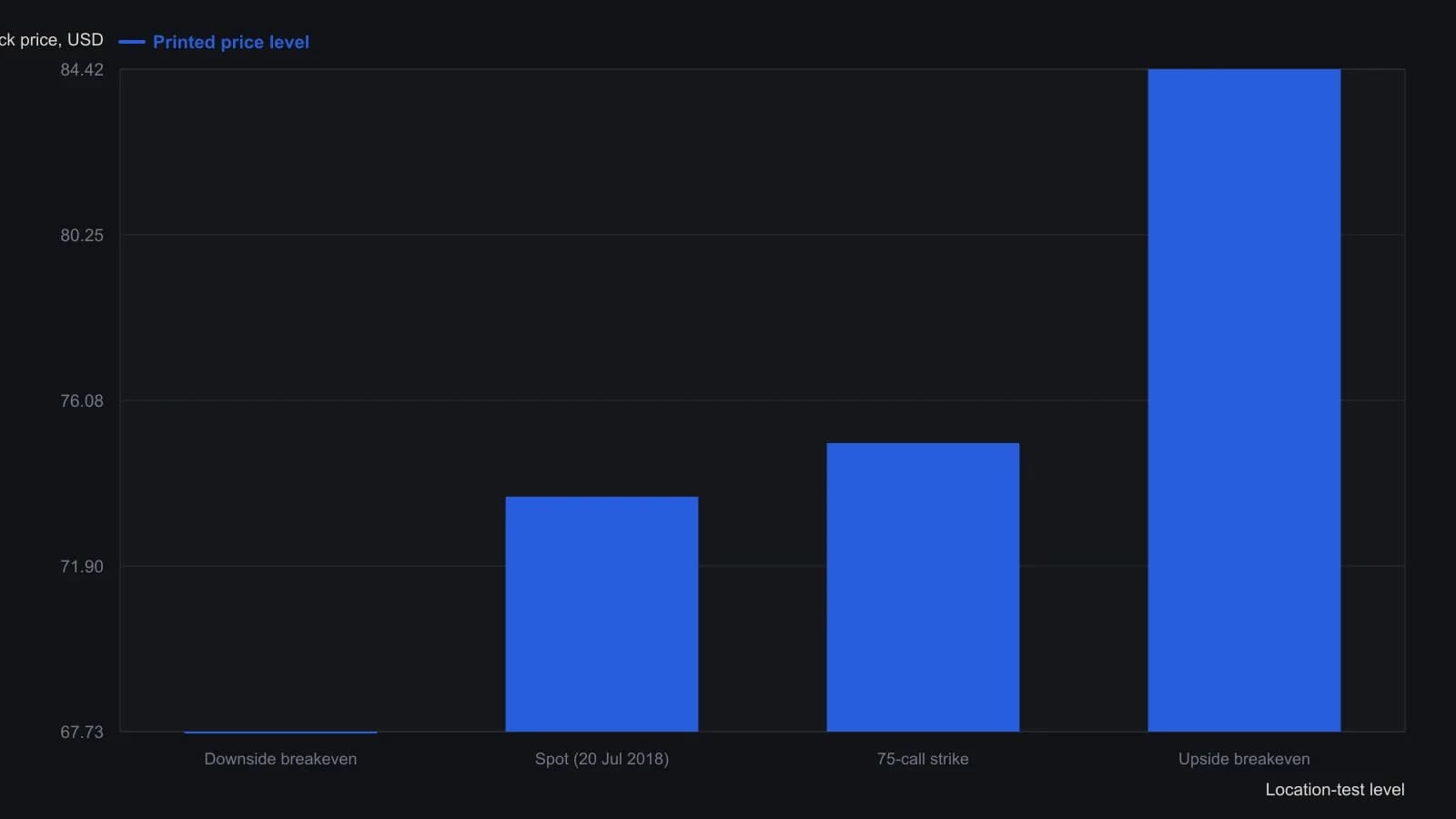
Short the 31 August 75 call and long the 19 October 75 call, entered at a 110-dollar debit. Ticket also prints max profit 276.46 dollars and max risk equal to that debit.
Implied volatility at entry
The illustrated near-the-money calendar was shown with positive vega and positive theta, so a rise in implied volatility and the passage of time were treated as helpful and a decline in implied volatility as harmful.
Longer-dated options were described as more sensitive to implied-volatility changes than shorter-dated options, so buying the back month when implied volatility is already high raises exposure to a later volatility decline. A volatility crush after entry can damage the longer-dated long option more than the short option.
A stated screening preference was to favor underlyings with currently low implied volatility, both to reduce the chance of a post-entry volatility drop and to leave room for a later rise to help the long-dated leg.
Events, chart levels, and rules written first
An impending earnings release was flagged as a large-move risk for a neutral calendar because a sharp reprice can push the underlying out of the profitable range. Chart-defined support and resistance were presented as useful because hesitation at those levels can give the calendar time to work before a breakout.
Before entry, the write-up required answers for a move outside the profitable range, a predefined profit-taking trigger, and an offset plan if the short option goes in the money and is exercised. The assignment-offset in that third answer is exercising the long option to neutralize a short option that is exercised after it trades in the money. Editorial reading: the calendar is coherent only when those three answers exist before the trade is on.
All readings on this track · 21 readings
- 1994Competing-bid calendar spreads and implied volatility
- 2001Calendar spreads as range overlays with wing repairs
- 2002Covered-call premium budgets and calendar-style rolls
- 2002Calendar-spread construction from time decay and implied volatility
- 2003Calendar ratio backspread construction for range and breakout regimes
- 2005Read the implied-volatility regime before calendar-spread assignment
- 2005Constructing calendars and straddles around implied volatility
- 2005Short option coverage through calendars, rolls, and expiration
- 2006Calendar spread expiration, assignment and time skew
- 2008The two clocks that close a calendar or a stock-plus-put
- 2010Cheap back-month implied volatility is a regime question, not a shopping rule
- 2010Calendar-spread assignment as a volatility regime shift
- 2010Uncapped collar overlays and earnings-week short calendars
- 2011Sequencing verticals, straddles, and calendars as construction tests
- 2012Executing conversion and ratio calendar option packages
- 2015Near-expiry options on new-crop grain futures
- 2018Calendar spreads as range and volatility regime trades
- 2019A directional put calendar after a failed resistance breakout
- 2019Sizing short-option risk with calendar puts
- 2019Limited-risk reversal construction
- 2020Covered-call writing versus a calendar call diagonal