2002issue C031-3
Covered-call premium budgets and calendar-style rolls
A covered call sold against owned shares can be split into intrinsic, time, and volatility pieces, written in the nearest month, and replaced once most of that premium has decayed. Editorial view: treat the leftover cushion as a disposable budget and check whether it still matches the stock's current regime.
- A covered call is a short call sold against stock already owned so assignment can be settled with those shares; a short call without the shares is treated as unhedged and open-ended.
- Option premium analysis splits the quote into an intrinsic piece, a time-to-expiration piece, and a volatility piece that can fall even when the underlying stock rises.
- Time decay typically speeds up as expiration nears, so the nearest listed month is the default tenor for a written call and the monthly window to adjust the overlay.
- A roll is considered once about 75 percent of the original premium has decayed; a calendar-style roll-out keeps the strike and replaces the near-expiry short call with the next month, and can be combined with a roll up or roll down.
A short call against shares already owned
A covered call is a short call sold against stock already owned so assignment can be settled with the existing shares. A short call written without those shares is treated as unhedged and open-ended.
Call moneyness is defined by strike versus the current stock price. A lower strike is in-the-money, an equal strike is at-the-money, and a higher strike is out-of-the-money.
How the quoted premium is split
Option premium analysis splits the quote into an intrinsic piece, a time-to-expiration piece, and a volatility piece. The volatility piece can fall even when the underlying stock rises.
Time decay in the premium typically speeds up as expiration nears. The nearest listed month is presented as the default tenor for a written call and as a monthly window to adjust the overlay.
Outlook and strike choice
A constructive outlook maps to an out-of-the-money write that keeps more stock appreciation. A neutral outlook maps to an at-the-money or in-the-money write that collects a larger premium cushion.
When a roll is considered
A roll is defined as buying back the short call and selling a replacement with a higher strike, a lower strike, or a later expiration. It is considered once about 75 percent of the original premium has decayed and most of the remaining downside offset is gone.
Rolling up buys back the written call and sells a higher-strike replacement after the stock has risen. Rolling down buys back the written call and sells a lower-strike replacement after the stock has fallen. Rolling out buys back the written call and sells a longer-dated replacement, often the next listed month.
A calendar-style roll-out keeps the same strike and replaces a near-expiry short call with the next-month short call after most of the remaining premium has eroded. That tenor shift can be combined with a roll up or a roll down.
Worked paths from the first write
Worked examples start from a stock bought at 100 that first sold a 30-day 100-strike call for 2.45. They show a roll-up after a rise to 105, a same-strike roll-out while the stock is unchanged, and a roll-down after a decline to 95.
Commissions, slippage, and volatility changes are omitted from the arithmetic.
Net P/L of three rolls from one $100 covered write
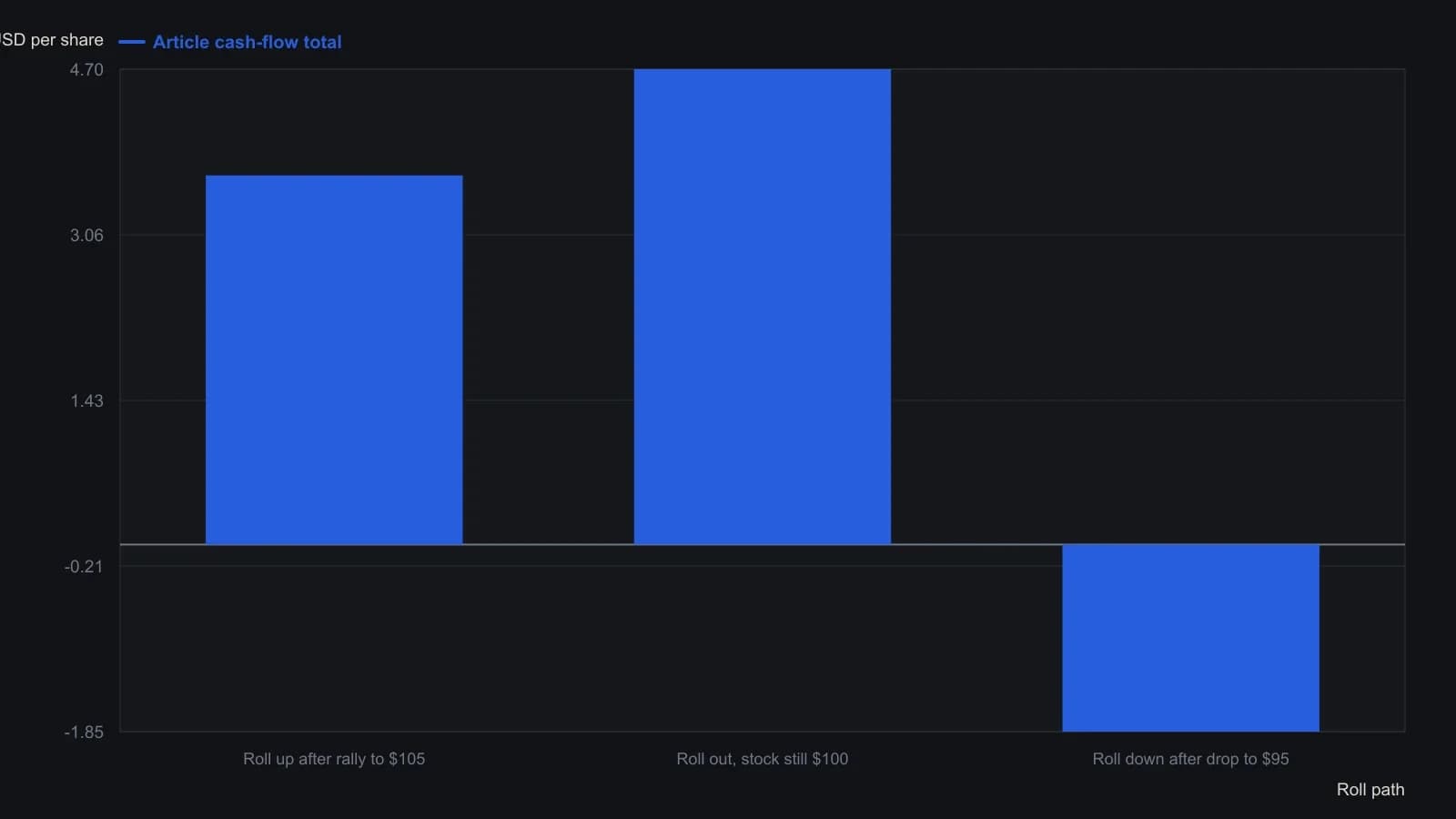
The source ignored commissions, slippage, and any rise in the volatility component after the large up or down move.
All readings on this track · 21 readings
- 1994Competing-bid calendar spreads and implied volatility
- 2001Calendar spreads as range overlays with wing repairs
- 2002Covered-call premium budgets and calendar-style rolls
- 2002Calendar-spread construction from time decay and implied volatility
- 2003Calendar ratio backspread construction for range and breakout regimes
- 2005Read the implied-volatility regime before calendar-spread assignment
- 2005Constructing calendars and straddles around implied volatility
- 2005Short option coverage through calendars, rolls, and expiration
- 2006Calendar spread expiration, assignment and time skew
- 2008The two clocks that close a calendar or a stock-plus-put
- 2010Cheap back-month implied volatility is a regime question, not a shopping rule
- 2010Calendar-spread assignment as a volatility regime shift
- 2010Uncapped collar overlays and earnings-week short calendars
- 2011Sequencing verticals, straddles, and calendars as construction tests
- 2012Executing conversion and ratio calendar option packages
- 2015Near-expiry options on new-crop grain futures
- 2018Calendar spreads as range and volatility regime trades
- 2019A directional put calendar after a failed resistance breakout
- 2019Sizing short-option risk with calendar puts
- 2019Limited-risk reversal construction
- 2020Covered-call writing versus a calendar call diagonal