2003issue C101-4
Calendar ratio backspread construction for range and breakout regimes
A long-heavy calendar overlay sells fewer shorter-dated options and buys more longer-dated options so the near-dated book can resemble a short-term options straddle while leftover farther longs keep breakout convexity. The archive admits that overlay only when implied volatility sits in the low part of its range and a sizable implied-volatility and calendar time skew can support the extra longs.
- The overlay sells fewer shorter-dated options and buys more longer-dated options, combining a ratio backspread with a diagonal calendar.
- Common constructions buy two contracts for each one sold or three for each two sold, keeping the short-to-long ratio at or below about 0.67.
- The book is assembled only with a directional bias and breakout potential, implied volatility in the low part of its range, a usable risk-reward profile, a sizable implied-volatility and calendar time skew, and extreme liquidity with narrow bid-ask spreads.
- The near-dated book is described as emulating a short-term options straddle, and the calendar overlay is said to carry less time-decay exposure than a standard straddle or a same-expiry ratio backspread.
How the overlay is built
The overlay is built by selling fewer shorter-dated options and buying more longer-dated options. That is a calendar-spread-options book: a long-heavy overlay that merges a ratio backspread with diagonal calendar timing.
A ratio-backspread is a same-expiry structure that buys more options than it sells, typically at a short-to-long ratio at or below about 0.67, so residual long options remain after the shorts. A diagonal-calendar pairs a nearer-dated short with a farther-dated long on the same underlying, using different strikes and different expirations.
Common constructions buy two contracts for each one sold or three for each two sold, keeping a short-to-long ratio at or below about 0.67. Either calls or puts can be used according to directional bias.
Stated risk and reward
Stated call-side risk equals short-call count times strike gap times contract point value, minus a net credit or plus a net debit. Call reward is specified as unbounded upside. Put reward is specified as extending if the underlying falls toward zero.
Filters that admit the overlay
Construction filters include a directional bias with breakout potential, implied volatility in the low part of its range, a usable risk-reward profile, a sizable implied-volatility and calendar time skew, and extreme liquidity with narrow bid-ask spreads.
Implied-volatility is the volatility input that equates a pricing model to the option's traded price. The archive treats that input as cyclical within a band and specifies the overlay as best assembled when the measure is low, consistent with other delta-neutral straddles and ratio backspreads.
Volatility-skew is a gap in implied volatility between options on the same underlying, including gaps across strikes and a time skew across expiration months at one strike. A sizable implied-volatility and calendar time skew is one of the filters required before the overlay is assembled.
Near-dated range book and farther breakout longs
The near-dated book is described as emulating a short-term options straddle. An options-straddle is a same-strike, same-expiry long call and long put. In this workflow that same-expiry shape is the near-dated payoff the calendar overlay is built to resemble, with less time-decay exposure than a standard long straddle. The calendar overlay is also said to carry less time-decay exposure than a same-expiry ratio backspread.
TradersWeek editorial: map that near-dated resemblance to a range regime and the leftover farther longs to a breakout regime inside one book. The range side is a delta-neutral-window, a short price band in which a correctly adjusted overlay can earn similarly on modest moves either way before a larger breakout dominates.
Rolls and opposing options
After a sideways period the short legs can be rolled to the next month to collect more premium. Extra shorts must stay at or below the remaining long count. An opposing option can be added after a large favorable move.
Worked call construction
A worked call construction sold one nearer 22.5-strike option against two farther 27.5-strike options. Low at-the-money implied volatility plus a 5 percent implied-volatility skew was treated as support for assembling the overlay.
MSFT ATM implied volatility by option tenor
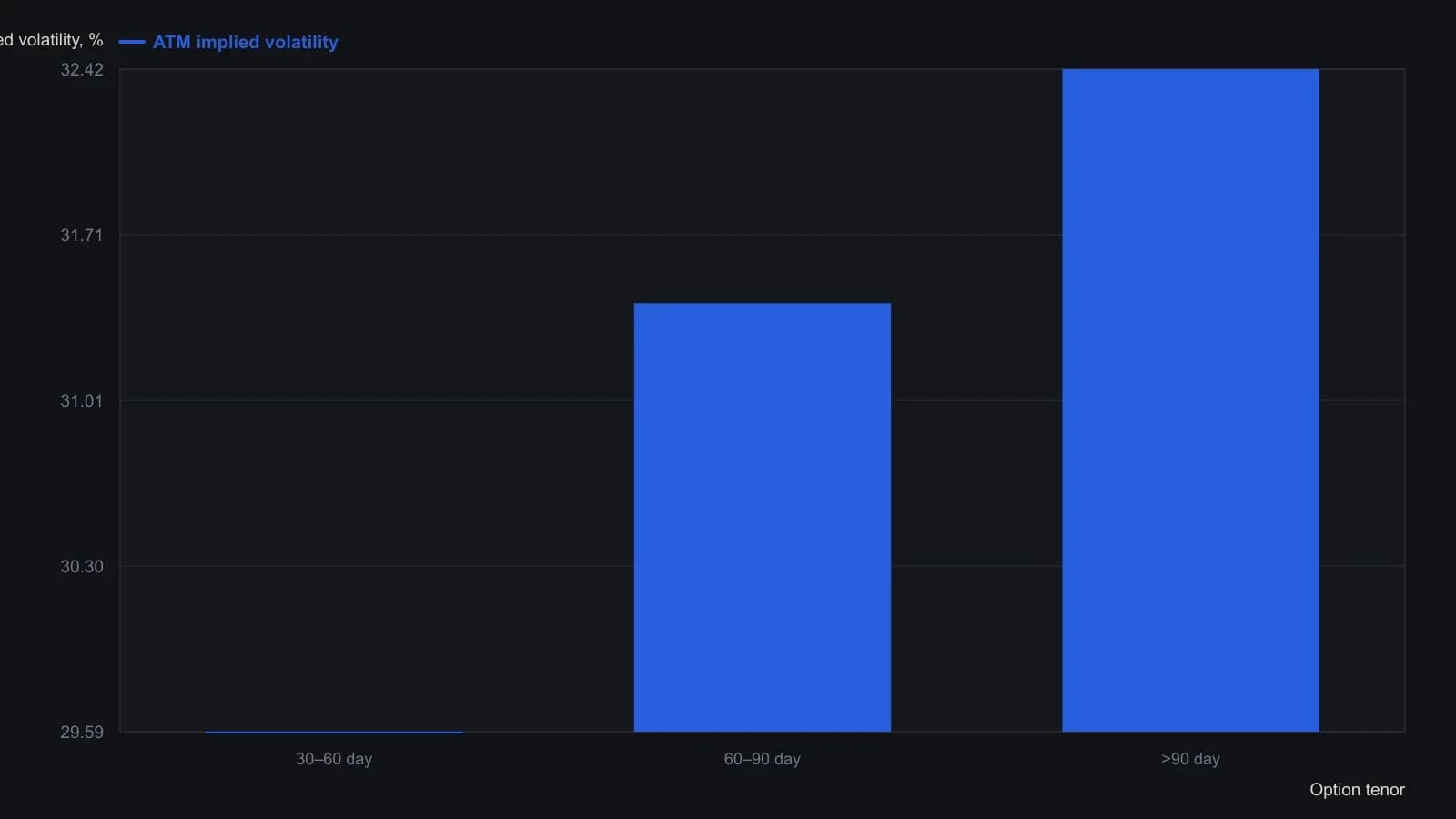
The source listed 7–30 day implied volatility as unknown, so that bucket is omitted. It separately called the skew about 5 percent; that remark is not the 2.83-point gap among these three printed tenors.
All readings on this track · 21 readings
- 1994Competing-bid calendar spreads and implied volatility
- 2001Calendar spreads as range overlays with wing repairs
- 2002Covered-call premium budgets and calendar-style rolls
- 2002Calendar-spread construction from time decay and implied volatility
- 2003Calendar ratio backspread construction for range and breakout regimes
- 2005Read the implied-volatility regime before calendar-spread assignment
- 2005Constructing calendars and straddles around implied volatility
- 2005Short option coverage through calendars, rolls, and expiration
- 2006Calendar spread expiration, assignment and time skew
- 2008The two clocks that close a calendar or a stock-plus-put
- 2010Cheap back-month implied volatility is a regime question, not a shopping rule
- 2010Calendar-spread assignment as a volatility regime shift
- 2010Uncapped collar overlays and earnings-week short calendars
- 2011Sequencing verticals, straddles, and calendars as construction tests
- 2012Executing conversion and ratio calendar option packages
- 2015Near-expiry options on new-crop grain futures
- 2018Calendar spreads as range and volatility regime trades
- 2019A directional put calendar after a failed resistance breakout
- 2019Sizing short-option risk with calendar puts
- 2019Limited-risk reversal construction
- 2020Covered-call writing versus a calendar call diagonal