2019issue C0343
Sizing short-option risk with calendar puts
Treat the protective strike and expiry as the first sizing inputs on a short-option book. The historical crude-oil construction keeps only leftover credit that still pays for an estimated loss band, not for a single at-expiration formula.
- A short option with no long offset is not capped by the premium collected. A farther out-of-the-money put that shares the short put's expiration turns the package into a defined-width credit spread.
- If the thesis is expected to resolve in weeks, a near-expiry hedge can sit in a nearer expiration than the short option.
- The same protection outlay inside the later expiration required a farther strike and widened the strike-gap residual far more than the mixed-expiry 38/36 construction.
- Dual-expiry path risk means worst-case loss is not one at-expiration equation. The credit-versus-band test compares maximum credit with an estimated loss band.
A short option is not capped by its premium
A short option with no long offset leaves loss potential that is not capped by the premium collected. Buying a farther out-of-the-money put that shares the short put's expiration turns the package into a defined-width credit spread.
That same-expiry long put fixes the width first. The leftover credit is what remains after that width is chosen, not the figure that decides how much risk the book can carry.
A nearer expiry can hedge a shorter thesis
If the directional thesis is expected to resolve in weeks rather than over the full life of the short option, the protective put can be taken in a nearer expiration. That long option is a near-expiry hedge: it expires sooner than the short option and is held only while the expected move is still inside that shorter window.
Same protection outlay, wider residual
In the crude-oil construction with the market near 44, a 38-strike put sold about 60 days out for 750 against a 36-strike put bought about 30 days out for 150 left a 600 net credit and a 2000 gap between those strikes. That gap is the strike-gap residual: the unprotected dollar width between a short option strike and a long protective strike before the net credit is applied.
Keeping the same 150 protection outlay inside the later expiration required a 30-strike put and widened the unprotected gap to about 8000 before the credit. The nearer 36-strike hedge left a much smaller residual than matching the later expiration at the same outlay.
Calendar-put hedge: residual risk vs same-month protection
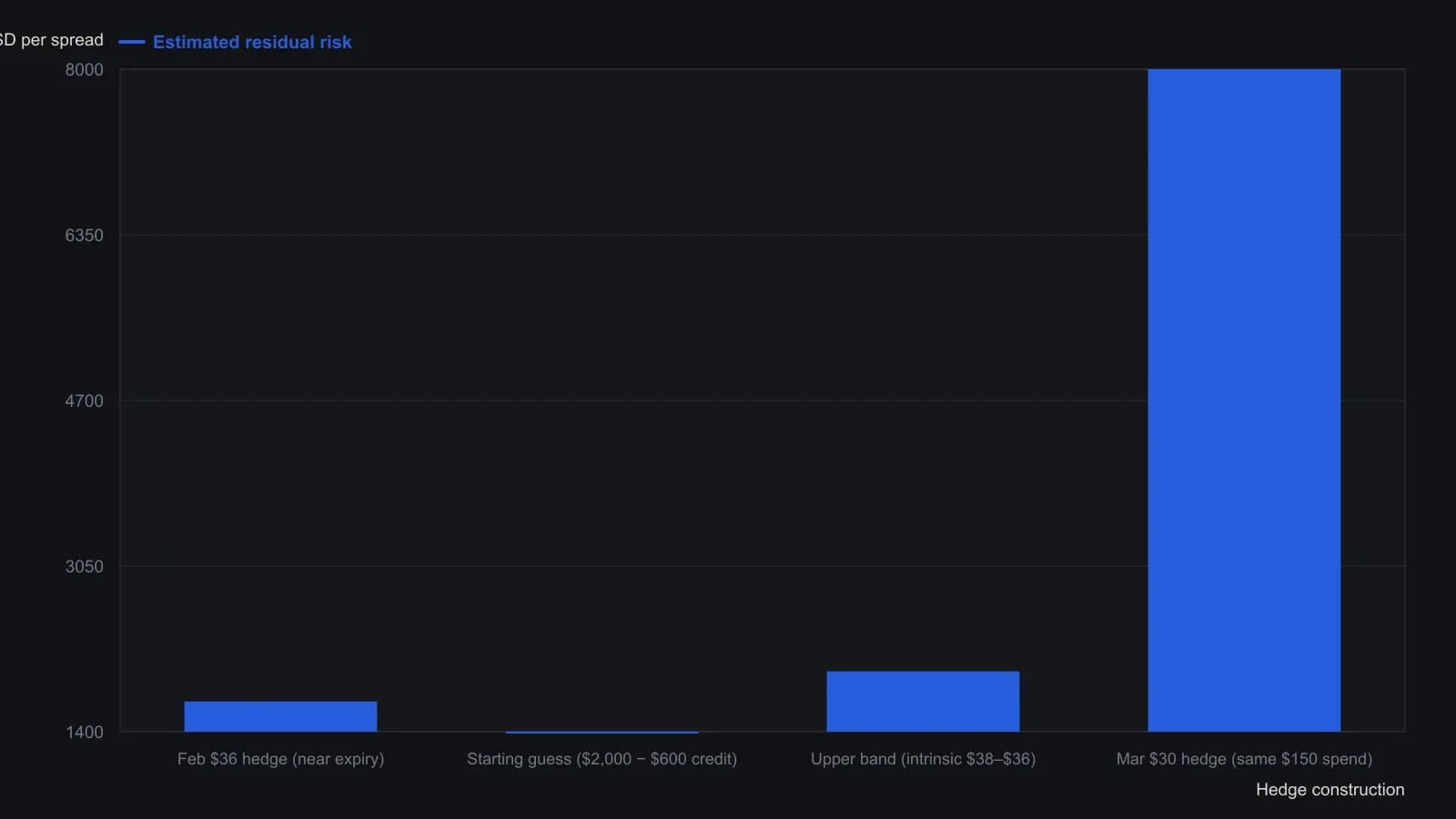
The $1,400–$2,000 band is an estimate: different expirations mean P&L also depends on time and volatility, so it is not a single at-expiration maximum.
A band instead of one expiration formula
When the long and short legs expire on different dates, worst-case loss cannot be reduced to a single at-expiration equation because remaining time and volatility still move the two contracts differently. That leftover uncertainty is dual-expiry path risk: time and volatility can reprice each leg independently.
For the 38/36 mixed-expiry example, a working loss band is framed as 1400 to 2000 against a 600 maximum credit, and those figures are treated as estimates rather than a hard cap. The credit-versus-band test is a pre-trade check that compares maximum collected premium with the estimated loss band, not with an at-expiration formula.
Editorial: once that band is locked, only leftover credit that still pays for the band is accepted.
All readings on this track · 21 readings
- 1994Competing-bid calendar spreads and implied volatility
- 2001Calendar spreads as range overlays with wing repairs
- 2002Covered-call premium budgets and calendar-style rolls
- 2002Calendar-spread construction from time decay and implied volatility
- 2003Calendar ratio backspread construction for range and breakout regimes
- 2005Read the implied-volatility regime before calendar-spread assignment
- 2005Constructing calendars and straddles around implied volatility
- 2005Short option coverage through calendars, rolls, and expiration
- 2006Calendar spread expiration, assignment and time skew
- 2008The two clocks that close a calendar or a stock-plus-put
- 2010Cheap back-month implied volatility is a regime question, not a shopping rule
- 2010Calendar-spread assignment as a volatility regime shift
- 2010Uncapped collar overlays and earnings-week short calendars
- 2011Sequencing verticals, straddles, and calendars as construction tests
- 2012Executing conversion and ratio calendar option packages
- 2015Near-expiry options on new-crop grain futures
- 2018Calendar spreads as range and volatility regime trades
- 2019A directional put calendar after a failed resistance breakout
- 2019Sizing short-option risk with calendar puts
- 2019Limited-risk reversal construction
- 2020Covered-call writing versus a calendar call diagonal