2020issue C0148-49
Covered-call writing versus a calendar call diagonal
A single-name archive case paired 100 shares bought at 30.90 with one sold November 31 call at 3.04, then housed the same short call on five January 29 in-the-money calls. Side-by-side premium analysis compared entry outlay, vega sign, unused capital, and the November expiration snapshot rather than a claim that one overlay is safer.
- A covered-call buy-write buys the shares and sells a call against that long stock at the same time. A calendar call diagonal buys a further-dated in-the-money call as a stock proxy and sells a nearer-term call at a higher strike.
- Both illustrated structures had similar positive delta and negative gamma, but opposite vega signs: the buy-write was short vega at -5.47 and the diagonal was long vega at 7.64, with higher theta on the diagonal.
- Entry outlay was 2786 for the buy-write versus 945 for the diagonal. The unused 1841 was treated as capacity for other positions, not as proof that one structure is better.
- A calendar diagonal was screened for open-ended upside profit, so the risk curve does not turn negative if the stock rises, and for a breakeven below an identifiable support level used as a stop reference.
A covered-call buy-write holds the underlying shares and sells a call against that long stock position. A calendar call diagonal buys a longer-dated option against a nearer-dated option sold, and can use a further-out in-the-money call as the long anchor instead of shares. This archive case put both constructions around the same short November 31 call.
Editorial reading: TradersWeek treats the illustration as a portfolio-context skill. The same short-call premium can sit on shares or on a longer-dated call. The comparison is capital lock-up, volatility sign, and payoff regime, not a search for a universally safer conservative overlay.
The illustrated buy-write
A covered-call buy-write is constructed by buying the shares and selling a call against that long stock position at the same time. In the illustrated buy-write, 100 shares bought at 30.90 were paired with one sold November 31 call at 3.04.
The case stated an expiration breakeven of 27.86 and a 9.8 percent downside cushion over 73 days.
The illustrated calendar call diagonal
The case framed a calendar call diagonal as buying a further-dated in-the-money call as a stock proxy and selling a nearer-term call at a higher strike.
The illustrated diagonal bought five January 29 calls at 4.93 and sold five November 31 calls at 3.04.
AMD buy-write vs calendar-diagonal payoff at November expiration
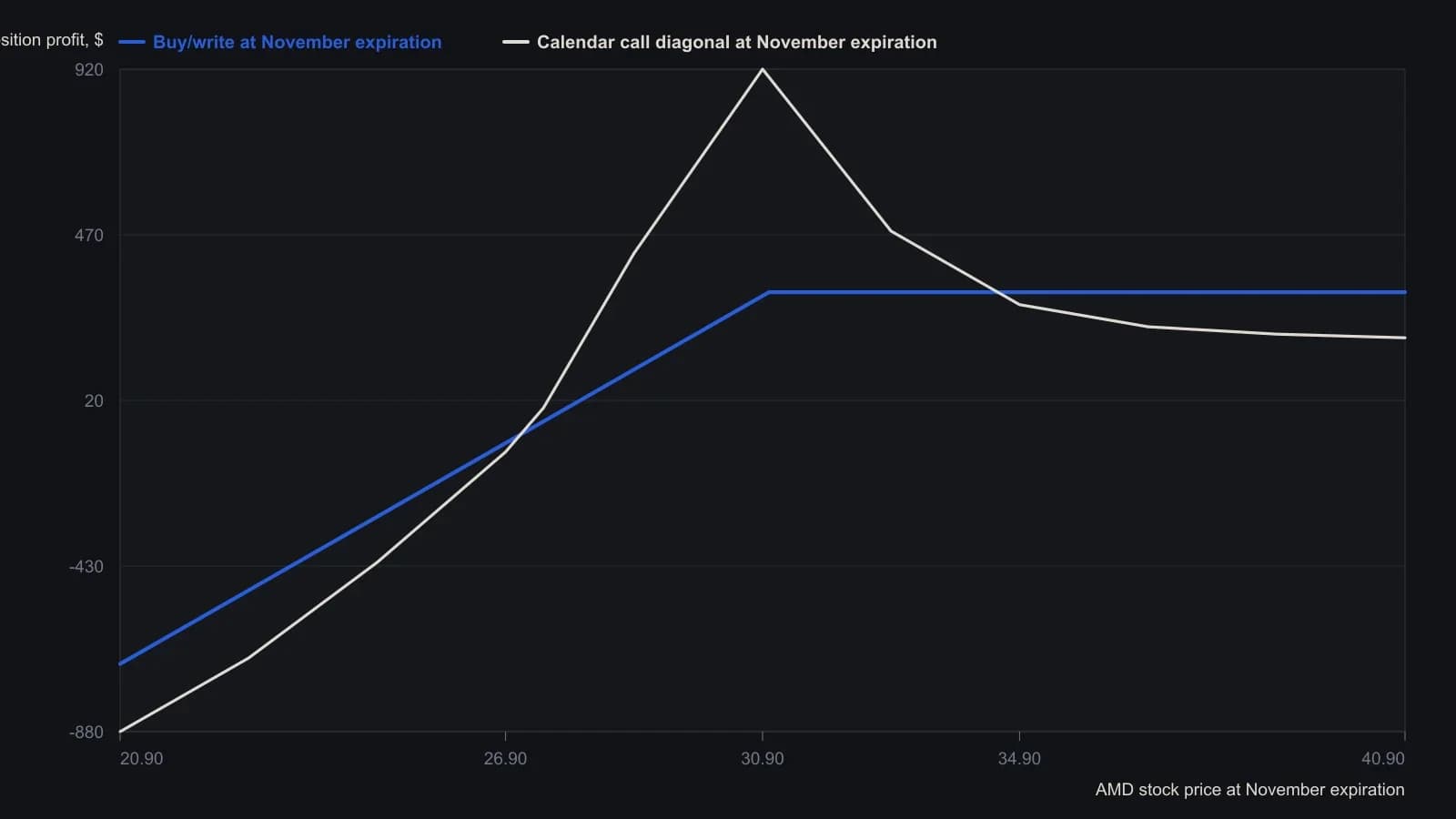
Buy-write payoff uses the article’s fills (100 shares at 30.90, one Nov 31 call sold at 3.04). The calendar series is digitized from the Days-to-expiration-0 risk curve for five Jan 17 29 calls bought at 4.92 against five Nov 15 31 calls sold at 3.04; remaining January time value is whatever the source plot implied, not recomputed.
Entry outlay, greeks, and stated profit
Option premium analysis here was a side-by-side reading of entry debit, collected premium, greeks, breakevens, and expiration payoffs, so each trade could be judged in capital and market-regime terms. The comparison listed an entry outlay of 2786 for the buy-write versus 945 for the diagonal, with stated maximum dollar profits of 314 versus 914.
Both examples carried similar positive delta and negative gamma, but opposite vega signs. The buy-write was short vega at -5.47 while the diagonal was long vega at 7.64. The diagonal also showed higher theta.
November expiration snapshot
At the November expiration snapshot, the diagonal showed a larger dollar gain if the stock was little changed, a smaller dollar gain once price was above about 36.90, and a larger dollar loss between about 27.90 and 18.60.
Unused capital and screening notes
The lower diagonal debit left 1841 of unused capital relative to the buy-write. The case treated that unused capital as capacity for other positions rather than proof that one structure is better.
Screening notes for a calendar diagonal included requiring open-ended upside profit so the risk curve does not turn negative if the stock rises, and placing breakeven below an identifiable support level used as a stop reference.
Editorial interpretation: once the short call is the same, the archive comparison is how much capital is locked, whether volatility exposure is short or long, and which price regime pays. Those differences were not converted into a single safer conservative overlay.
All readings on this track · 21 readings
- 1994Competing-bid calendar spreads and implied volatility
- 2001Calendar spreads as range overlays with wing repairs
- 2002Covered-call premium budgets and calendar-style rolls
- 2002Calendar-spread construction from time decay and implied volatility
- 2003Calendar ratio backspread construction for range and breakout regimes
- 2005Read the implied-volatility regime before calendar-spread assignment
- 2005Constructing calendars and straddles around implied volatility
- 2005Short option coverage through calendars, rolls, and expiration
- 2006Calendar spread expiration, assignment and time skew
- 2008The two clocks that close a calendar or a stock-plus-put
- 2010Cheap back-month implied volatility is a regime question, not a shopping rule
- 2010Calendar-spread assignment as a volatility regime shift
- 2010Uncapped collar overlays and earnings-week short calendars
- 2011Sequencing verticals, straddles, and calendars as construction tests
- 2012Executing conversion and ratio calendar option packages
- 2015Near-expiry options on new-crop grain futures
- 2018Calendar spreads as range and volatility regime trades
- 2019A directional put calendar after a failed resistance breakout
- 2019Sizing short-option risk with calendar puts
- 2019Limited-risk reversal construction
- 2020Covered-call writing versus a calendar call diagonal