2004issue C011
Calendar construction from exercise style, time budget, and carry
A historical options archive treated a calendar as three construction choices: the short leg's exercise style, a monthly time budget taken from the quoted premium, and interest-and-dividend carry already inside the call or put price.
- European-style options can be bought or sold before expiration but cannot be exercised until expiration, whereas American-style options can be exercised on any date before expiration.
- A calendar-spread was framed as selling a short-dated European-style option against a longer American-style long, using paired Standard & Poor's 100 listings, so the short leg had no early-assignment path.
- Short-dated options were cheaper in cash outlay but faster to lose time value, and a historical hypothetical converted at-the-money call quotes into monthly time costs that fell as tenor lengthened.
- Call cost-of-carry was the risk-free interest rate minus the dividend over remaining life, and rising interest rates were described as increasing call premiums because assignment interest is embedded in time premium.
Three construction inputs
The archive described listed options by exercise style, by how fast time premium eroded, and by interest and dividends already inside the quote. A calendar-spread sold a nearer-dated option against a longer-dated option.
TradersWeek editorial reading: treat that material as a three-input construction problem. Assign the short leg an exercise style that blocks or allows early exercise. Convert each quoted premium into a monthly time budget instead of a cheaper ticket. Read interest-and-dividend carry as already sitting inside the call or put price.
Exercise style on the short leg
A European-style option can be bought or sold before expiration but cannot be exercised until expiration. An American-style option can be exercised on any date before expiration. Listed US equity options were described as almost entirely American-style, while most index options were European-style.
European-style options were described as typically richer than comparable American-style options because early exercise is blocked. The archive framed a calendar as selling a short-dated European-style option against a longer American-style long, using paired Standard & Poor's 100 listings as the example. Early-assignment is exercise of an American-style short option before expiration, a path European-style shorts do not have.
Settlement and liquidation
American-style options were described as settling on the Saturday after Friday expiration. European-style options were described as settling on the Friday they expired, with any needed liquidation framed as occurring on the prior Thursday.
A monthly time budget
Short-dated options were described as cheaper in cash outlay but faster to lose time value than longer-dated options over comparable intervals. Time-decay was described as steeper for shorter remaining life, and most of an option's time premium was described as decaying in the final 30 days.
In a historical hypothetical with the underlying at 30, at-the-money calls were 2.00 for December, 3.00 for January 2004, and 4.50 for April 2004, equal to monthly time costs of 2.00, 1.50, and 0.90. TradersWeek editorial reading: the lower cash ticket was not the lower monthly time budget.
Carry already in the price
Call cost-of-carry was defined as the risk-free interest rate minus the dividend over remaining life. Put time value was described as assuming the dividend minus the interest rate.
Rising interest rates were described as increasing call premiums because assignment of a written call creates a short stock position that earns interest, and that interest is embedded in the call's time premium. TradersWeek editorial reading: carry is not a separate add-on. It already sits inside the quoted call or put.
Monthly time budget of ATM XYZ 30-strike calls
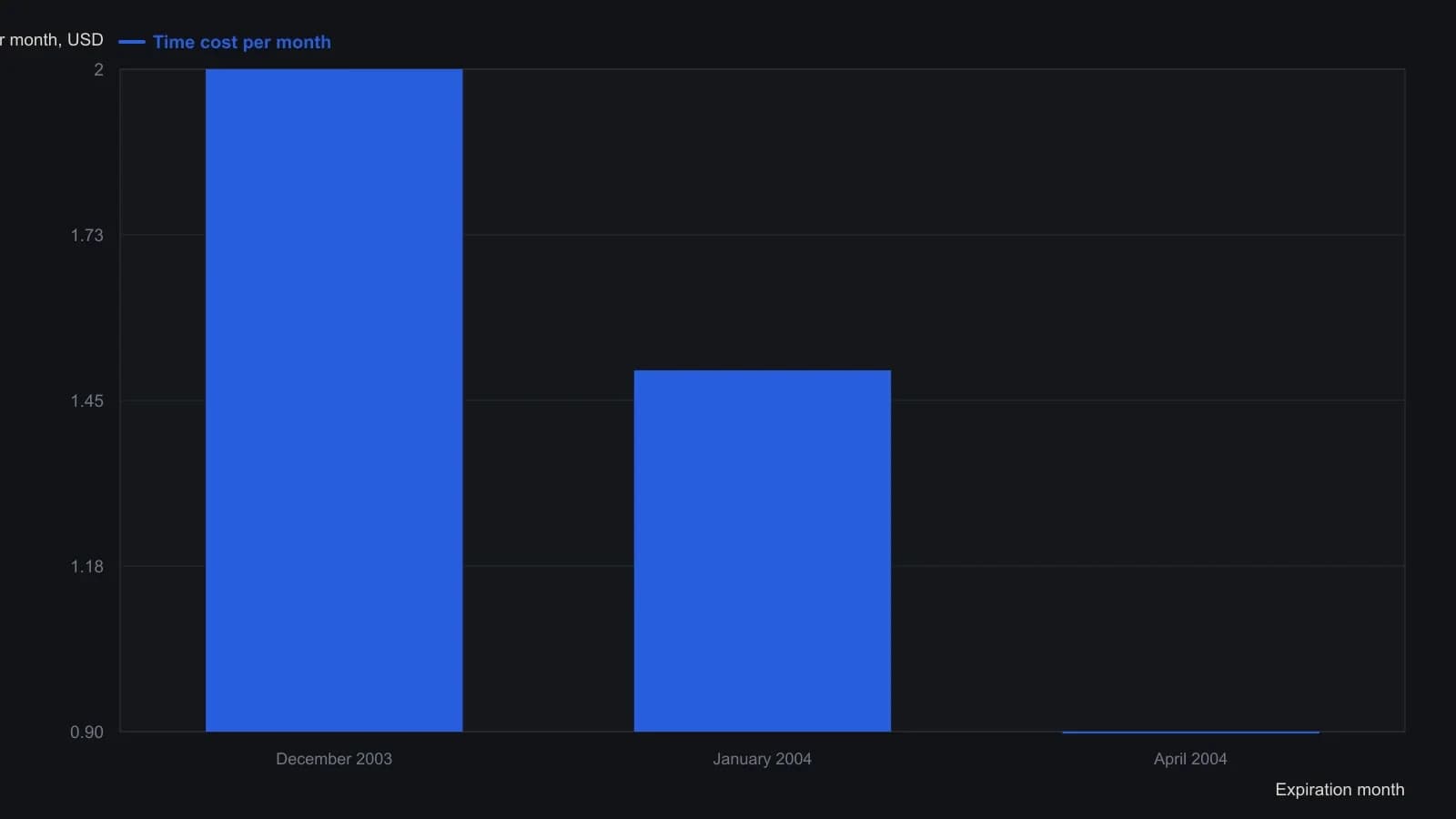
Hypothetical at-the-money 30-strike calls while XYZ is at $30. Each premium is treated as 100 percent time value and divided by months remaining, as Gentile did.
All readings on this track · 18 readings
- 1988Critiquing Black-Scholes early exercise on futures options
- 1988Constructing option premiums against a Black-Scholes baseline
- 1989Limit fills around option fair value
- 1990When volatility skews are regimes, not mispricings
- 1994Estimating closeout value on a Treasury bond options strangle
- 1996Constructing option theta from premium, volatility, and moneyness
- 2002Calendar income from volatility skew and time stops
- 2003Constructing option value from historical and implied volatility
- 2004Calendar construction from exercise style, time budget, and carry
- 2005A mid-life payoff chart is a volatility-regime assumption
- 2005Exotic option payoffs beyond the vanilla premium
- 2006Auditing index volatility inputs in call income studies
- 2008Ratio write delta adjustment when the tape rises
- 2010Expiration-dated volatility cones as portfolio context
- 2015Auditing buy-write recovery overlays against pricing and scenario breaks
- 2015Odd-lot mini-option hedges versus implied volatility
- 2018Implied volatility as an option-premium construction gauge
- 2019Black-Scholes construction from a covered-call balance sheet