2000issue C081-5
Fixed-horizon walk-forward tests of first-print breakouts
A Donchian-style first new high can be evaluated as one closed procedure: lookback, first-print-filter, close entry, fixed-horizon-exit, and cash between signals. The archive workflow then judged that design with a lookback-by-holding-period grid, an occupancy-baseline, and later unused windows rather than a handful of chart examples.
- A donchian-breakout counted only when the current high exceeded the lookback highest high and was the first such new high inside that window.
- The breakout-system entered at the close of the first qualifying bar and exited at the close after a fixed holding period, remaining in cash between signals.
- Robustness work scanned lookbacks from 2 through 20 bars with four-week and eight-week exits, then reapplied the same four-week-hold rules on a later unused window.
- The write-up treated a long bull regime as a limit on generalization and framed the same procedure as something to retest on other tradables and in ranges or downtrends.
The evaluation question
The primary weekly study ran from February 1988 through November 1998. It asked whether a first new high versus a lookback was followed by stronger four-week and eight-week outcomes than a typical span of the same length.
The object of the test was a complete long-only rule set, not an isolated chart pattern. A breakout-system in this usage enters on a defined upside break, exits after a preset number of bars, and holds no position between signals.
What counted as a donchian-breakout
A qualifying donchian-breakout required the current high to exceed the lookback highest high and to be the first such new high inside that window. The lookback is the number of prior bars whose highest high must be exceeded before a break is counted.
The first-print-filter is the extra constraint that accepts only the first new high inside the current lookback. Clustered highs after that first print were not treated as separate setups.
Entry, exit, and abstention as one procedure
The tested breakout-system entered at the close of the first qualifying bar and exited at the close after a fixed holding period. That fixed-horizon-exit measured post-break behavior without a separate stop.
Entry, exit, and abstention were therefore one procedure. Between signals the breakout-system stayed in cash.
Chart checks and the lookback grid
Chart-level checks compared 4-week, 6-week, and 12-week lookbacks with a four-week exit. In the same window, fewer signals were recorded as the lookback lengthened.
Robustness work then iterated the lookback from 2 through 20 bars and repeated that grid with both a four-week and an eight-week exit.
Four-week-hold net profit by lookback
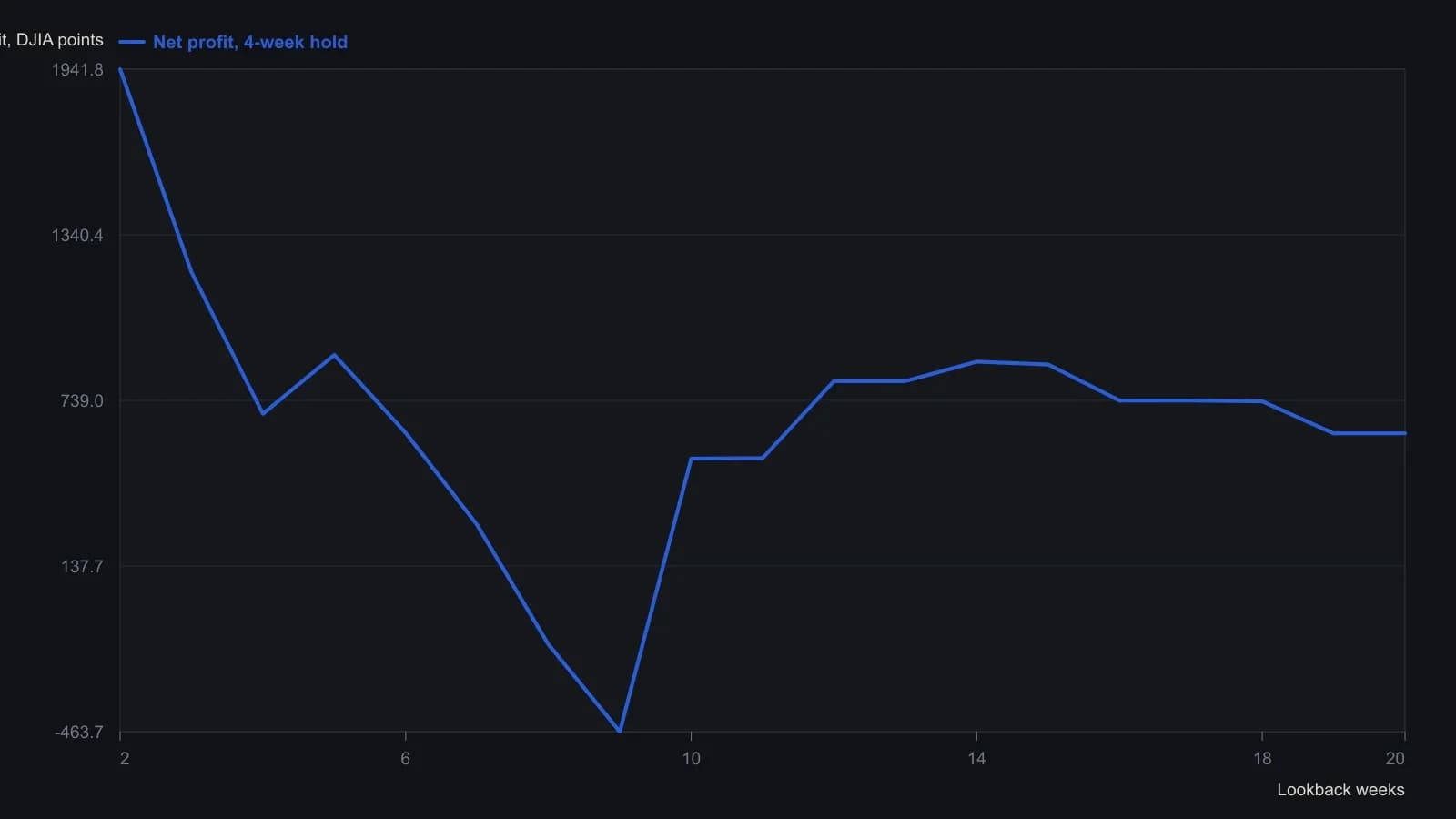
The rule kept only the first new high inside each lookback, entered the weekly close, and stood in cash between signals. Sample is weekly DJIA from February 1988 through November 1998; the unused 1998–1999 window is not in this sweep.
Why buy-and-hold was the occupancy-baseline
The evaluation treated full-span buy-and-hold as the occupancy-baseline because the breakout-system stayed in cash between signals for most of the 11-year window. An occupancy-baseline is a full-span always-invested comparison used when a signal-only system spends long stretches in cash.
Unused window and a longer span
Walk-forward-analysis then applied the same four-week-hold procedure from November 1998 through the end of 1999. Lookbacks above 13 generated no trades in that unused window.
A longer check from 1900 through 1989 compared every overlapping four-week span with the four-week change after each six-bar breakout, instead of relying only on the 1988 to 1998 sample.
In this usage, walk-forward-analysis means scanning the procedure on an earlier sample, then re-applying the same unchanged rules to a later unused window and to a much longer historical span.
Limits on generalization
The write-up treated a long bull regime as a limit on generalization. It presented the same procedure as something to retest on other tradables and in ranges or downtrends.
All readings on this track · 6 readings
- 1989Evaluating channel breakout with intraday and close-only stops
- 1990Delayed channel breakout stop construction
- 2000Fixed-horizon walk-forward tests of first-print breakouts
- 2013Z-score value filter on reversals and Donchian entries
- 2014Length fit versus later window for a two-length Donchian breakout
- 2014Walk-forward complexity in Donchian breakout systems