Economic calendar: six events, the actual figure and the market's first hour
/economic-calendar lists the dates of Fed, ECB and Bank of Japan decisions and of US CPI, payrolls and GDP — and for every past release, how far bitcoin, EUR/USD and gold moved in the hour after it.
Six events, not sixty
The new /economic-calendar covers six events, and each of them regularly moves the dollar, the euro, the yen, gold and bitcoin at the same time. The dates come from the calendars of the publishers themselves — the BLS, the BEA, the Federal Reserve, the ECB and the Bank of Japan — and are rechecked every three hours, so a rescheduled release moves here too. Times are shown in the publisher's own time zone and in UTC.
The market's reaction instead of a forecast
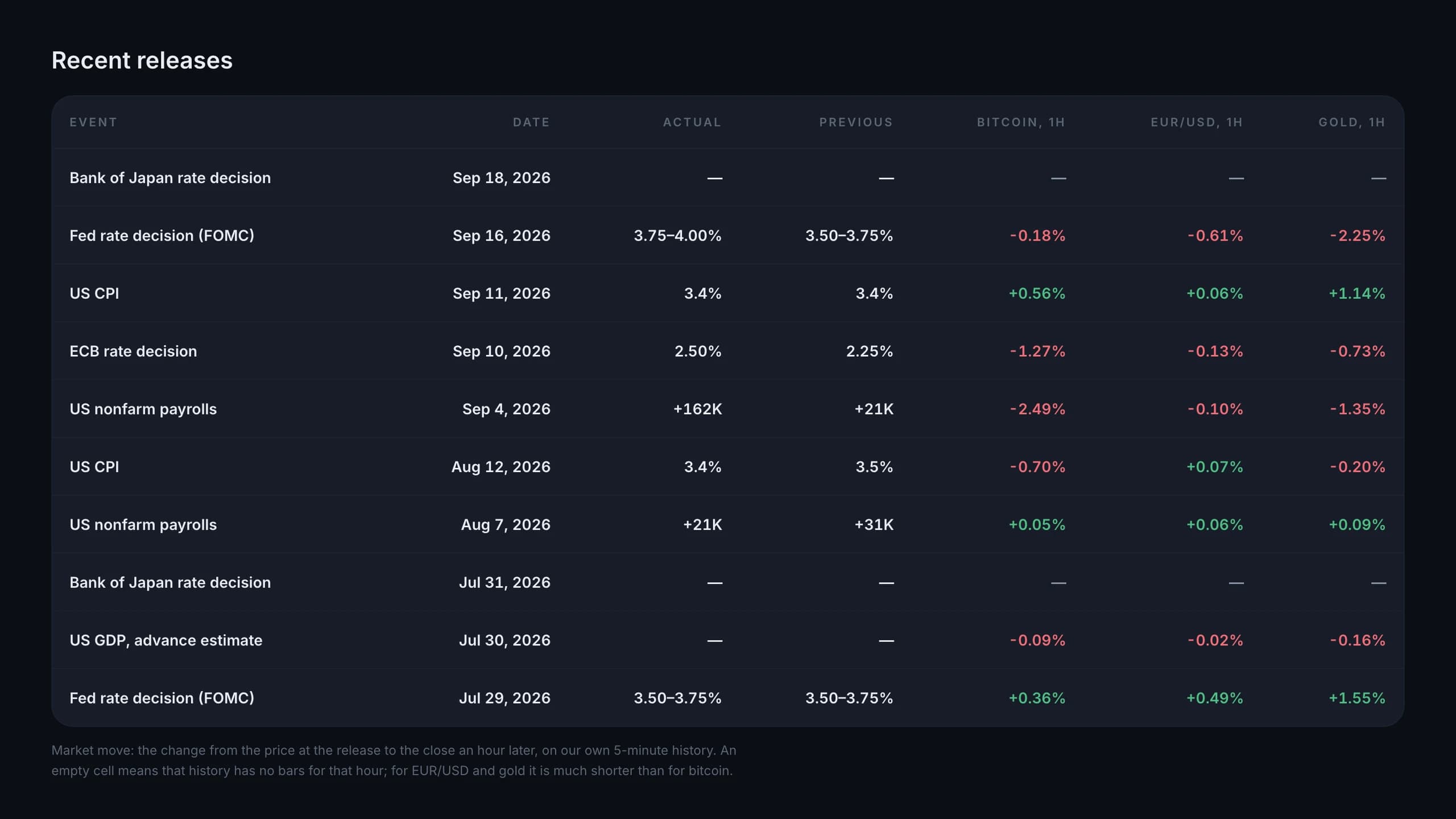
There is no consensus forecast column. Forecasts are sold by data vendors under licences that do not allow them on a free public page, and we chose not to copy them. What we show is what the publisher itself released: the actual figure and the previous one for inflation, payrolls, the Fed rate and the ECB deposit rate. GDP and the Bank of Japan have dates only for now.
What we add instead is the reaction. For every past release the table shows how far bitcoin, EUR/USD and gold moved in the hour after it, measured on our own price history: from the open of the 5-minute bar in which the release came out to the close of the last 5-minute bar of that hour. It shows which releases actually move the market you trade, and by how much.
A page for each event
Each of the six has a page of its own — FOMC, US CPI, nonfarm payrolls, US GDP, the ECB and the Bank of Japan: the days left until the next release, the schedule ahead, history since 2021 and the typical move — the median over up to the last twelve releases.
The limits: for some of the older releases EUR/USD and gold have no move — where our history lacks a clean bar at either end of the hour, the cell stays empty rather than showing a zero. The Bank of Japan has no move column at all, because its decision has no fixed hour. Payrolls figures are the current ones, revisions included, so an older NFP number may not match what calendars showed on the day.
In Strategy Builder too
Economic-event conditions in Strategy Builder take their dates from the same calendar. Until now the CPI and payrolls dates there stopped in spring 2025, so backtests over the last year and a half did not see those releases. A live strategy also notices a release scheduled after it was started: before, an entry on CPI or a no-trading-around-CPI filter only caught it after a restart.