2011issue C0364-71
A three-bar inside-bar commodity setup still needs portfolio context
An inside bar is a pause fully inside the prior bar's range. The three-bar version adds the direction of closes as a short-term gold, silver, or crude oil bias. Editorial view: that single-market signal should not occupy risk until correlation, diversification, and limit-order implementation have been checked.
- An inside bar sits fully inside the prior bar's range, with a higher low and a lower high, and marks a pause rather than a two-bar trigger by itself.
- The three-bar version treats that pause plus higher closes as a short-term uptrend bias, and the same pause plus lower closes as a short-term downtrend bias.
- The same setup on gold, silver, and crude oil still needs correlation analysis and diversification so one market's pause-and-break sequence is not treated as three independent bets.
- A limit order still has to be executable: joint-failure math can overstate the chance both books are tested, and paying per share rather than per ticket makes resting orders more practical for typical retail size under 200 shares.
A pause, not a two-bar trigger
The archive defines an inside bar as a bar fully inside the prior bar's range, with a higher low and a lower high. That shape shows a pause in activity. It is not, by itself, a two-bar trigger.
The three-bar version uses the inside bar as the middle bar and the direction of closes to mark a short-term long or short bias. An inside bar plus higher closes is treated as a short-term uptrend bias. An inside bar plus lower closes is treated as a short-term downtrend bias.
A common pause across markets
The pattern appears on many timeframes and in uptrends, downtrends, and quieter markets, so it is a common pause rather than a rare event.
The same three-bar inside-bar setup was examined on daily gold, silver, and crude oil contracts over May 2001 to August 2010.
Correlation and diversification come first
Correlation analysis checks how gold, silver, and crude oil moves travel together so one setup is not treated as three independent bets. The archive workflow still has to ask whether the same pause-and-break idea is repeating across names that already move as one book.
Diversification, in this workflow, means spreading the same pattern across several commodity contracts so one market's pause-and-break sequence does not dominate the book.
Editorial view: if the three names travel together, adding each new three-bar inside-bar does not automatically spread risk. The weeks-to-months backdrop still comes from cross-market prices, volatility, carry, and portfolio weights.
Ports include risk management, not entries alone
Software ports of the setup include long and short entries plus a predefined risk-management technique, not entries alone.
One implementation test is specified to enter on the next bar's open with zero trade delay after the pattern completes.
Editorial view: a next-bar open with no delay is a complete-pattern rule. It is not a substitute for checking whether the book already holds the same commodity exposure.
A limit order still has to be touched
A limit order is a resting order used to enter or manage the setup instead of crossing the spread with a market order. Implementation cost is the extra cost of getting filled, including spread, ticket versus per-share pricing, and the chance a resting order is never touched.
Paying per share rather than per ticket makes limit orders more practical for typical retail size under 200 shares. All-you-can-trade market-order pricing can discourage resting orders.
A two-name failure probability of 74% and 9% can be combined as 74% times 9%, or 6.7%, only if the names are treated as jointly failing. An average of the two rates is 41.5% and answers a different question. Once one name is already failing, a second resting book may never be challenged, so joint-failure math overstates the chance both books are tested.
Editorial view: spreading the same setup across contracts does not make two resting limit orders independent tests of the same idea.
Three-bar inside-bar closed equity on daily Brent
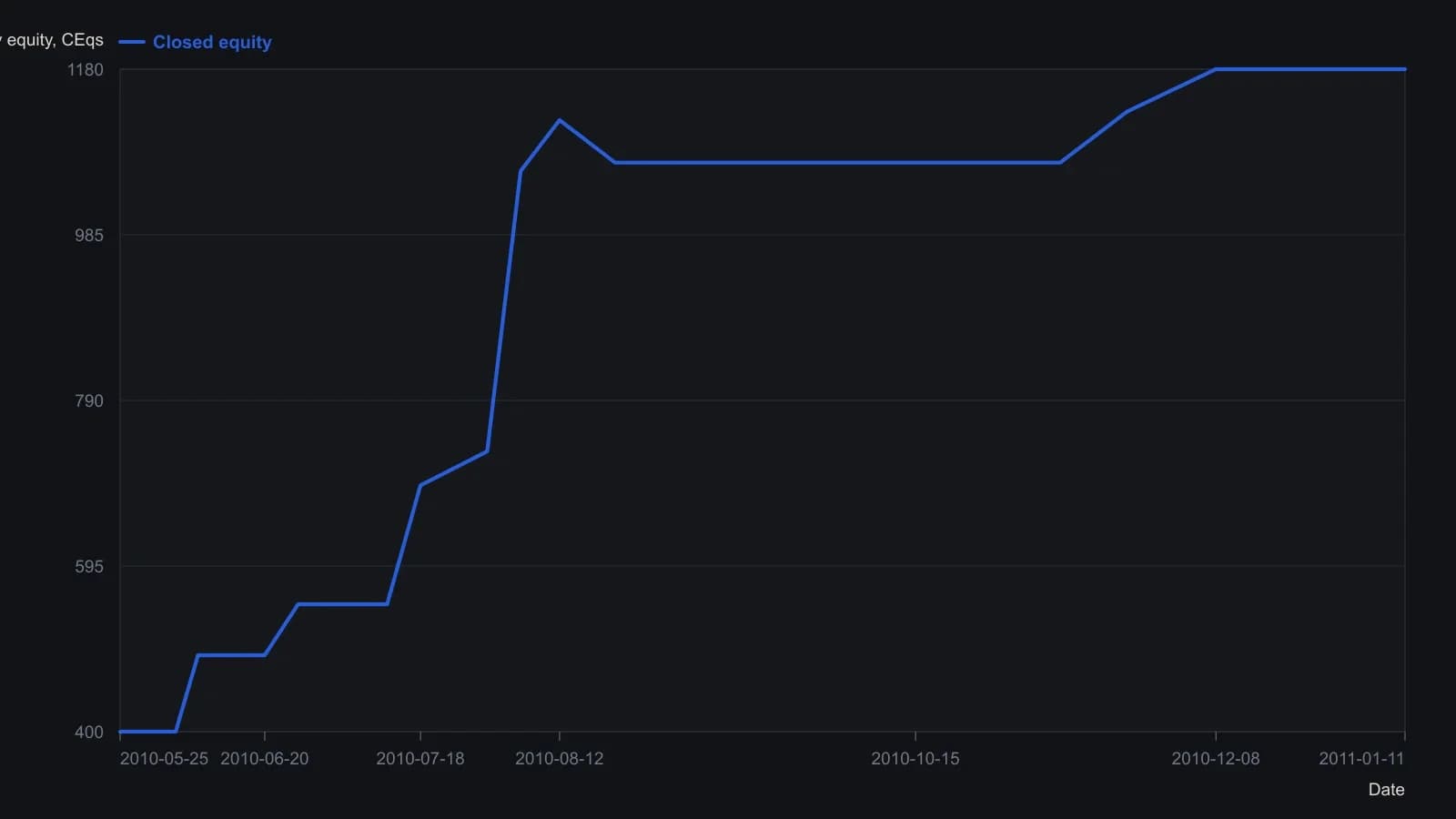
The study header fixes a 0.75 percent stop and 0.75 percent target. Intermediate equity levels are approximate readings from the raster; only the final 1,180 is an on-chart number.
All readings on this track · 20 readings
- 1994Cash-first stops beyond crowded landmarks
- 1996Index spread pairs with seasonal filters and limit orders
- 2003Precommit the stop and limit after a rule-based entry
- 2005Limit orders, routing paths, and commission tradeoffs
- 2005Bracket orders that precommit stop and target exits
- 2005Precommit a stop-loss at entry with pivot triggers
- 2006Mechanical systems need fill-aware failure modes
- 2006Ranking near-term support for ETF limit entries
- 2007Precommit futures stops and limits with contingent orders
- 2007Overnight option limit fills, stops and trailing exits
- 2010Seasonal commodity windows and stop-limit fill risk
- 2011Routing fees, do-not-ship flags, and maker-taker limit orders
- 2011A three-bar inside-bar commodity setup still needs portfolio context
- 2012Limit orders when a tick saved costs the fill
- 2013Futures platform order entry and per-trade fees
- 2013Iceberg hidden size and option-spread packages
- 2014Marketable limits, directed venues, and spread filters
- 2015Filtering commodity option liquidity by spread, not open interest
- 2015Paired range-bar averages and next-bar limit exits
- 2019Uneven-wing modidor as one limit package