2005issue C101-3
Bracket orders that precommit stop and target exits
A bracket is a three-ticket package: a limit entry plus a pre-set stop-loss and a pre-set profit-taking limit, so both exits are already live once the trader steps away. Size the share count from the stop first, send the three tickets together, and flatten anything still open at the cash-session close.
- A bracket is a three-ticket package: a limit entry plus a pre-set stop-loss and a pre-set profit-taking limit, so both exits are already live once the trader steps away.
- Share count equals the dollar risk limit divided by the price gap between the intended entry and the stop, and the profit-taking limit sits at a chosen multiple of that same gap.
- All three tickets should be sent together; if the entry price is revised, the stop and profit limit must be restacked so the original dollar risk and reward multiple stay intact.
- Any leftover position should be flattened at the cash-session close, and the broker must cancel the remaining exit if either the stop or the profit limit fills.
A three-ticket package
A bracket is a three-ticket package: a limit entry plus a pre-set stop-loss and a pre-set profit-taking limit, so both exits are already live once the trader steps away.
A long bracket uses a buy limit, a stop below that price, and a sell limit above it. A short bracket uses a sell limit, a stop above that price, and a buy limit below it.
XYZ bracket: stop, entry, and profit-taking prices
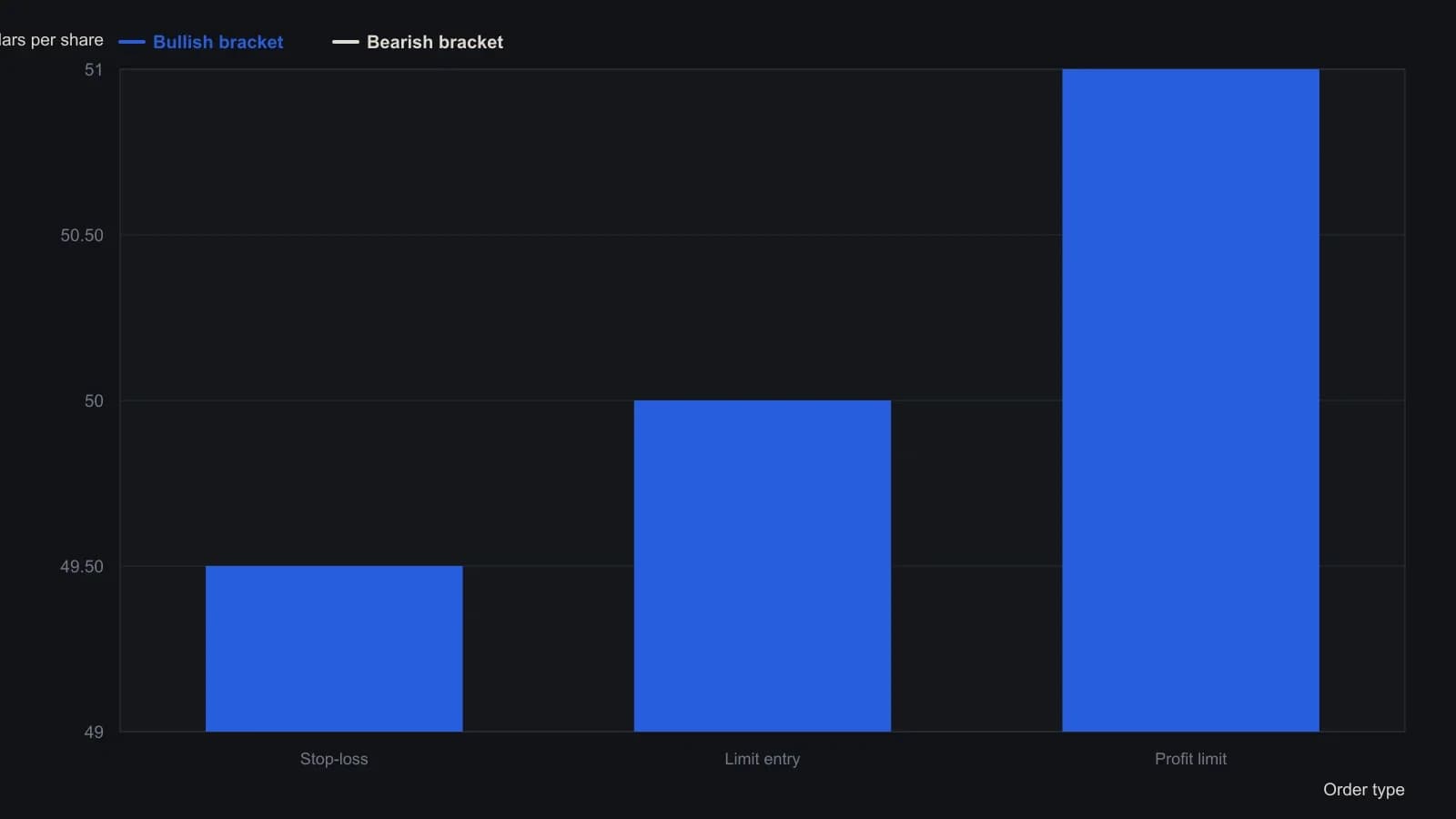
The source holds the entry-to-stop gap at $0.50 and the profit multiple at 2. On a $100,000 account risking 0.5 percent ($500) that gap sizes the ticket at 1,000 shares.
Size the ticket from the stop
How many names can be staged is bounded by account size and the house risk protocol, not by how many symbols pass a screen.
Share count equals the dollar risk limit divided by the price gap between the intended entry and the stop. Position-size-from-stop uses that stop-loss gap as the denominator for the share count, and it converts the acceptable adverse swing into a hard loss bound.
On a $100,000 account with a 0.5% per-trade risk cap, a $50 buy limit and a $49.50 stop imply a $500 / $0.50 gap and a 1,000-share ceiling.
Place the profit limit from the same gap
The profit-taking limit is placed at a chosen multiple of that same entry-to-stop gap. A multiple of two on the $50 / $0.50 long puts the sell limit at $51.
That multiple is the risk-reward-ratio. It locates the profit-taking limit a fixed number of stop-distances beyond the intended fill, so the reward side is sized from the same gap that caps the loss.
Send the three tickets together
All three tickets should be sent together. If the entry price is revised, the stop and profit limit must be restacked so the original dollar risk and reward multiple stay intact.
The limit-order is the price-conditioned ticket used for the entry and for the profit-taking exit, so fills are attempted only at the chosen prices rather than at an unpriced market.
Cancel the leftover exit and flatten at the close
Any leftover position should be flattened at the cash-session close. Session-close-flatten is the day-session rule that closes any leftover position if neither attached exit has triggered, so the trade is not carried into after-hours.
The broker must cancel the remaining exit if either the stop or the profit limit fills. Linked-exit-cancel is that routing, so the two closing tickets cannot both complete.
Attached stop and profit-limit tickets remove discretionary exit decisions. A later drop of the profit limit leaves the automatic stop as a triggered market order that can incur slippage.
All readings on this track · 20 readings
- 1994Cash-first stops beyond crowded landmarks
- 1996Index spread pairs with seasonal filters and limit orders
- 2003Precommit the stop and limit after a rule-based entry
- 2005Limit orders, routing paths, and commission tradeoffs
- 2005Bracket orders that precommit stop and target exits
- 2005Precommit a stop-loss at entry with pivot triggers
- 2006Mechanical systems need fill-aware failure modes
- 2006Ranking near-term support for ETF limit entries
- 2007Precommit futures stops and limits with contingent orders
- 2007Overnight option limit fills, stops and trailing exits
- 2010Seasonal commodity windows and stop-limit fill risk
- 2011Routing fees, do-not-ship flags, and maker-taker limit orders
- 2011A three-bar inside-bar commodity setup still needs portfolio context
- 2012Limit orders when a tick saved costs the fill
- 2013Futures platform order entry and per-trade fees
- 2013Iceberg hidden size and option-spread packages
- 2014Marketable limits, directed venues, and spread filters
- 2015Filtering commodity option liquidity by spread, not open interest
- 2015Paired range-bar averages and next-bar limit exits
- 2019Uneven-wing modidor as one limit package