2006issue C091
Ranking near-term support for ETF limit entries
When a one-way decline ages every usable support line, leftover pivot-point history can be ranked by near-term-touches and written as a one-to-two-bar limit-order bid on a NASDAQ-100 exchange-traded fund.
- A long-only account that cannot sell short can treat a NASDAQ-100 exchange-traded fund as the vehicle for the composite and drop unused swing indicators in favor of mapped support and resistance.
- As a decline continues, candidate support often has to be taken from older pivot-point history, while a shallow dip keeps those levels nearby and more influential.
- Two daily support lines were drawn from past pivot points, and the lower line was preferred because it had more prior touches than the nearer upper line.
- The preferred level was written as a limit-order bid for a one-to-two-bar hold, with a sell-stop after a fill so a failed turn would not stay open.
A long-only map of the composite
A long-only account that cannot sell short can treat a NASDAQ-100 exchange-traded fund as the vehicle for the composite. Unused swing indicators are dropped in favor of mapped support and resistance.
Support-resistance here means horizontal price zones taken from prior turning areas. Those zones become the long-entry hypothesis when unused swing tools no longer fit a falling tape.
Older pivot history as the decline continues
As a decline continues, candidate support often has to be taken from older pivot history. A shallow dip keeps those levels nearby and more influential.
A pivot-point is a historical turning price used to project a candidate support or resistance line across later sessions.
Ranking two daily support lines
Two daily support lines were drawn from past pivot points. The lower line was preferred because it had more prior touches than the nearer upper line.
Near-term-touches are repeated contacts of a level that sit closer in time than older unused pivots. They are used to rank competing lines.
QQQQ daily closes versus the 37.5 limit-bid support
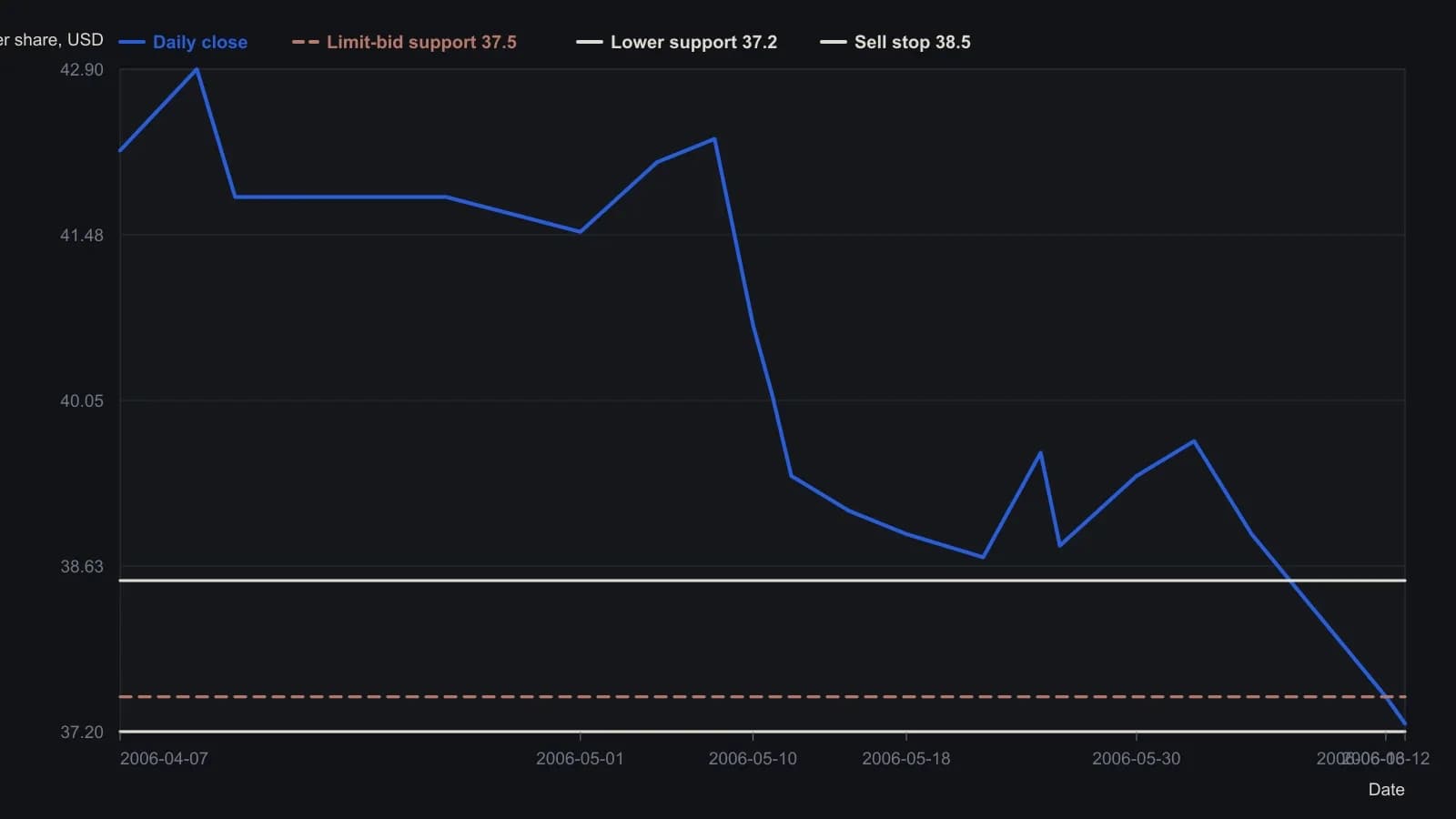
Closes are approximate to the nearest 0.1 against the printed 37–43 axis. Individual bars are small, so labeled dates and visible swings were read rather than every session. The last close is the MetaStock quote in the window title, not a raster estimate.
A short hold after a support fill
A worked long used a buy limit near 37.5 on June 7, with a planned exit at the close or a sell-stop near 38.5.
After a support fill, the intended hold was only one or two bars. That horizon is shorter than the unused swing indicators were built for.
A limit-order is a resting buy placed at a chosen support price so a fill occurs only if the market reaches that level. Execution was specified as limit bids at the drawn support and sell-stops after a fill so a failed turn would not stay open.
A sell-stop is a protective sell placed after a support fill so a failed bounce can exit without remaining an open swing.
All readings on this track · 20 readings
- 1994Cash-first stops beyond crowded landmarks
- 1996Index spread pairs with seasonal filters and limit orders
- 2003Precommit the stop and limit after a rule-based entry
- 2005Limit orders, routing paths, and commission tradeoffs
- 2005Bracket orders that precommit stop and target exits
- 2005Precommit a stop-loss at entry with pivot triggers
- 2006Mechanical systems need fill-aware failure modes
- 2006Ranking near-term support for ETF limit entries
- 2007Precommit futures stops and limits with contingent orders
- 2007Overnight option limit fills, stops and trailing exits
- 2010Seasonal commodity windows and stop-limit fill risk
- 2011Routing fees, do-not-ship flags, and maker-taker limit orders
- 2011A three-bar inside-bar commodity setup still needs portfolio context
- 2012Limit orders when a tick saved costs the fill
- 2013Futures platform order entry and per-trade fees
- 2013Iceberg hidden size and option-spread packages
- 2014Marketable limits, directed venues, and spread filters
- 2015Filtering commodity option liquidity by spread, not open interest
- 2015Paired range-bar averages and next-bar limit exits
- 2019Uneven-wing modidor as one limit package