1996issue C071-6
Index spread pairs with seasonal filters and limit orders
The archive builds an index futures spread from similar but not identical underlyings, chooses the pair with the greatest cash-versus-futures divergence, and works limit spread orders that do not always fill.
- A futures spread is a long futures position offset by a short futures position in contracts with similar but not identical underlyings, which is distinct from same-product arbitrage.
- Among the four indices discussed, only the Value Line is not capitalization-weighted, and the cited pair ratios are one-to-one for S&P versus Value Line, three miniature Value Line contracts versus one NYFE, and one Value Line versus two Mid-Caps.
- A workable pair is chosen by selecting the two indices that show the greatest divergence across the small set of cash-versus-futures direction combinations.
- Value Line thinness and one-sided paper order flow are treated as the condition for large premiums or discounts to cash, and limit spread orders worked through Kansas City Value Line brokers are described as not always filling.
What the archive means by a futures spread
The archive defines a futures spread as a long futures position offset by a short futures position in contracts with similar but not identical underlyings. That construction is distinct from same-product arbitrage.
Pair construction from index design
Among the four indices discussed, only the Value Line is not capitalization-weighted, while the S&P 500, NYFE, and Mid-Cap 400 are capitalization-weighted.
Typical contract ratios cited for these index pairs are one-to-one for S&P versus Value Line, three miniature Value Line contracts versus one NYFE, and one Value Line versus two Mid-Caps.
Choosing a pair from cash-futures patterns
Cash-versus-futures direction can form only a small set of combinations. A workable pair is chosen by selecting the two indices that show the greatest divergence across those patterns.
A monthly Value Line versus S&P spread chart is presented as showing Value Line gaining on the S&P 500 between 1991 and 1994, with the spread later widening again to over 6800 points in a stronger blue-chip phase.
March 1996 Value Line and S&P premium over cash
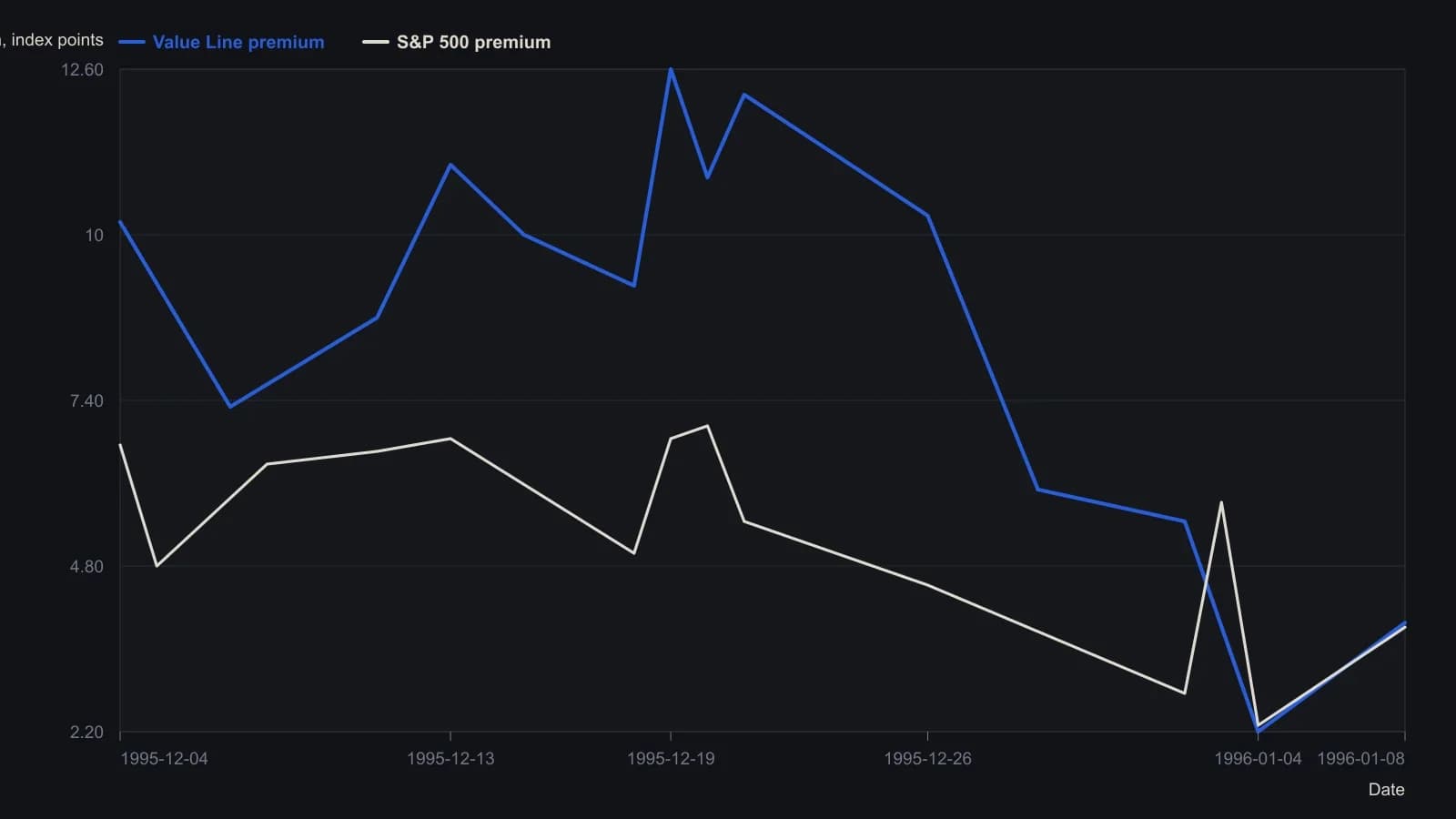
Vendor scale is index points times 100 (391 printed equals 3.91). Fair value was stated as 4.50–5.50 over cash for both contracts and was not drawn on the figure. The 7.11 S&P reading is the article’s high, not necessarily that session’s close.
Limit orders when the market is thin
The archive treats Value Line thinness and one-sided paper order flow as the condition that creates large premiums or discounts to cash. That condition is presented as the volatility needed for spread opportunity.
Index spread orders can be placed as limit spread orders worked through Kansas City Value Line brokers. Those Limit order working instructions are described as not always filling.
Related seasonal reading
Related-reading titles cited in the archive include seasonal-cycle, January-barometer, semiconductor-seasonal, season, and S&P 500 seasonality studies.
All readings on this track · 20 readings
- 1994Cash-first stops beyond crowded landmarks
- 1996Index spread pairs with seasonal filters and limit orders
- 2003Precommit the stop and limit after a rule-based entry
- 2005Limit orders, routing paths, and commission tradeoffs
- 2005Bracket orders that precommit stop and target exits
- 2005Precommit a stop-loss at entry with pivot triggers
- 2006Mechanical systems need fill-aware failure modes
- 2006Ranking near-term support for ETF limit entries
- 2007Precommit futures stops and limits with contingent orders
- 2007Overnight option limit fills, stops and trailing exits
- 2010Seasonal commodity windows and stop-limit fill risk
- 2011Routing fees, do-not-ship flags, and maker-taker limit orders
- 2011A three-bar inside-bar commodity setup still needs portfolio context
- 2012Limit orders when a tick saved costs the fill
- 2013Futures platform order entry and per-trade fees
- 2013Iceberg hidden size and option-spread packages
- 2014Marketable limits, directed venues, and spread filters
- 2015Filtering commodity option liquidity by spread, not open interest
- 2015Paired range-bar averages and next-bar limit exits
- 2019Uneven-wing modidor as one limit package