2003issue C061-4
Precommit the stop and limit after a rule-based entry
A rule-based long is incomplete until the trader names the market action that would invalidate the idea. TradersWeek editorial view: that rule-based-entry stays unfinished until the invalidation-stop and the target-limit are already linked and working.
- A rule-based long is incomplete until the trader names the market action that would invalidate the idea, typically a break of the support that justified the setup.
- Entry can wait for a defined trigger, such as a print above the prior day's high, using a stop-limit-entry so the working limit caps how far the fill may slip.
- After the fill, an invalidation-stop and a full-position target-limit can sit as a linked-exit-pair so that a fill on either cancels the remaining order.
- Once the linked orders are confirmed live and free of entry errors, managing that position does not require continued quote-screen attention.
Name the action that would invalidate the idea
A rule-based long is incomplete until the trader names the market action that would invalidate the idea. That action is typically a break of the support that justified the setup.
A rule-based-entry becomes active only after a pre-stated trigger prints, not after a mid-trade change of mind. The invalidation-stop is the protective stop placed at the price that would prove the setup thesis wrong.
Boston Scientific daily uptrend with the precommitted stop and limit
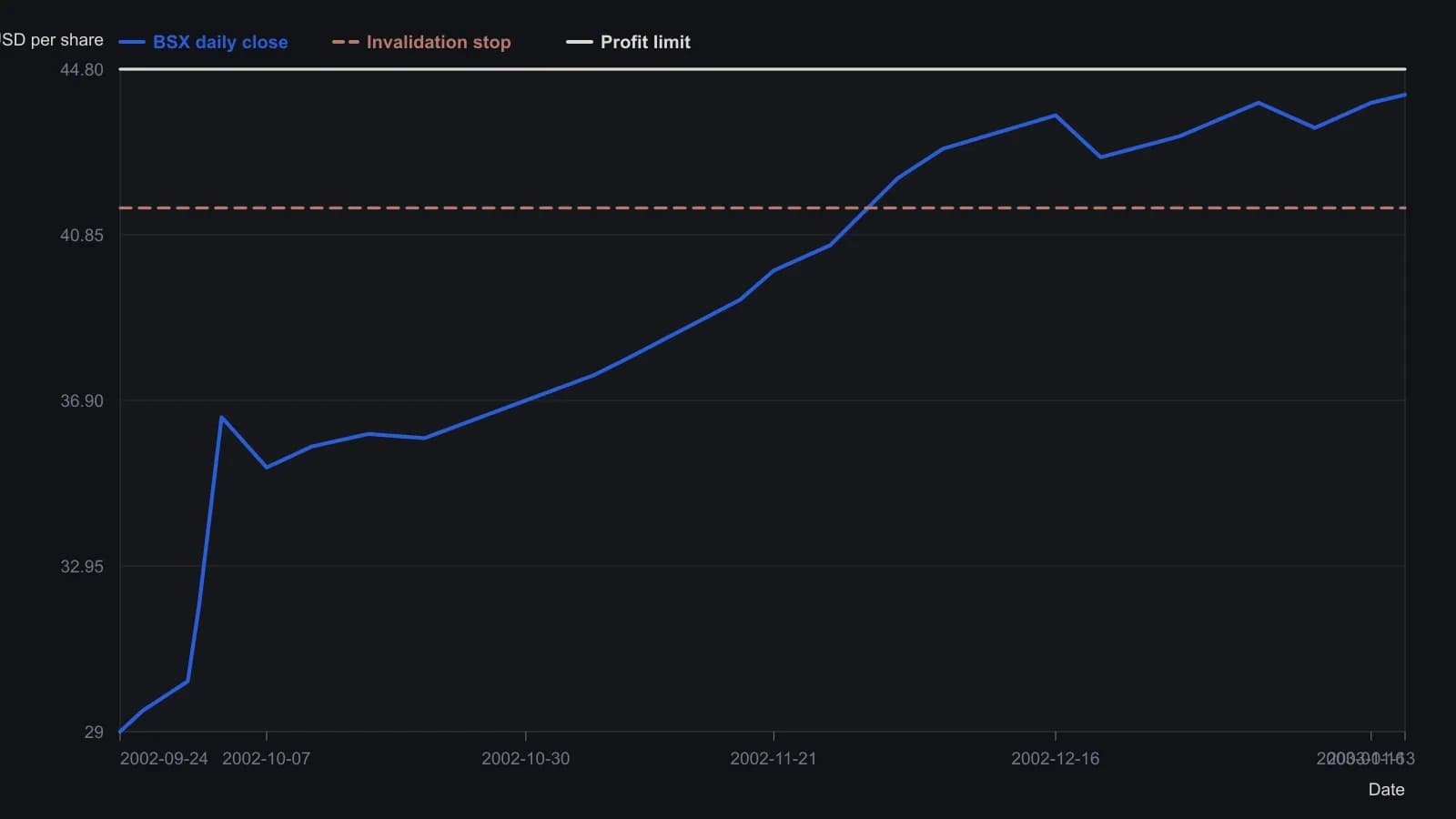
Closes are approximate visual readings from the printed daily candlesticks, generally to the nearest 0.2–0.3 dollars. The last print 44.19 is the figure’s own quote label. Stop 41.49 and limit 44.80 are the exact text values. The buy-stop trigger of 42.66 is omitted from the plot.
Wait for a defined trigger
Entry can wait for a defined trigger, such as a print above the prior day's high, using a buy stop-limit so the working limit caps how far the fill may slip.
That stop-limit-entry becomes a live limit only after the specified price prints, capping acceptable slippage.
Link the protective stop to the target
After the entry fill, a protective stop and a full-position limit at the profit objective can be linked so that a fill on either cancels the remaining order.
The target-limit is a resting limit sized for the full position at a pre-chosen objective. The linked-exit-pair is that stop and limit joined so a fill on either cancels the other.
Exit a failed idea with a market stop
Stop-market-protection is used when exiting a failed idea is the priority. The stop becomes a market order on the trigger print, accepting extra slippage rather than risking a stop-limit that never becomes an executable market order.
Leave the original target working
A linked pair can sit through a sharp pullback that never reaches the stop, leaving the original target-limit still working when price later resumes in the planned direction.
Price can miss a resting cover limit by ten cents, reverse, and only later print through that same limit, which is why the unfilled target is left working instead of being rewritten during the retracement.
The same boxing on a short
The same boxing applies on a short-horizon chart. After a short fill, the stop sits just beyond nearby moving-average resistance and a limit covers in full at a predefined new-low objective.
Confirmed orders do not need quote-screen attention
A boxed-trade is the finished set of trigger, invalidation, and target that can be left with the broker once confirmed. Once the linked orders are confirmed live and free of entry errors, managing that position does not require continued quote-screen attention.
TradersWeek editorial view: continued quote-screen attention only reopens the discretionary decisions the linked-exit-pair was meant to close.
All readings on this track · 20 readings
- 1994Cash-first stops beyond crowded landmarks
- 1996Index spread pairs with seasonal filters and limit orders
- 2003Precommit the stop and limit after a rule-based entry
- 2005Limit orders, routing paths, and commission tradeoffs
- 2005Bracket orders that precommit stop and target exits
- 2005Precommit a stop-loss at entry with pivot triggers
- 2006Mechanical systems need fill-aware failure modes
- 2006Ranking near-term support for ETF limit entries
- 2007Precommit futures stops and limits with contingent orders
- 2007Overnight option limit fills, stops and trailing exits
- 2010Seasonal commodity windows and stop-limit fill risk
- 2011Routing fees, do-not-ship flags, and maker-taker limit orders
- 2011A three-bar inside-bar commodity setup still needs portfolio context
- 2012Limit orders when a tick saved costs the fill
- 2013Futures platform order entry and per-trade fees
- 2013Iceberg hidden size and option-spread packages
- 2014Marketable limits, directed venues, and spread filters
- 2015Filtering commodity option liquidity by spread, not open interest
- 2015Paired range-bar averages and next-bar limit exits
- 2019Uneven-wing modidor as one limit package