2010issue C1338-43
Short strangle construction from range, volatility and premium
A short-strangle is a same-expiry out-of-the-money put and call. The archive construction places those wings from a bollinger-band-range, sells only after option-premium-analysis finds the quote rich to a model that uses implied-volatility, then keeps the book delta-neutral once price leaves the midpoint.
- A short-strangle is an out-of-the-money short put and an out-of-the-money short call that share one expiration, so only one side can finish in the money.
- The bollinger-band-range places the wings near two- and three-standard-deviation bounds, which the archive describes as containing price about 95 percent and 99 percent of the time.
- Option-premium-analysis compares model fair value with the live quote, and implied-volatility is the input that equates the model to that quote so only overvalued wings are sold.
- The same book is a margin-efficient-strangle that can be run delta-neutral, managed with dynamic-hedging, or built by choosing to leg-into the second wing after a reversal.
A same-expiry pair of out-of-the-money wings
A short-strangle is constructed as an out-of-the-money put and an out-of-the-money call that share one expiration, so only one side can finish in the money. Because both wings start out of the money, the book is a margin-efficient-strangle: margin is reduced and is computed from the side closer to being in the money.
Strikes from the range envelope
Range construction uses Bollinger bands. Price is described as staying inside two standard deviations about 95 percent of the time and inside three standard deviations about 99 percent of the time. The bands narrow in quiet markets and widen in volatile ones. The bollinger-band-range is the envelope used to locate likely trading bounds and to place the short strikes near those bounds.
Fair value against the quote
Entry is conditioned on a premium check. Option-premium-analysis compares a model's fair value with the live quote so the seller can identify overpriced contracts before both sides of the strangle are sold. Implied-volatility is the volatility input that equates a pricing model to the option's market price, used here to judge whether a quoted premium is rich relative to recent realized movement.
The September 2009 EUR/USD construction
In the September 2009 EUR/USD example, a nine-week range and a pullback toward the 30-day average were used to sell a strangle near mid-range, with 1.3800 near the range low and 1.4500 near the three-standard-deviation line. Before the sale, a modified Black-Scholes calculator was fed the futures price, strike, 30-day annualized volatility of 8.7, days to expiration, and interest-rate inputs. Each wing's model value was 0.23 with a delta of 0.14, and the quoted calls were 2.39 times that model value. The worked book was initially delta-neutral, expired in 25 days on September 4, 2009, and posted initial margin of about $4,500 plus $2,650 of collected premium.
Keeping the book tradable after the midpoint
The same construction supports delta-neutral management. The short call's positive delta is balanced against the short put's negative delta, then adjusted with the underlying or extra options so time decay of collected premium can work with less directional exposure. Delta is treated as the option's price change relative to a one-point move in the underlying and as an approximate probability that the option finishes in the money. An at-the-money short 100 call is given as +0.50 when the underlying is 100.
Construction choices after the midpoint include selling both wings together in a range, or the choice to leg-into the book by selling one wing at a reversal and waiting to sell the other. Later decisions cover hedge interval, margin, stops, early profit-taking, futures versus option hedges, rolls, and managing hedge P&L so it does not erase expiration decay. Dynamic-hedging adds or subtracts futures, shares, or extra options after entry so the book's net delta stays near the planned target as price and time change. Every outcome outside the planned range or volatility forecast needs a countering hedge plan.
September 2009 EUR/USD short-strangle construction levels
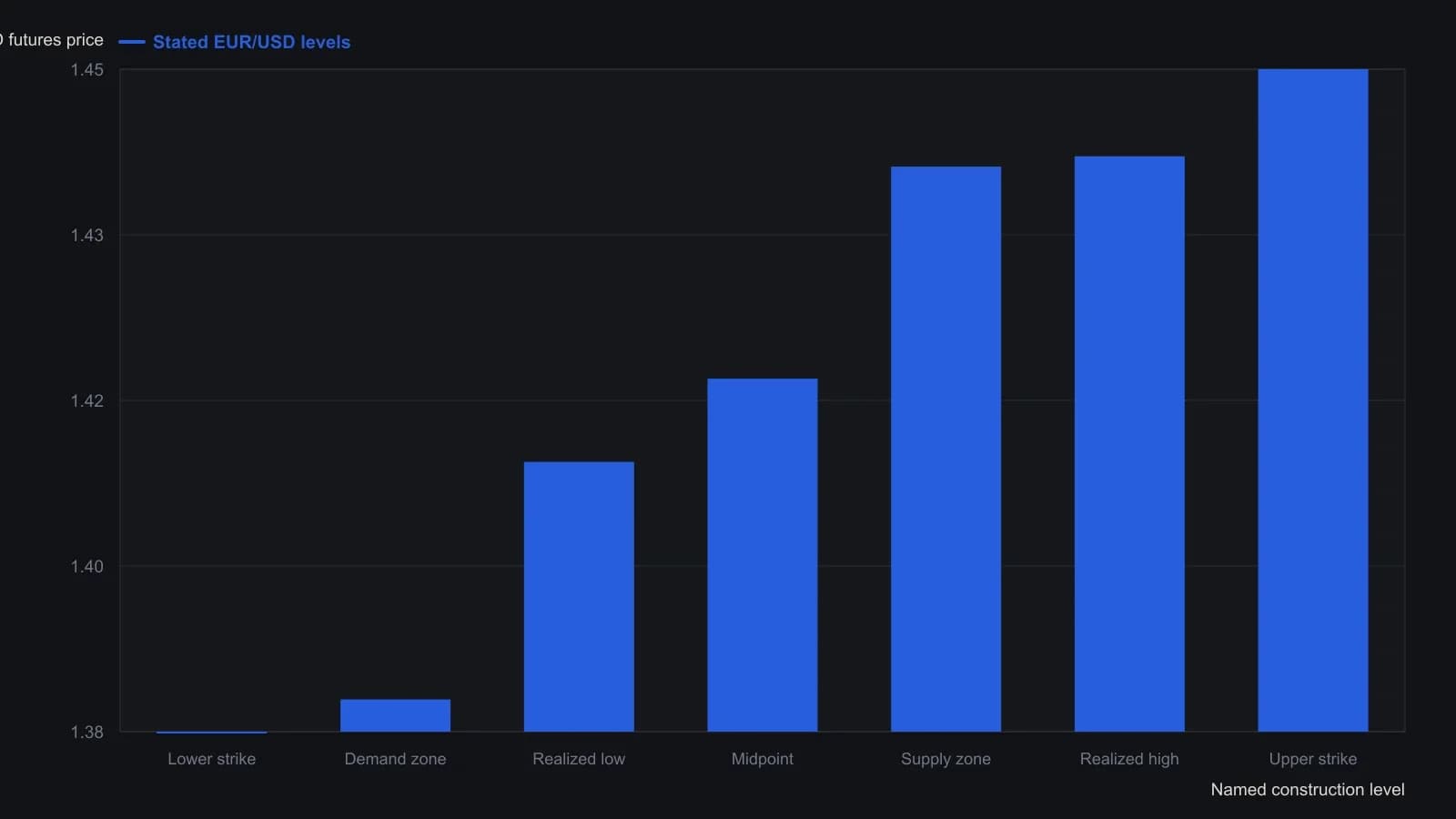
Wings were taken from the nine-week low and the 30-day three-standard-deviation band. Steiner forecast a seven-point range; the four-week holding-period range he reports is 3.23 points.
All readings on this track · 15 readings
- 1987Write the exclusion zone, then choose the structure
- 2001Straddles, strangles, and calendars in an index portfolio context
- 2006Event-week straddle and strangle construction with residual delta
- 2007Straddle versus strangle construction and a debit-spread cash audit
- 2010Critiquing event-priced straddles and expiration pin-risk
- 2010Placing an options strangle in the 2010 market regime
- 2010Short strangle construction from range, volatility and premium
- 2011Iron butterfly as packaged straddle and strangle
- 2012Calm as one testable trading procedure
- 2014Long-strangle premium hurdle and event volatility
- 2014Constructing short strangles as range income in futures options
- 2014Paired stop futures strangles fail on false breakouts
- 2015Construct a name-specific fear overlay before a short strangle
- 2016Financed protective puts, upside caps, and hedge timing
- 2017Hours, capital gates, and strangle margin on emini S&P options