2007issue C051
Straddle versus strangle construction and a debit-spread cash audit
A long straddle buys a put and a call at one strike. A long strangle splits those wings around the stock. Debit size, the two expiration breakevens, and the worthless-expiration zone are the move the rest of the book must tolerate. A two-leg debit is then sized on confirmed cash, including any per-leg cash charge.
- A long straddle buys a same-expiry put and call that share one strike, usually at or near the stock. A long strangle uses different strikes so the call sits above the stock and the put sits below it, and both contracts are out of the money.
- With the stock near 30.05, ten 30-strike straddles debit 5.00 per pair, or 5,000 after the 100-share multiplier. The same-size strangle of 32.50 calls and 27.50 puts debits 2.00 per pair, or 2,000 in total.
- Straddle expiration breakevens are 25 and 35. Strangle expiration breakevens are 25.50 and 34.50. Both strangle options expire worthless between 27.50 and 32.50. Both straddle options expire worthless only if the stock finishes exactly at 30.
- One construction response to dual-worthless risk is to buy several months of time and use a planned early exit at least 30 to 45 days before expiration. A ten-lot bull call spread quoted as a 1.10 debit is 1,100 after the multiplier, while a confirmed 1,125 outlay can include a 25 charge, or 12.50 per leg.
Same strike or split wings
A long straddle is assembled by buying a put and a call on the same underlying, with the same expiration and the same strike, typically at or near the current stock price. That shared strike is usually at the money.
A long strangle is assembled by buying a same-expiration put and call with different strikes, so the call strike is above the stock and the put strike is below it. Both contracts are out of the money.
Debit size in the worked example
In the worked example with the stock near 30.05, the 30-strike call is 2.55 and the matching put is 2.45, so ten straddles debit 5.00 per pair, or 5,000 after the 100-share multiplier.
The same-size strangle using 32.50 calls at 1.05 and 27.50 puts at 0.95 debit 2.00 per pair, or 2,000 in total, because both contracts are out of the money.
Expiration breakevens and the worthless-expiration zone
Straddle expiration breakevens equal the shared strike plus and minus the 5.00 debit, which is 35 on the upside and 25 on the downside.
Strangle expiration breakevens equal the call strike plus the 2.00 debit and the put strike minus that debit, which is 34.50 and 25.50.
Both strangle options expire worthless if the stock finishes anywhere between 27.50 and 32.50. Both straddle options expire worthless only if the stock finishes exactly at 30.
SBUX June expiration levels for the straddle and the strangle
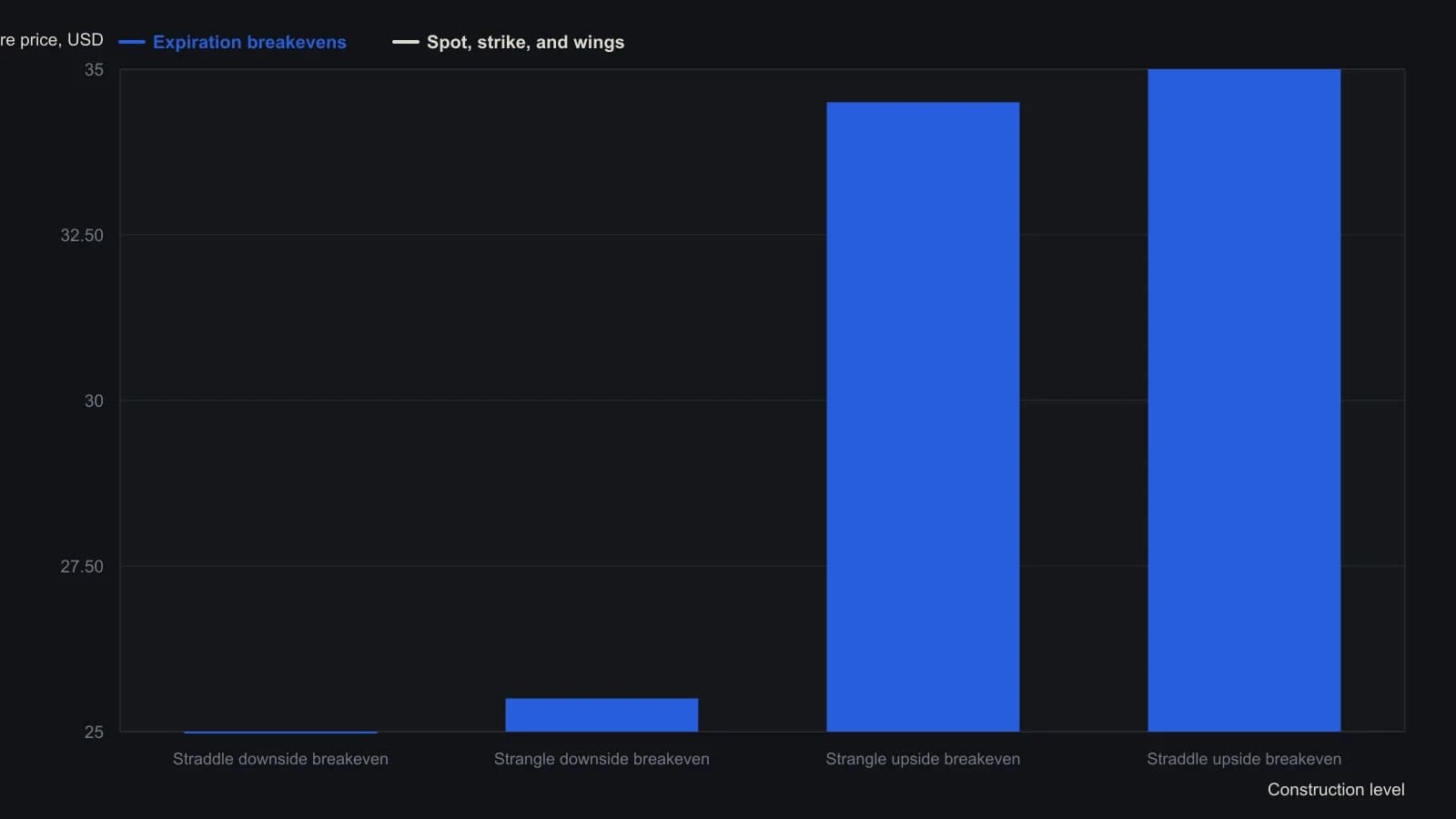
The strangle is a 100 percent loss if expiration prints between the 27.50 put and the 32.50 call. The straddle is worthless only on an exact 30 print. Premiums themselves are $5.00 and $2.00 a share for the 10-lot packages.
Planned early exit and assignment at strike
One construction response to dual-worthless risk is to buy contracts with several months remaining and to exit at least 30 to 45 days before expiration. That planned early exit leaves time on the contracts instead of holding into the worthless-expiration zone.
A short put or short call that finishes exactly at its strike has no intrinsic value and usually expires unused, but the holder can still exercise, so assignment is not impossible. Assignment at strike remains a residual chance on a short option that finishes exactly at its strike.
Confirm the two-leg debit in cash
For a ten-lot bull call spread quoted as a 1.10 debit, premium math after the 100 multiplier is 1,100. A confirmed 1,125 outlay can equal that debit plus a 25 charge, or 12.50 per leg, taken off the short-call credit.
The bull-call-spread debit is the net premium paid for a long lower-strike call minus a short higher-strike call, scaled by contract count and the 100-share multiplier. A per-leg cash charge can sit on one side of a two-leg fill and make the confirmed debit larger than the raw premium difference.
All readings on this track · 15 readings
- 1987Write the exclusion zone, then choose the structure
- 2001Straddles, strangles, and calendars in an index portfolio context
- 2006Event-week straddle and strangle construction with residual delta
- 2007Straddle versus strangle construction and a debit-spread cash audit
- 2010Critiquing event-priced straddles and expiration pin-risk
- 2010Placing an options strangle in the 2010 market regime
- 2010Short strangle construction from range, volatility and premium
- 2011Iron butterfly as packaged straddle and strangle
- 2012Calm as one testable trading procedure
- 2014Long-strangle premium hurdle and event volatility
- 2014Constructing short strangles as range income in futures options
- 2014Paired stop futures strangles fail on false breakouts
- 2015Construct a name-specific fear overlay before a short strangle
- 2016Financed protective puts, upside caps, and hedge timing
- 2017Hours, capital gates, and strangle margin on emini S&P options