1985issue C041-5
A range-bound bond strangle as a premium-regime overlay
Editorial view: confirm a mid-range Treasury-bond tape and rich out-of-the-money premiums first, then place the short options strangle as a lower-margin overlay inside a broader book rather than as a directional wager.
- Editorial view: screen for a mid-range tape and rich unused premiums before treating a two-sided short as a book overlay.
- A Treasury-bond short options strangle of one out-of-the-money put and one out-of-the-money call was described as using $1,000 of margin versus a $2,000 minimum exchange margin for one futures position.
- Neutral option spreads were presented as constructions for a tape that lacks a trend or is too volatile for an outright position, and as the only described way to trade a flat tape.
- While June bonds held a 70-to-74 range through December, January, and February, both the 66 put and the 76 call stayed out of the money and each lost more than half of its remaining time-value premium.
A case from the early futures-options years
Listed stock options had about twelve years of exchange history in the archive period, while options on futures and cash indexes had been listed for less than three years. In that setting the archive walked through option-spread constructions as an alternative to an outright futures stance.
Those constructions were presented as a way to lessen exposure to an intraday stop-out or a limit-move gap versus an outright futures position. They were also described as giving more time to reassess after a sudden direction change.
The short strangle and its margin-offset
A Treasury-bond short options strangle of one out-of-the-money put and one out-of-the-money call was described as using $1,000 of margin versus a $2,000 minimum exchange margin for one futures position. The second wing of that short strangle was described as carrying no extra margin because the market cannot move against both the put and the call at the same time.
That margin-offset is the archive account of why the second strike does not double the capital charge. The case study showed a June bond short 66 put and 76 call collected as a $1,355 net credit.
Option premium analysis before both wings are sold
Option premium analysis in the archive focused on selling rich options and buying cheap ones. That work included temporary gaps between a cash index and the option on that index that must close by expiry.
Cash-index-convergence is the requirement that the index option and its cash index meet at expiry. The archive used that meeting to frame whether a temporary premium gap favored selling or buying.
Neutral option spreads on a flat tape
Neutral option spreads were presented as constructions for markets that lack a trend or are too volatile for an outright position, and as the only way described for trading a flat tape.
Within that framework, an out-of-the-money short call on an overbought, overvalued commodity ranked as a high-probability construction. An at-the-money long put ranked just below it because leftover time value decays. Neutral option spreads ranked at the top.
Both wings unused while bonds held mid-range
While June bonds held a 70-to-74 range through December, January, and February, both the 66 put and the 76 call stayed out of the money and each lost more than half of its remaining time-value premium.
The archive estimated that markets are neutral or non-trending about 80 percent of the time. Daily time-value decay on both wings was treated as the short strangle's main attraction in that regime. Residual decay was also described as a buffer if a trend later appears.
June Treasury-bond daily tape while the 66/76 strangle stayed out of the money
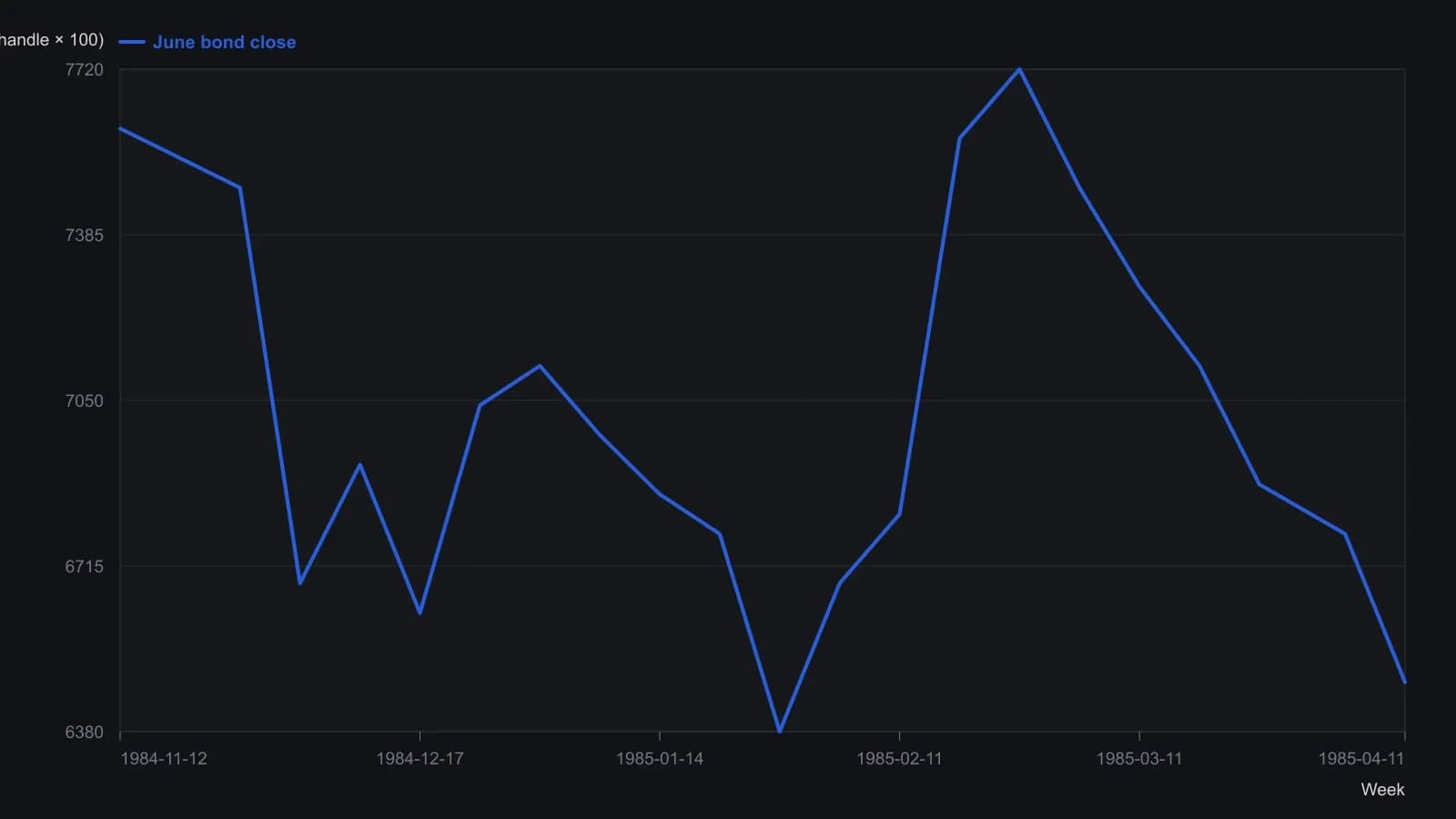
Closes were read at the chart’s weekly date ticks only; daily highs and lows and any 32nd-handle fraction finer than a quarter-point are beyond the raster.