1994issue C041-5
Estimating closeout value on a Treasury bond options strangle
A historical case estimates a short options strangle on U.S. Treasury bond futures before entry. Implied volatility is solved from the premiums that would be sold, then the Black-Scholes model restates closeout value after the futures stay inside the strikes or break outside them.
- The case estimates a short options strangle on U.S. Treasury bond futures before entry by changing the futures price, remaining time, and volatility together.
- Listed premiums are entered so implied volatility can be solved for each sold leg before any scenario column is changed.
- Two later columns move the calculation date two months forward and use the Black-Scholes model to restate closeout value inside the intended range and outside it.
- Selling the 118 call instead of the 120 call after a large decline in bonds raises the credit and narrows the band that can still keep the strangle profitable.
Estimating the position before entry
The archive uses a short options strangle made from two U.S. Treasury bond futures options as the case for estimating the position's future value before entry. The position is an options strangle: a short put-and-call combination that collects premium if the underlying futures stay inside a chosen band and that must later be bought back to exit.
That pre-trade estimate is built around three changing inputs at once: movement in the underlying futures price, option time decay, and shifts in volatility.
How the sold legs are locked in
After a large decline in bonds, the sold call in the case uses an 118 strike instead of 120. That choice raises the call premium and narrows the underlying range that still keeps the strangle profitable. The extra credit is a trading-range premium: extra credit taken by selling a closer call after a large decline, paid for with a narrower band in which the strangle can remain profitable.
The put leg is set as a 110-strike futures option against June T-bond futures, with a T-bill interest rate, a calculation date, and the option's expiration date. The listed put price of 51/64 is entered so implied volatility can be solved rather than supplied as an input.
The 118-strike call is copied across later columns, and implied volatility is solved for each option before any scenario fields are changed. Implied volatility is the volatility that makes a pricing model match an observed option premium and that then becomes the baseline for later scenario columns.
Date and price scenarios two months forward
Two later column pairs move the calculation date two months forward and compare an underlying price inside the intended range with a price outside that range.
Those altered columns are recomputed with the Black-Scholes model to produce theoretical put and call values under the new date, price, and volatility assumptions. The Black-Scholes model is the pricing engine used to restate each leg after the planner changes remaining time, the underlying price, or volatility.
T-bond short-strangle closeout premiums under two April scenarios
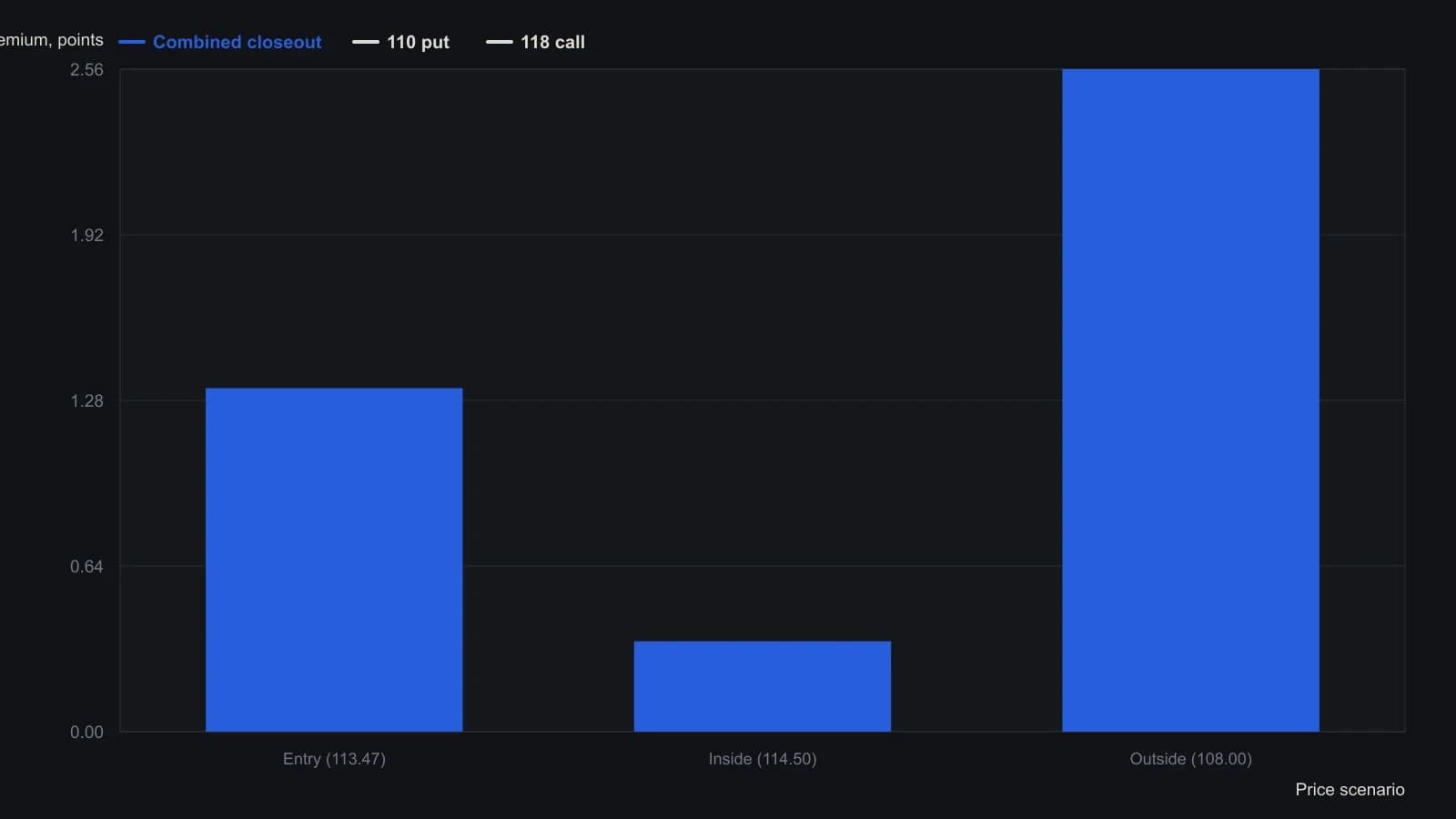
Implied volatilities were solved from the sold premiums (8.40 percent on the 110 put, 8.59 percent on the 118 call) and then held fixed. Interest rate 3.5 percent, expiration 20 May 1994, 98 days of life at entry and 39 days in the April cases. The 118 call was used instead of a 120 call after bonds had already dropped.
Reading the output as closeout value
The theoretical values are read as the prices at which the two legs would have to be purchased to close the strangle if those conditions occurred. That buy-back price is the closeout value: the theoretical price at which each sold leg would have to be purchased to unwind the strangle under a stated future date, price, and volatility. The in-range pair is treated as the more favorable closeout.
Volatility can be overwritten as its own what-if input. The same layout can be extended beyond two options, and a worksheet figure is shown as a planning aid for alternative scenarios.
All readings on this track · 18 readings
- 1988Critiquing Black-Scholes early exercise on futures options
- 1988Constructing option premiums against a Black-Scholes baseline
- 1989Limit fills around option fair value
- 1990When volatility skews are regimes, not mispricings
- 1994Estimating closeout value on a Treasury bond options strangle
- 1996Constructing option theta from premium, volatility, and moneyness
- 2002Calendar income from volatility skew and time stops
- 2003Constructing option value from historical and implied volatility
- 2004Calendar construction from exercise style, time budget, and carry
- 2005A mid-life payoff chart is a volatility-regime assumption
- 2005Exotic option payoffs beyond the vanilla premium
- 2006Auditing index volatility inputs in call income studies
- 2008Ratio write delta adjustment when the tape rises
- 2010Expiration-dated volatility cones as portfolio context
- 2015Auditing buy-write recovery overlays against pricing and scenario breaks
- 2015Odd-lot mini-option hedges versus implied volatility
- 2018Implied volatility as an option-premium construction gauge
- 2019Black-Scholes construction from a covered-call balance sheet