1987issue C061-6
Write the exclusion zone, then choose the structure
Archived cases start by naming a price region the structure can survive without a correct next-tick forecast. The credit option spread, the range strangle, and the financed protective put are three ways to make that exclusion, the hold, and the abstention rule one procedure.
- Write the exclusion zone first: the price region the structure is built to survive without a correct next-tick forecast.
- A credit option spread can treat rising, flat, and slowly falling paths as favorable if a distant short strike is not breached, with time-value erosion on the short put as the hold buffer.
- A range strangle sells an out-of-the-money put and call outside a stated band so both sides can decay while price chops, using high premium, a short horizon, and a range regime as setup filters.
- A financed protective put buys a nearer put against an existing long and sells farther calls, remaining removable, so a stated cap is where further upside is surrendered.
Name the exclusion zone first
The archived constructions do not begin with a next-tick forecast. They begin by writing a price region the structure is built to survive. That region is the exclusion zone.
Once the zone is written, the case chooses a credit option spread, a range strangle, or a financed protective put. Editorial reading: the useful habit is to make the exclusion, the hold, and the abstention rule the same procedure, then pick the structure that already encodes all three.
Credit option spreads and the hold buffer
An index case bought a higher-strike call and sold a lower-strike put for a credit. The book required only that price stay above the short put for the remaining life, rather than a correct next-tick call.
That credit option spread was specified with a stated margin and with open-ended upside above the long call. Rising, flat, and slowly falling prices were treated as favorable. A fast break was the residual risk.
The same case treated ongoing time-value loss in the short, overvalued, out-of-the-money put as the hold buffer. A temporary decline did not, by itself, force an exit while that buffer was still doing the work.
Ratio spreads after a large advance
The ratio-spread procedure bought one at-the-money or near-the-money option and sold two or more farther out-of-the-money options. The archive preferred a credit and wide strike spacing. The designed loss path was a move through the short strikes.
A Swiss franc illustration followed that procedure after a large advance with elevated premiums: it bought the nearer calls and sold two farther calls for a credit. A wide band from zero through a high marked level was treated as favorable.
Range strangles without a directional forecast
When a market was treated as range-bound, the case sold an out-of-the-money put and an out-of-the-money call outside that band. Both sides could decay while price chopped. No directional forecast was required. That construction is the range strangle.
A live-cattle example sold out-of-the-money puts and calls against a stated range. The three setup filters were historically high premium, a short horizon, and a range regime.
Financed protective puts after a vertical rally
After a vertical index rally, a zero-debit hedge bought a near-the-money put and sold one or more far out-of-the-money calls against an existing long. The hedge remained removable at any time. That construction is the financed protective put.
A move through a stated cap was the point where further upside would be surrendered. Below that cap, the put-plus-short-call collar was meant to keep most open profits intact.
Choose the structure that matches the written zone
Editorial reading: the matching structure is the one that already contains the hold and the abstention rule. A credit option spread or a ratio spread matches a zone in which several path types can finish favorable if a distant short strike is not breached, with time-value erosion on the short, distant options as the hold buffer. A range strangle matches a written band in which decay, not direction, is the intended source of edge. A financed protective put matches an existing long that must bound give-back after a vertical move, with a stated cap as the price at which further upside is surrendered.
April live cattle held inside the written 58–64 range
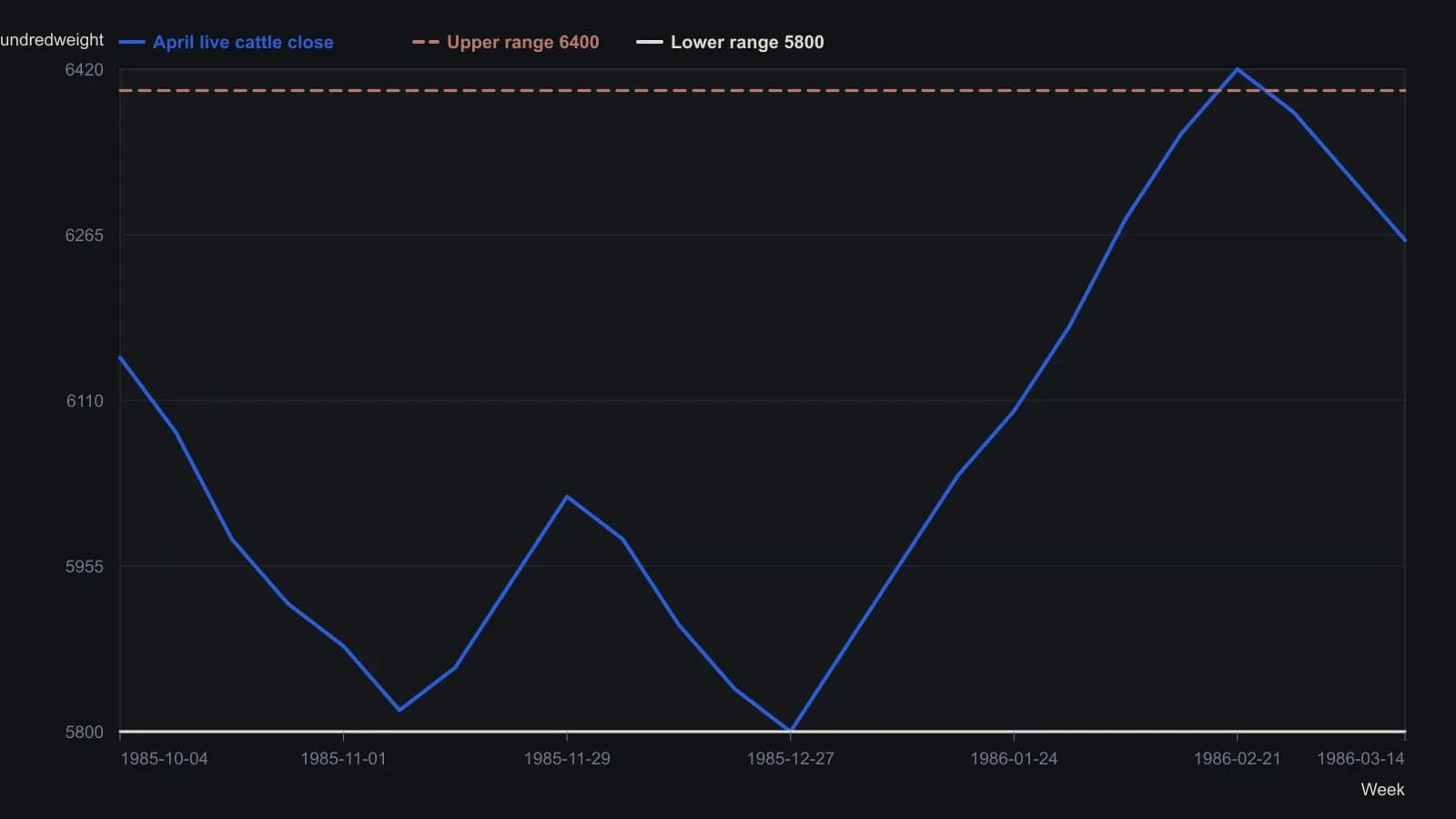
Closes only, about one point per weekly column. Strikes 5800 and 6400 are taken from the article, not estimated from the raster.
All readings on this track · 15 readings
- 1987Write the exclusion zone, then choose the structure
- 2001Straddles, strangles, and calendars in an index portfolio context
- 2006Event-week straddle and strangle construction with residual delta
- 2007Straddle versus strangle construction and a debit-spread cash audit
- 2010Critiquing event-priced straddles and expiration pin-risk
- 2010Placing an options strangle in the 2010 market regime
- 2010Short strangle construction from range, volatility and premium
- 2011Iron butterfly as packaged straddle and strangle
- 2012Calm as one testable trading procedure
- 2014Long-strangle premium hurdle and event volatility
- 2014Constructing short strangles as range income in futures options
- 2014Paired stop futures strangles fail on false breakouts
- 2015Construct a name-specific fear overlay before a short strangle
- 2016Financed protective puts, upside caps, and hedge timing
- 2017Hours, capital gates, and strangle margin on emini S&P options