2016issue C098-9
Liquidity filters, weighting rules, and index proxies in a same-category sleeve
A mid-2016 small-cap blend review compared six same-sleeve ETFs and screened tradability first. High average daily volume was the liquidity filter, equal weighting was a separate construction rule, and four distinct benchmarks showed that the funds were not interchangeable index proxies.
- The six-name table was a reduced working set inside a small-cap blend sleeve of more than 60 ETFs, not the full category.
- High average daily volume served as a liquidity filter because it was expected to coincide with narrower bid-ask spreads and faster execution.
- The equal-weight fund and one other name were removed on volume grounds, including a 1,150-share three-month average and a 16,566-share three-month average.
- After the filter, remaining candidates still differed in volume, expense ratio, fund size, holding count, and which index they proxied.
A working set, not the sleeve
A same-category sleeve is a group of funds labeled as one market segment, such as small-cap blend, that can still differ in benchmark, weighting, size, and tradability. A mid-2016 same-sleeve review compared six small-cap blend ETFs. The small-cap blend sleeve contained more than 60 ETFs, so the six-name table was a reduced working set rather than the full category.
Those six funds recorded four distinct underlying benchmarks, so they were not interchangeable index proxies. An index proxy is a listed fund used as a stand-in for a stated benchmark; two proxies in the same sleeve may still track different indexes.
Assets under management across the six funds ranged from 57.9 billion dollars to 39.6 million dollars. Assets under management is used here as a viability and capacity check rather than a forecast of results. Five of the six funds were market-capitalization weighted. The sixth used equal weighting and rebalanced quarterly.
Apply the liquidity filter first
A liquidity filter is a pre-trade screen that drops vehicles whose volume, spread, or book depth would make the intended order costly or unexecutable. The working method treated high average daily volume as a liquidity filter because it was expected to coincide with narrower bid-ask spreads and faster execution.
The equal-weight fund showed a three-month average daily volume of 1,150 shares in the comparison table and was removed on liquidity grounds. A second fund was also removed after the liquidity filter because its three-month average daily volume was 16,566 shares, even though other tabulated fields were not outliers.
Equal weighting is a construction rule that assigns the same weight to each holding and typically resets those weights on a fixed calendar. In this working set that rule belonged to one fund, and that fund was dropped on volume, not because equal weighting and cap weighting are the same.
Differences that survived the screen
After weak-volume names were dropped, remaining candidates still differed in three-month average daily volume from 804,961 shares to 28.6 million shares. They still differed in expense ratio, fund size, holding count, and which index they proxied.
Implementation cost is the spread, impact, and related friction paid to enter or exit a position, distinct from a fund's stated expense ratio. Editorial reading: surviving the volume screen does not make a remaining fund the sleeve. Name the index proxy, keep the weighting rule visible, and treat fund size as a capacity check rather than a result.
Cumulative gain for six small-cap blend ETFs, Dec 2010–Jun 2016
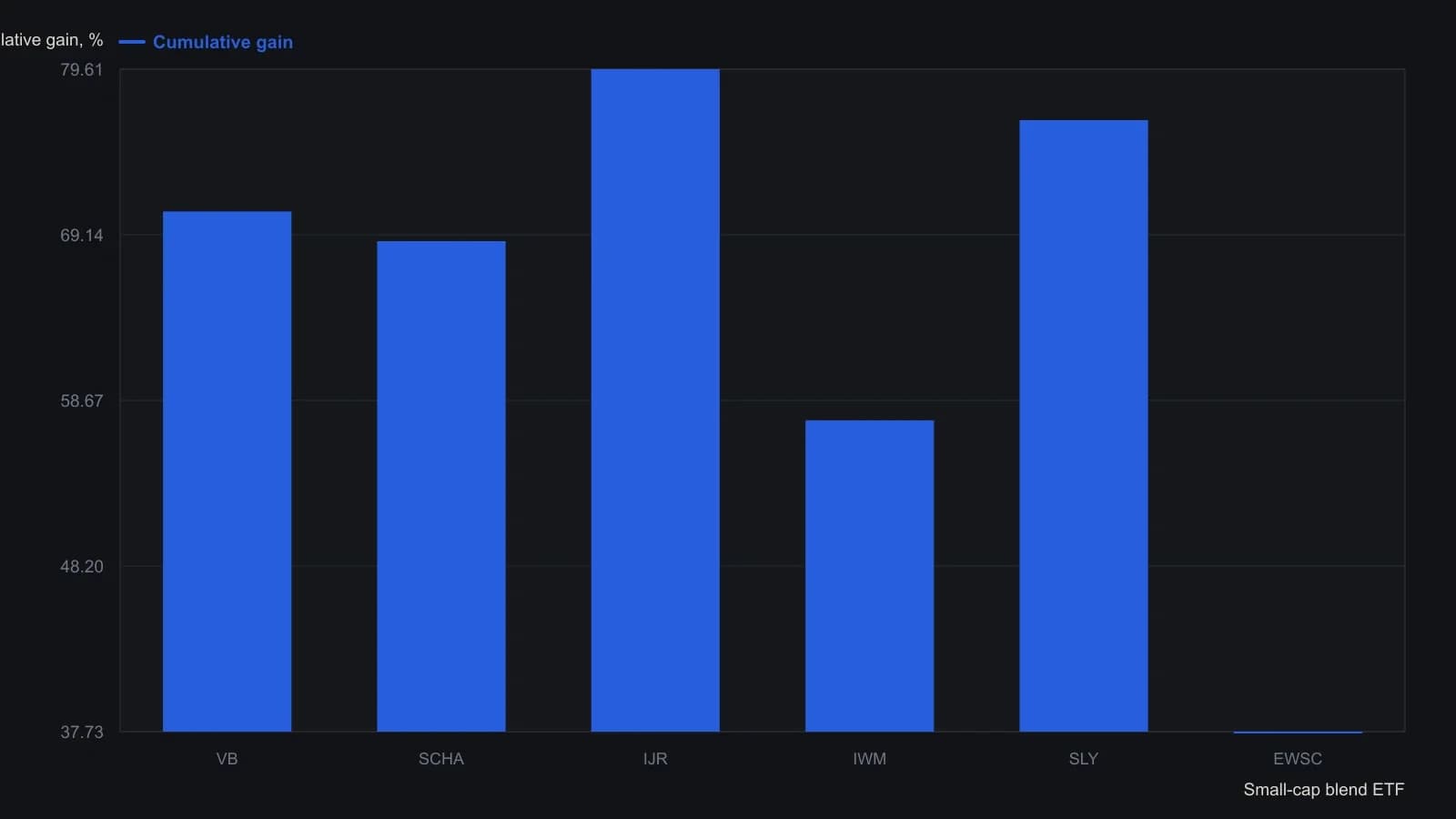
The plot covers 1,379 days from 30 December 2010 to 22 June 2016 as printed on the chart; the column dates the same window from 1 January 2011. EWSC is the only equal-weight fund and is rebalanced quarterly; the other five are market-cap weighted and do not share one benchmark.
All readings on this track · 10 readings
- 1992Evaluating equity sleeves against an index-proxy cost drag
- 1996Match a technology position to an index-proxy, then to a listed futures contract
- 2001Equal-weight pictures, rank rotation, and regime-aware allocation
- 2005Listed index baskets as allocation sleeves
- 2016A 9/36 inflation state for a commodity and dollar basket
- 2016Liquidity filters, weighting rules, and index proxies in a same-category sleeve
- 2018Values-screened ETF sleeves as an allocation case study
- 2019Equal-weight rank-rotation tests for a disclosed value book
- 2019High-dividend-paying ETFs as a portfolio-construction choice
- 2020A Nasdaq-100 proxy as a construction problem, not a ticker