2019issue C0230-33
Equal-weight rank-rotation tests for a disclosed value book
A concentrated value-investing book from a public holding series can be rebuilt with a delayed one-year-hold, scored by equal-weighting and by a capital-weighted-average, parked beside sector sleeves, and sliced with rank-rotation on the cheapest and lightest names.
- Equal-weighting scores a disclosed book by averaging each holding’s one-year return, so every name is one unit of analysis regardless of capital size.
- A capital-weighted-average of the same names lets large sleeves dominate the measured path.
- A thirteen-f-lag of about 45 days is why the evaluation delayed entry by two months and did not assume fills on the filing day.
- Rank-rotation of the five and fifteen lowest-priced names, and of the five and fifteen lowest-weighted names, tests whether cheap entry or light size changes the equal-weighted path versus the full-name book.
Read the book as a holding map
A long public institutional series from 2001 through 2016 can be rebuilt into a one-year-hold evaluation of a concentrated value-investing book. Value-investing, in this archive sense, means reading that book as a sector-and-name allocation map rather than as a short-term timing signal.
Those reports become public about 45 days after the report date. Because of that thirteen-f-lag, the evaluation delayed entry by two months and did not assume fills on the filing day. After the delay, the reconstructed names or sector baskets were kept for a one-year-hold and then rescored.
Score the same book two ways
Equal-weighting scores the disclosed book by averaging each holding’s one-year return as if every name were the same unit of analysis. Capital size does not change that count.
A capital-weighted-average scores the same book by multiplying each holding’s one-year return by its portfolio weight and dividing by the sum of those weights. Large sleeves then dominate the measured path.
Both scores use the same holdings and the same one-year-hold. One reading counts names as equal units. The other reading follows where the capital sat.
Park each sleeve beside its sector basket
Over that 15-year window the reconstructed book sat mainly in three sectors, with average weights near 38% finance, 36% consumer staples, and 6% information technology.
Sector context used nine long-running sector ETFs and omitted the then-new real-estate sleeve. Each stock group could then be compared with its matching industry basket rather than with a single market index.
The study’s premise was sector-first value-investing: locate where capital sat, then ask whether individual names or the matching sector ETFs carried the measured yearly path. A sector-sleeve is the portion of the book mapped to that basket, so a single name can be judged against its industry tide.
Sector sleeve weights in the disclosed book, 2001–2016
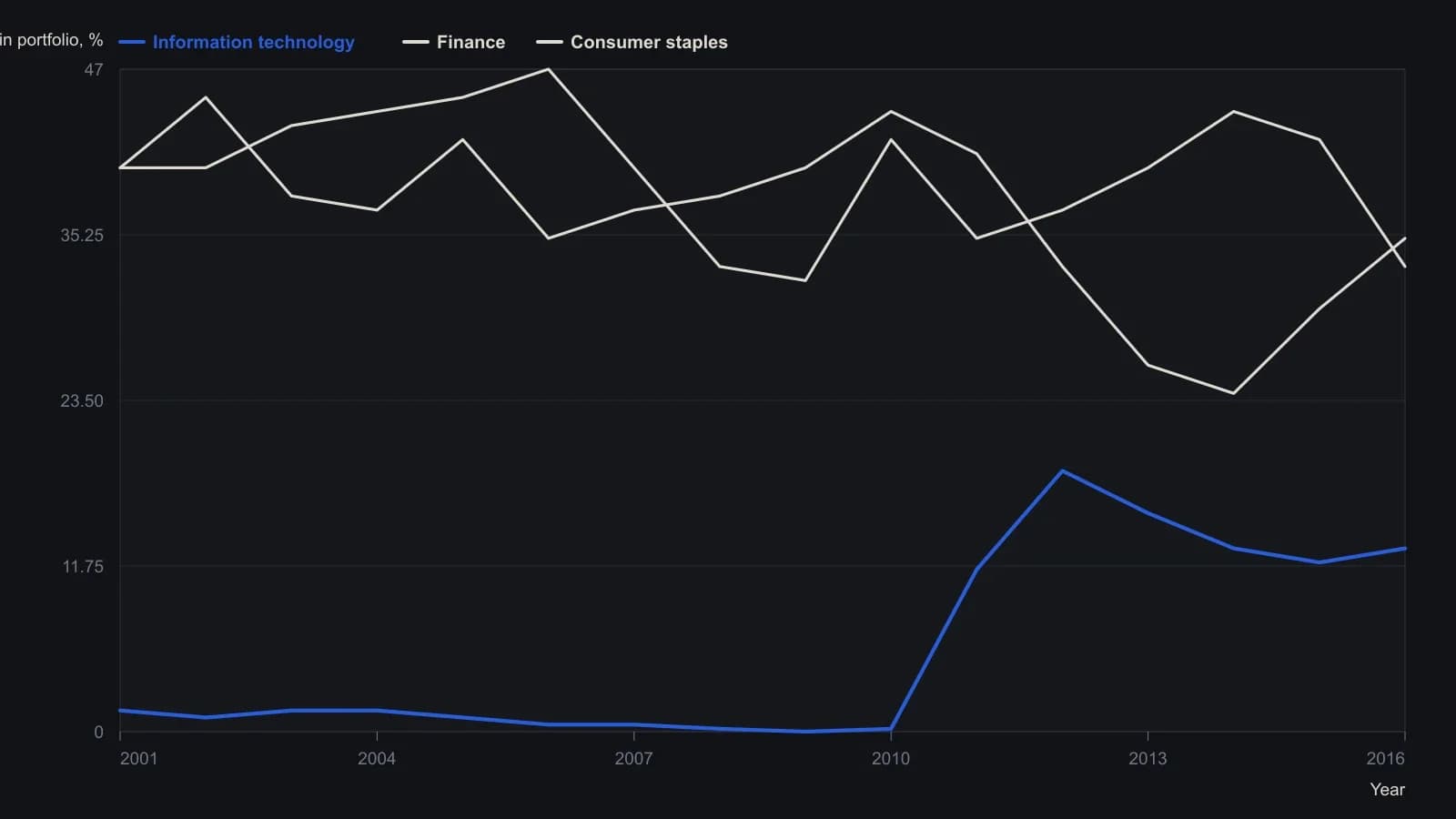
Copycat entries are lagged two months after each 13F. The real-estate sector ETF was omitted because it launched late in the sample. Bar heights are nearest 1 percentage point on the 0–50 sleeves and nearest 0.5 on the 0–20 technology sleeve.
Rotate the cheapest and the lightest names
Rank-rotation rebuilds the book from a short ranked slice, either the lowest entry price or the lowest position weight, and compares that slice with the full-name set over the same holding period.
One test took the five and fifteen lowest-priced names, equal-weighted them for one year, and asked whether entry-price rank changed the path versus the full-name book.
A parallel rank-rotation of the five and fifteen lowest-weighted names asked whether light position size, not only cheap price, produced a different equal-weighted path than the full book.
All readings on this track · 10 readings
- 1992Evaluating equity sleeves against an index-proxy cost drag
- 1996Match a technology position to an index-proxy, then to a listed futures contract
- 2001Equal-weight pictures, rank rotation, and regime-aware allocation
- 2005Listed index baskets as allocation sleeves
- 2016A 9/36 inflation state for a commodity and dollar basket
- 2016Liquidity filters, weighting rules, and index proxies in a same-category sleeve
- 2018Values-screened ETF sleeves as an allocation case study
- 2019Equal-weight rank-rotation tests for a disclosed value book
- 2019High-dividend-paying ETFs as a portfolio-construction choice
- 2020A Nasdaq-100 proxy as a construction problem, not a ticker