1997issue C011-9
Rule-based intraday system design with genetic search
A mechanical trading system can be written as two thresholded price-comparison rules plus a genetic search that tunes their inputs together. Solutions are judged by whether entries, exits, and abstention stay consistent on held-out periods, not by in-sample profit alone.
- The mechanical trading system enters the S&P 500 on the next open and exits at that same session close only when two thresholded price-comparison rules are both true.
- System optimization searches six inputs together with recombination, mutation, and selection instead of stepping every parameter combination.
- In-sample fitness is net profit on the training window, but solution choice also checks whether profitable trades are spread through the test period and whether withheld spans stay consistent.
- The reported systems take only intraday trades, are framed as multi-system portfolio candidates, and point toward letting the genetic search choose the rules themselves.
A mechanical trading system as one procedure
The mechanical trading system is an open-to-close S&P 500 procedure. It enters on the next open and exits at that same session close when two thresholded price-comparison conditions are both true. If either rule fails, the system abstains for that session.
Each rule compares two selected prices from the recent past and requires the first to exceed the second by a multiple of the average absolute difference between those prices. Rule-based entry, exit, and abstention are therefore tested as one object rather than as separate decisions.
Six inputs searched together
Six parameters are searched together: for each of the two rules, two lookback indices that pick the prices and one threshold multiplier. A genetic search that uses recombination, mutation, and selection is used instead of stepping every parameter combination, because a full grid over six inputs would produce an enormous number of trials.
The six inputs are therefore treated as system optimization of one mechanical trading system.
How solutions are chosen
In-sample fitness is defined as net profit on the training window. Solution choice also inspects whether profitable trades are spread through the test period rather than bunched in a few blocks.
The historical series is continuous back-adjusted end-of-day data, split so one window is in-sample and two other spans are withheld for out-of-sample checks. The author prefers solutions with fewer trades or less profit per trade when they show lower drawdowns and more consistent trading than the optimizer's raw fitness ranking.
Comparison with a hypothesis-based model
Relative to an earlier hypothesis-based model that allowed very tight stops but thin profit per trade, this empirically tuned model is described as having adequate profit per trade while being unable to use tight stops and showing higher drawdown.
The reported systems take only intraday trades and are framed as candidates for a multi-system portfolio rather than a finished standalone method. The planned next step is to let the genetic search choose the rules themselves, not only the parameters of two fixed price-comparison rules.
Half-year net profit of two genetically searched long-only S&P 500 rules
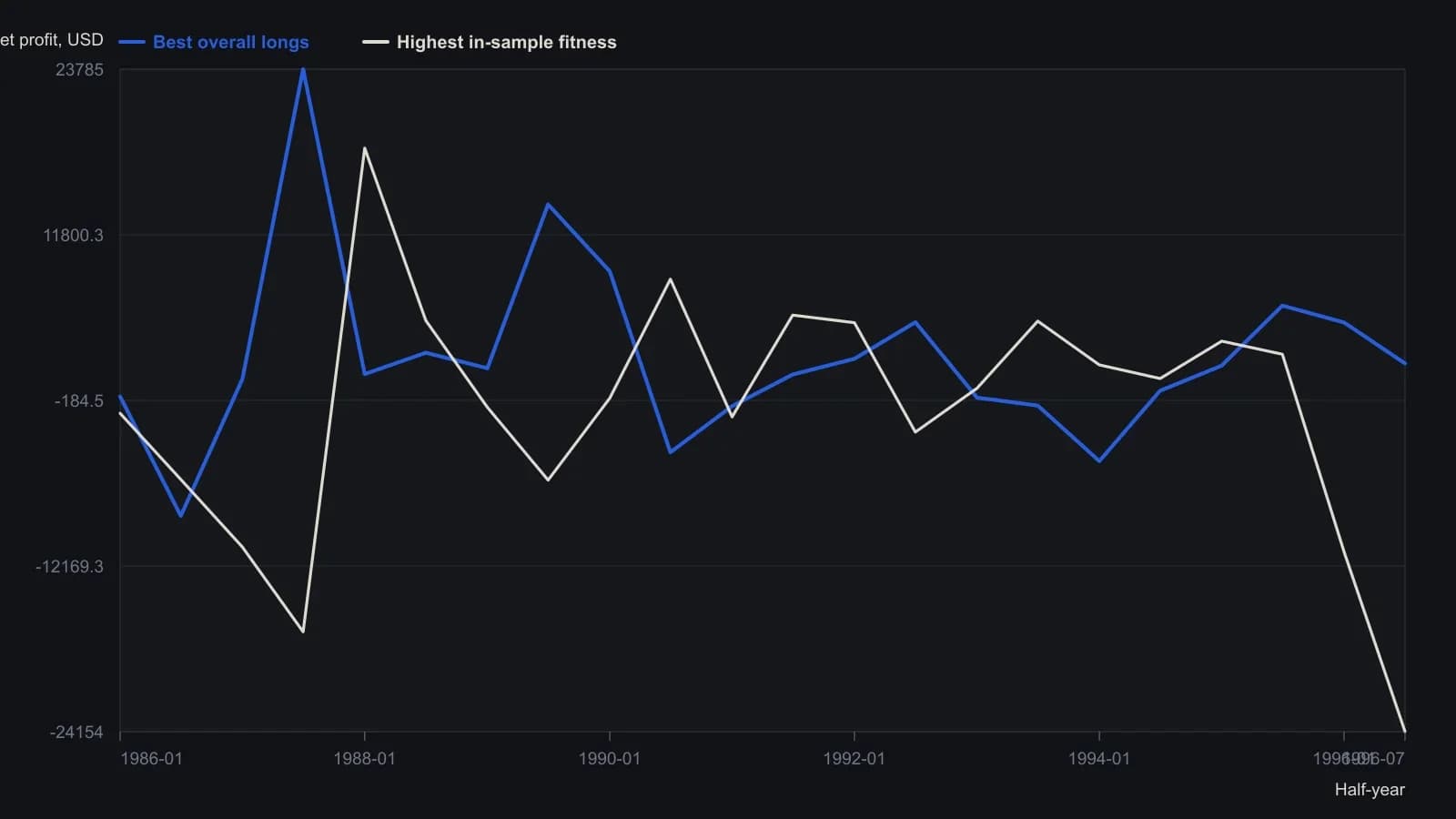
Fitness was in-sample net profit from 4 January 1988 through 30 December 1994. Half-years in 1986–87 and 1995–96 were held out. Assumed costs were a $30 round-turn commission and $75 slippage.
All readings on this track · 23 readings
- 1984Evaluating mechanical systems beyond net profit
- 1987Mechanical systems need more than pretty charts
- 1987Evaluating silver moving averages and RSI by scoring rule
- 1988Simple systems over optimized complexity
- 1988Cycle rule inputs until the parameter search stops
- 1990Split-sample tests for stochastic parameter grids
- 1993Four-subsystem trading system construction
- 1993Randomized price paths for stock system parameters
- 1994Mechanical timing with out-of-sample and filter checks
- 1995Evaluating asymmetric percent-reversal trading rules
- 1996Evaluating a daily volume-strength and new-high new-low timing procedure
- 1997Rule-based intraday system design with genetic search
- 1997Evolving three-rule systems with genetic templates
- 1997Audit the holdout and the exposure before the fitted entries
- 2001Inner weights are part of the candlestick signal
- 2003Mechanical short-term rules for news-sensitive rallies
- 2004Band construction as a testable trading procedure
- 2006Layered day-session automation from brackets to rules
- 2006Why mechanical rules must be retuned per security
- 2006A linear-regression next-bar forecast needs a searchable cutoff
- 2015Construct if-then rules, then backtest and optimize
- 2015Mechanical system design as a critique of discretion
- 2025Joint channel design with a trend filter and stop-loss orders