2004issue C071-6
Band construction as a testable trading procedure
A trading band is assembled from a smoothed center and a distance, then restated as one Mechanical trading system. Bandwidth, a volatility link, and a Trend filter become the controls, rather than extra exception rules.
- A usable center is made by averaging open, high, low, and close, then smoothing that series, because raw bar midpoints are too jumpy.
- The same band family can be written as a lower-bound entry, a short holding window, and a small profit target under explicit position-size and commission constraints.
- Narrower bands raise trade count, while profit and profit-per-bar typically peak at different widths, so width is a comfort tradeoff rather than a secret number.
- A later construction mixes a constant with live range and trend terms so a Trend filter can widen or tighten the band instead of sitting as a separate overlay.
Center and distance
A trading band is assembled from a center line that tracks the middle of the price series and a distance that places upper and lower boundaries around that center.
Raw bar midpoints are too jumpy for a usable center, so the construction first averages open, high, low, and close and then applies a smoother such as a simple, exponential, weighted, or asymmetrical moving average.
A constant-distance band can be drawn as a fixed percentage offset from a smoothed center, illustrated with a six-period exponential average of average price and a six-percent offset.
The band as a procedure
The same band family can be restated as a fully specified procedure: a lower-bound entry, a short holding window, and a small profit target, then executed under explicit position-size and commission constraints.
Width as a control
Bandwidth is an explicit control: a narrower band raises trade count, while profit and profit-per-bar typically peak at different widths, so the width can be chosen as a comfort tradeoff rather than a one-time secret number.
A single fixed optimal width is impractical because that width can change with the series and with time. Linking distance to a volatility estimate such as range or true range is presented as an automatic alternative to continual System optimization.
When a sample of names is compared at their chosen widths, higher measured volatility lines up with larger recorded profit, but the table does not yield a simple formula that maps volatility onto one universal bandwidth.
NXTL range-band profit versus bandwidth
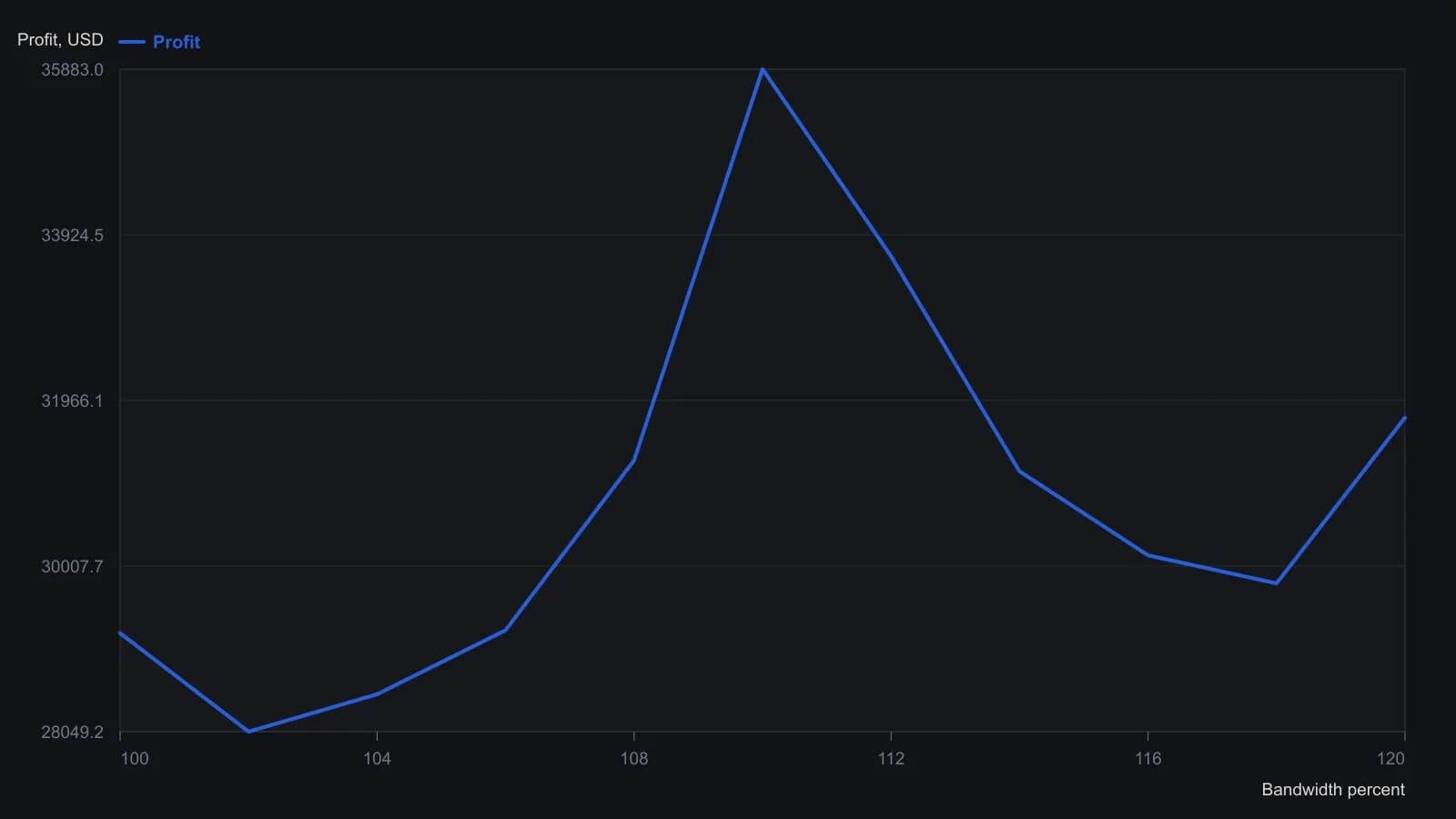
Wealth-Lab run on 1,000 daily bars with $100,000 start, $10,000 per trade, $10 one-way commission, a 1% profit target and a two-day timeout. Win/loss stayed between 78% and 82% across this sweep. Chart x is OptVar1, i.e. master bandwidth in percent. Printed bar labels use three decimal places (35,882.992 at 110 matches the 35882 NXTL figure in the article’s results table).
Trend inside the band
A later construction mixes a constant with live range and trend terms so that a trend reading, defined as the daily change of an optimal tracking filter, can widen or tighten the band instead of sitting as a separate overlay.
Editorial. That trend reading is the Trend filter in this construction. It changes bandwidth from inside the band rather than adding another overlay.
Exception rules as a poor habit
Patching isolated failure patterns with extra exception rules is described as a poor construction habit because a local fix often creates new failures elsewhere. Further work is directed at dynamic weights, extra scaled components, and nonlinear mixing rather than more special cases.
All readings on this track · 23 readings
- 1984Evaluating mechanical systems beyond net profit
- 1987Mechanical systems need more than pretty charts
- 1987Evaluating silver moving averages and RSI by scoring rule
- 1988Simple systems over optimized complexity
- 1988Cycle rule inputs until the parameter search stops
- 1990Split-sample tests for stochastic parameter grids
- 1993Four-subsystem trading system construction
- 1993Randomized price paths for stock system parameters
- 1994Mechanical timing with out-of-sample and filter checks
- 1995Evaluating asymmetric percent-reversal trading rules
- 1996Evaluating a daily volume-strength and new-high new-low timing procedure
- 1997Rule-based intraday system design with genetic search
- 1997Evolving three-rule systems with genetic templates
- 1997Audit the holdout and the exposure before the fitted entries
- 2001Inner weights are part of the candlestick signal
- 2003Mechanical short-term rules for news-sensitive rallies
- 2004Band construction as a testable trading procedure
- 2006Layered day-session automation from brackets to rules
- 2006Why mechanical rules must be retuned per security
- 2006A linear-regression next-bar forecast needs a searchable cutoff
- 2015Construct if-then rules, then backtest and optimize
- 2015Mechanical system design as a critique of discretion
- 2025Joint channel design with a trend filter and stop-loss orders