2010issue C0260-63
Neural-net pairs from a prediction spread
This archive article teaches pairs-trading as a two-step procedure. A constrained model first picks one predictor from a sector basket. The actual-predicted-spread then becomes shared long and short rules that can be tested as one system.
- Pairs-trading is framed here as two steps: a constrained network selects one sector predictor, then the actual-predicted-spread times a simultaneous long-short hedge.
- Neural-network-pair-matching lets a genetic optimizer choose the input and later set buy and sell thresholds, instead of a fixed two-standard-deviation rule.
- Loose-fit-prediction keeps a limited linear mapping so actual and predicted values still cross and separate enough to trade.
- Proxy-entry applies the same spread thresholds to both legs, with an unoptimized side flag, so the hedge is tested as one system.
A two-step pairs procedure
The case study frames pairs-trading as a two-step system. A neural net first predicts one stock from another name in the same sector. The gap between the actual price and that prediction then produces simultaneous long and short hedge signals on both names.
The method does not cross two normalized prices. It uses one stock to forecast another and times trades from the size and sign of the actual-minus-predicted difference. That difference is the actual-predicted-spread, and it becomes the entry, exit, and stop trigger.
How the predictor is chosen
A genetic optimizer can pick the predictor from a sector basket and later customize buy and sell thresholds for that pair. The case study does not rely on a fixed two-standard-deviation rule.
This is neural-network-pair-matching: a constrained one-input network lets the optimizer, not a prechosen pair, select which related security best predicts the target.
In the utility-sector example, the optimizer was limited to one input and zero hidden neurons. It therefore had to choose either Pepco or Southern Company as a linear predictor of Consolidated Edison.
After training, the network assigned Pepco a 100 percent contribution-factor and dropped Southern Company as the input for the Consolidated Edison prediction. With only one allowed input, that contribution-factor is the full share of the selected predictor in the trained model.
Why the forecast stays loose
The authors required a loose linear fit, not a highly accurate nonlinear one. The aim of loose-fit-prediction is that actual and predicted values still cross and then separate enough to define a tradable spread.
Because the actual close and the prediction sit in the same price range, the rules use the absolute difference of those two series. They do not normalize the two stock prices.
Actual versus predicted Consolidated Edison close
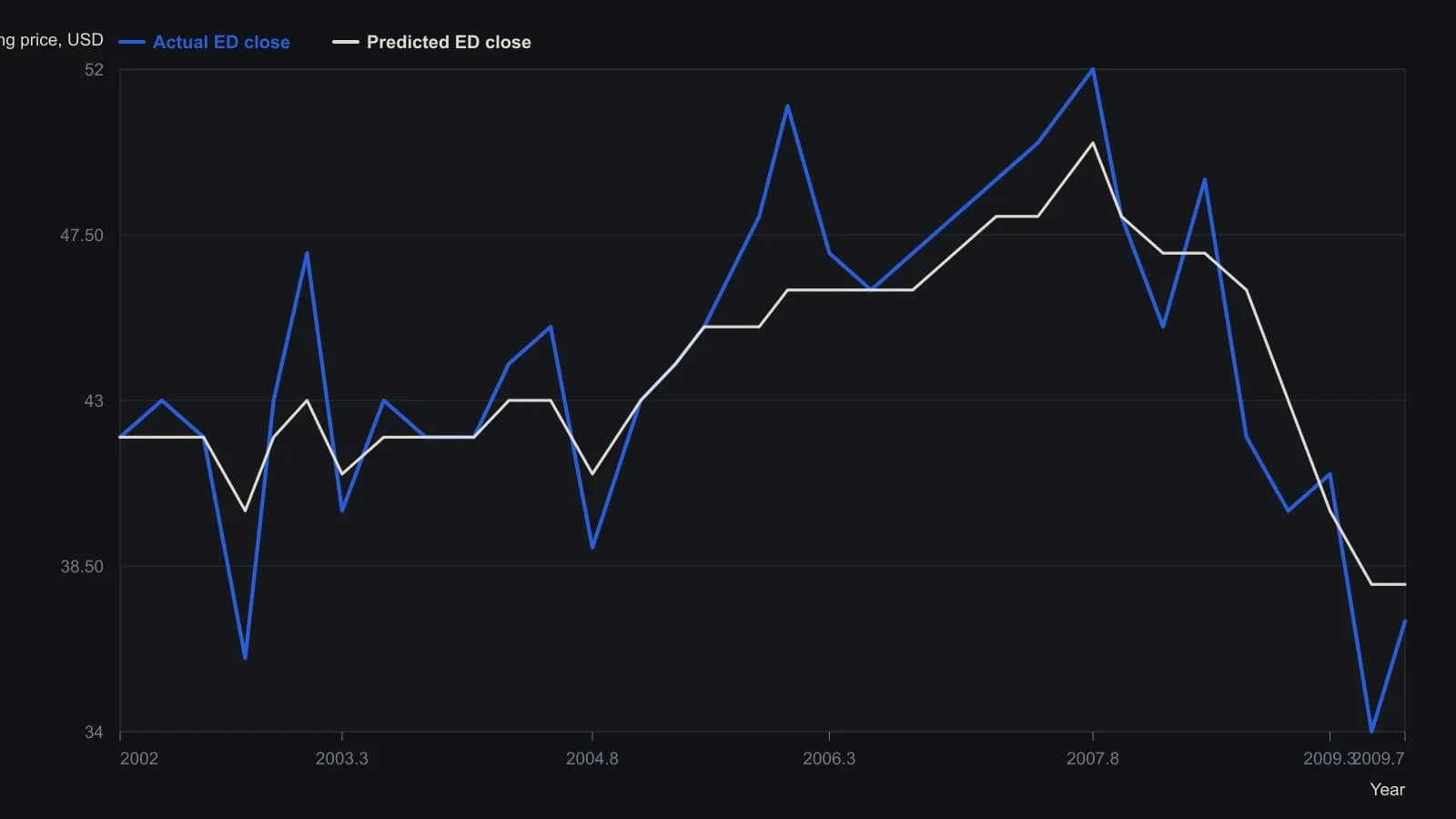
Approximate readings from the published raster, to the nearest dollar. The network was forced to a linear loose fit (zero hidden neurons, one input) so the forecast would diverge from the actual close.
Shared rules for the hedge
Both legs share the same proxy-entry parameters so entries fire together. The implementation keeps a +1 or -1 side flag unoptimized to track the simultaneous hedge. The hedge is therefore entered and exited as one pairs-trading procedure.
Search ranges supplied for the shared rules were an entry spread of 2 to 4, an exit spread of 0.01 to 1.9 as the series reconverge, and a rarely hit stop exit of 4.1 to 6.
All readings on this track · 17 readings
- 1994Evaluating rsi-ratio bands on a linked currency-spread
- 2001Control over capital in the trader decision process
- 2004Three after-close filters on a two-basket pairs procedure
- 2005Constructing pairs trades with capitalization-adjusted spreads
- 2005Sequential pairs execution with liquidity leans
- 2007Constructing pair-spreads as one testable instrument
- 2007Hybrid tape sweeps, pairs triggers, and fair-value cash-and-carry
- 2010Neural-net pairs from a prediction spread
- 2010Rebate parking fails a private-fund checklist
- 2013Ranked pre-trade checklist for pairs and moving averages
- 2014Long-only ETF sleeves for trend-switch construction
- 2014Isolated setups versus a testable pre-trade procedure
- 2017Macro theme ETF pairs and the nightly review
- 2018October as a regime worksheet for pairs, seasonals, and bands
- 2019A pair system checklist for entry, hold, and abort
- 2019Failed-break rules for pairs and supervised systems
- 2020Deal structure sets the residual in a cash-and-stock mega-deal