2020issue C0260-61
Deal structure sets the residual in a cash-and-stock mega-deal
An illustrated North American mix of cash and stock shows why the live deal-spread can be a merger-arbitrage completion book, a pairs-trading inventory around the contractual ratio, or a cash-and-carry-arbitrage financing residual. Editorial reading: write those three methods as one entry, exit, and abstention procedure.
- US mega-merger announcements increased in the final quarter of 2019 while merger activity elsewhere declined, against a backdrop of nearly $4 trillion of 2019 deal volume.
- The illustrated contract paid $120.30 in cash plus 0.866 acquirer shares for each target share, and the deal-spread had a worked starting value of $14.7662.
- Stock and mixed-stock contracts lock one share price to the other, so merger-arbitrage and pairs-trading share the same residual: live deviations from the contractual relationship.
- Editorial reading: put a collar, a floating-ratio, a competing bid, the blow-up-path, and weekend-announcement-risk inside one entry, exit, and abstention procedure.
The 2019 backdrop and one mixed contract
US mega-merger announcements increased in the final quarter of 2019 while merger activity elsewhere declined, against a backdrop of nearly $4 trillion of 2019 deal volume.
One illustrated North American mega-deal was structured as $120.30 in cash plus 0.866 acquirer shares for each target share. The illustrated offer implied a 45% premium to the target close on 24 June 2019.
How the deal-spread is written
For a mixed cash-and-stock contract, the deal-spread equals the exchange ratio times the acquirer price, minus the target price, plus the cash component. The worked starting value was $14.7662.
The deal-spread is generally expected to decay toward completion and to approach zero if the transaction closes. Dividends paid on the timeline can shift the spread level.
Announcement-day gaps can unwind toward the pre-deal relationship if the contract is canceled. That cancellation route is the blow-up-path.
Which residual the structure creates
Merger-arbitrage is a completion-linked spread book that treats the announced mix of cash, stock, time, and cancellation paths as one residual to fade, hold, or stand aside from.
Pairs-trading is inventory around a contractual or statistical link between two names, here the merger ratio, so entry, exit, and abstention are defined on the residual, not on either stock alone.
Cash-and-carry-arbitrage is a financing comparison that prices locked-in delivery at a known date against the cost of holding the underlier until that date.
Cash-only mergers typically compress target-stock volatility, leaving cash-and-carry-arbitrage as a comparison of holding cost with a borrowing rate that institutions can fund more cheaply than individual accounts.
Stock or mixed-stock contracts lock one share price to the other, so pairs-trading and merger-arbitrage share the same residual: live deviations from the contractual relationship.
When the residual is no longer a fixed ratio
A competing bid can push the spread negative early by lifting the target. Later, residual risk shifts from calendar decay toward cancellation or regulatory blow-up as the close date nears.
Issuers may attach a collar or a floating-ratio, sometimes reset over the last ten sessions before close, so the pairs-trading hedge ratio is not a fixed share count. A collar is a contractual band on the stock value delivered for the target, which forces the exchange ratio to move when prices move. A floating-ratio is an exchange ratio recalculated from recent prices rather than fixed at announcement.
Merger announcements cluster on Mondays and after long weekends, so weekend-announcement-risk for a pair exceeds ordinary weekday overnight risk.
ABBV–AGN cash-and-stock deal spread after the June 2019 announcement
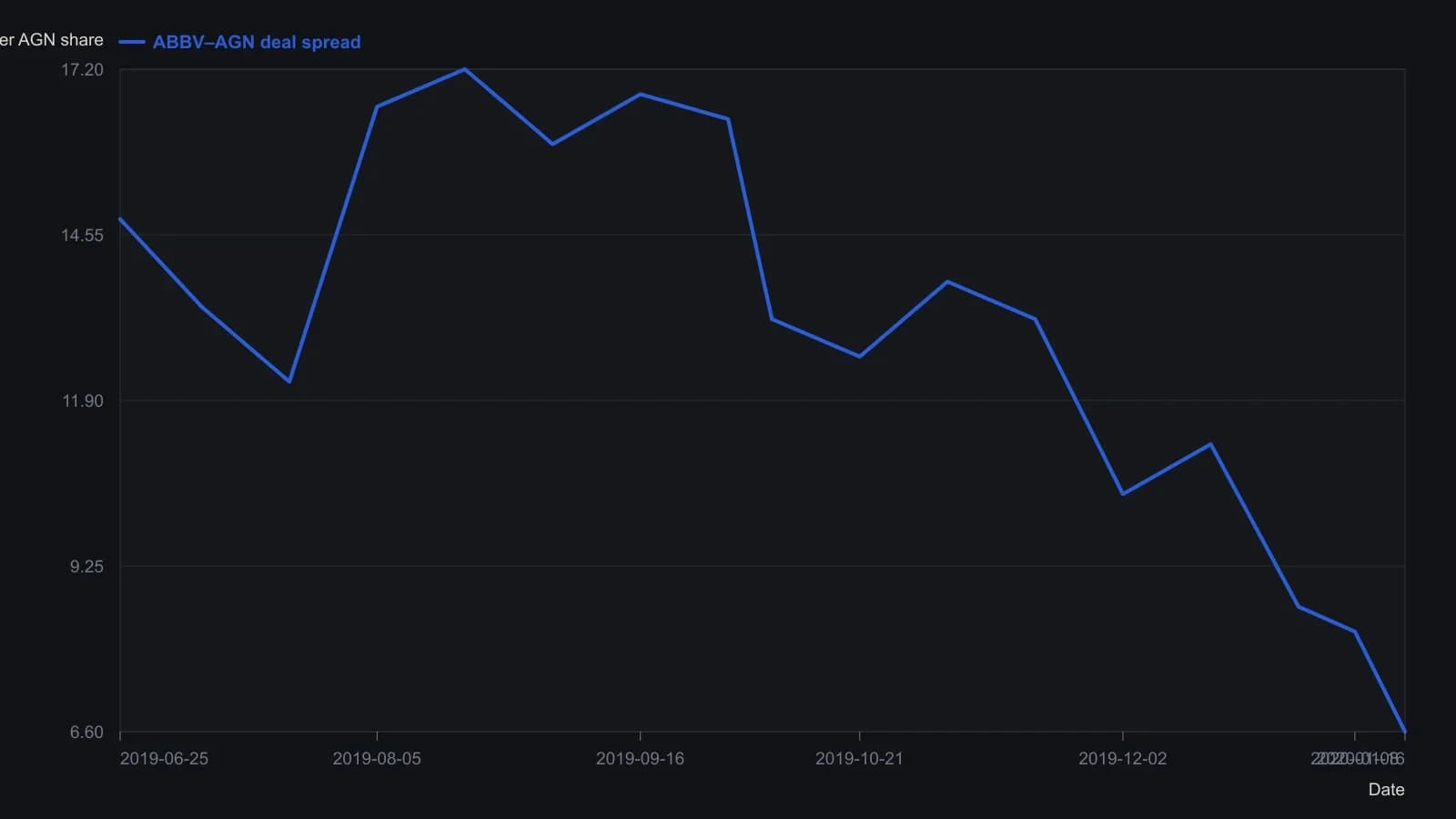
Spread formula used for the plotted series: (0.866 × ABBV) − AGN + $120.30 cash. Digitized from the raster; y-values are approximate to about 0.25. The source notes that dividends payable during the timeline can alter the printed spread.
One entry, exit, and abstention procedure
Editorial reading: keep merger-arbitrage, pairs-trading, and cash-and-carry-arbitrage in a single procedure. Fade or hold the deal-spread while the announced mix remains intact. Define inventory on deviations from the contractual relationship, not on either name alone. Compare holding cost with a borrowing rate only when delivery is locked at a known date.
Editorial reading: a lean-position uses the contractual twin as a hedge so one name can be overweighted while the merger remains intact. Stand aside when a collar or floating-ratio is still resetting, when a competing bid has replaced the original residual, or when weekend-announcement-risk dominates inventory. The blow-up-path is an exit or abstention test, not a second chart.
Editorial reading: a sympathy-move is a peer-group reaction to a target announcement that need not persist and need not help competitors. It is not the deal-spread and does not belong in the same book.
All readings on this track · 17 readings
- 1994Evaluating rsi-ratio bands on a linked currency-spread
- 2001Control over capital in the trader decision process
- 2004Three after-close filters on a two-basket pairs procedure
- 2005Constructing pairs trades with capitalization-adjusted spreads
- 2005Sequential pairs execution with liquidity leans
- 2007Constructing pair-spreads as one testable instrument
- 2007Hybrid tape sweeps, pairs triggers, and fair-value cash-and-carry
- 2010Neural-net pairs from a prediction spread
- 2010Rebate parking fails a private-fund checklist
- 2013Ranked pre-trade checklist for pairs and moving averages
- 2014Long-only ETF sleeves for trend-switch construction
- 2014Isolated setups versus a testable pre-trade procedure
- 2017Macro theme ETF pairs and the nightly review
- 2018October as a regime worksheet for pairs, seasonals, and bands
- 2019A pair system checklist for entry, hold, and abort
- 2019Failed-break rules for pairs and supervised systems
- 2020Deal structure sets the residual in a cash-and-stock mega-deal