1994issue C091-7
Evaluating rsi-ratio bands on a linked currency-spread
Two closely linked European currencies were framed as one pairs-trading problem: hold opposite sides so the question is whether the pair resumes its usual parallel path, not which way both markets move. After intermarket-analysis showed the spots traveling together, one market's relative-strength-index was divided by the other's to form an rsi-ratio read through signal-band rules.
- Two closely linked European currencies were framed as one pairs-trading problem: hold opposite sides so the question is whether the pair resumes its usual parallel path, not which way both markets move.
- A visual overlay of the two spot series over the last six months of 1993 was used as intermarket-analysis that the currencies traveled together, while the currency-spread still showed intervals of trend and was judged a weak standalone indicator.
- Subtracting two relative-strength-index readings was judged no more useful than comparing the markets one at a time; dividing them produced an rsi-ratio that generally oscillated around 1.
- A close above 1.2 sold the numerator and bought the denominator until the rsi-ratio left that signal-band; 0.85 was preferred on the lower side after 0.80 produced only four signals in more than four years.
One pair, opposite sides
Two closely linked European currencies were framed as one pairs-trading problem. Opposite sides were held so the question was whether the pair resumed its usual parallel path, not which way both markets moved.
Listed currency futures and listed options on spot quotes were identified as practical venues for the comparison. Spot series were used for the study because listed contracts were said to track those quotes closely.
Confirm the shared path
A visual overlay of the two spot series over the last six months of 1993 was used as intermarket-analysis evidence that the currencies traveled together, while the subtracted currency-spread still showed intervals of trend.
From 1 January 1990 through 31 May 1994 the currency-spread was defined as the higher-quoted currency minus the other. Its average sat a little under 9 and observed differences ran from about 4 to more than 15. The short-term gap itself was judged a weak standalone indicator.
Editorial: intermarket-analysis reads the two markets together so the currency-spread is judged inside a shared regime of tandem movement rather than as an isolated directional bet.
From two oscillators to one rsi-ratio
Editorial: a relative-strength-index is a lookback oscillator built from ordered price observations. Each market's reading is kept as a same-scale input so two series can be compared without forecasting either market's next move on its own.
After several momentum comparisons, subtracting the two relative-strength-index readings was judged no more useful than comparing the markets one at a time.
Dividing one market's relative-strength-index reading by the other's produced an rsi-ratio that generally oscillated around 1, with an average of 1.01, a high of 1.41, and a low of 0.72.
Swiss franc RSI divided by Deutschemark RSI, mid-1993 to early 1994
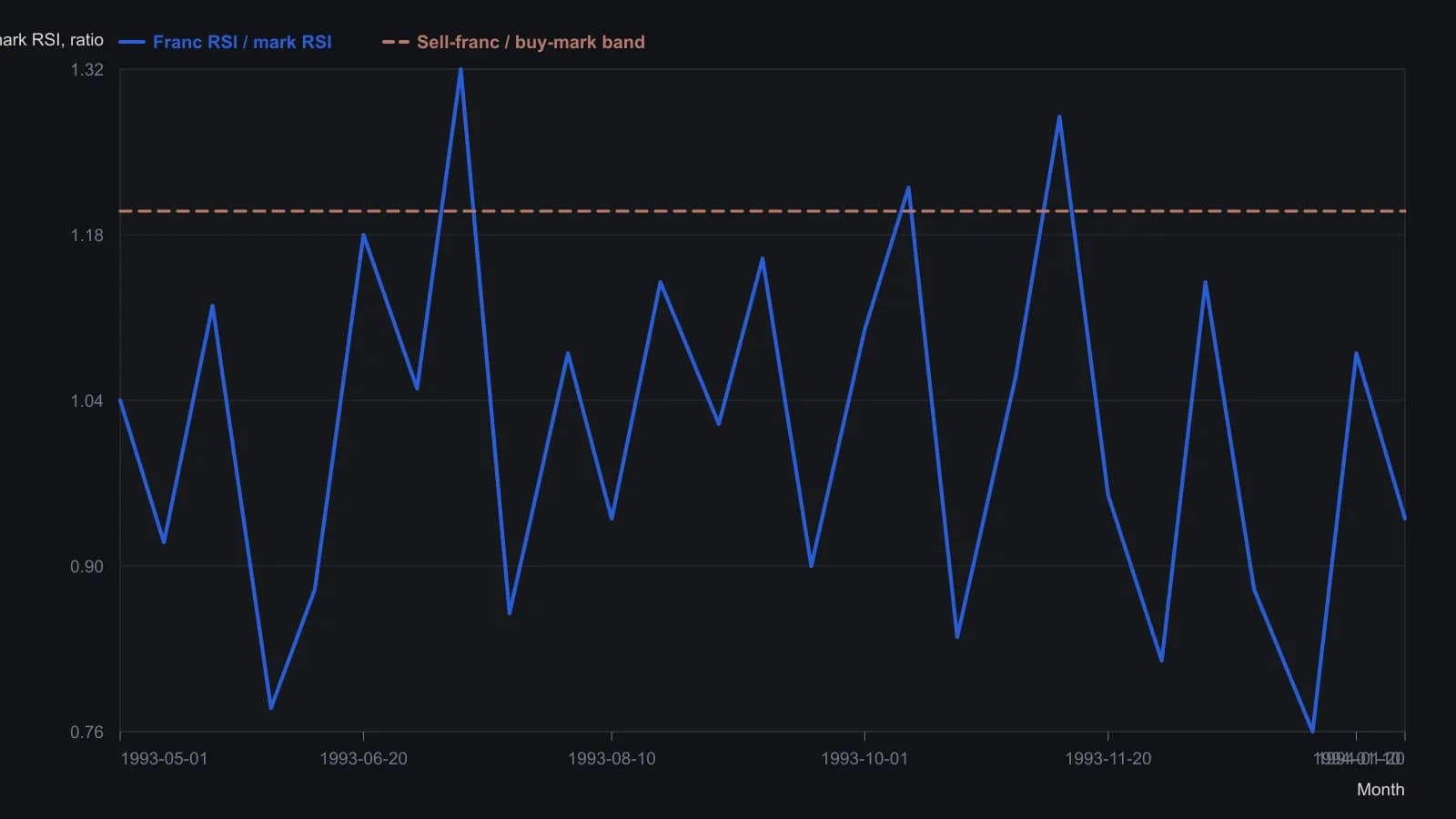
Source tested January 1, 1990–May 31, 1994; ratio = Swiss franc RSI / Deutschemark RSI. Average 1.01, high 1.41, low 0.72. Sell/buy-mark trigger at 1.20; buy-franc/sell-mark originally 0.80, later 0.85 after 0.80 produced only four trades.
One signal-band for entry and exit
A closing rsi-ratio above 1.2 was treated as a pairs-trading signal to sell the numerator market and buy the denominator market, with the position held until the ratio left that signal-band.
The mirrored lower band was first set at 0.80 and produced only four signals in more than four years. A level of 0.85 was then used as the preferred long-numerator, short-denominator trigger, with exit when the ratio moved back above 0.85.
Across both bands the historical procedure produced 35 trades in a little more than four years.
Editorial: pairs-trading here is a single procedure that treats entry, exit, and abstention as one rule set over the system holding period.
The same construction on other tandem markets
The same relative-strength-index ratio construction was described as reusable on other regionally linked exchange rates and on other tandem instruments such as related agricultural futures or jointly moving rates and equities.
All readings on this track · 17 readings
- 1994Evaluating rsi-ratio bands on a linked currency-spread
- 2001Control over capital in the trader decision process
- 2004Three after-close filters on a two-basket pairs procedure
- 2005Constructing pairs trades with capitalization-adjusted spreads
- 2005Sequential pairs execution with liquidity leans
- 2007Constructing pair-spreads as one testable instrument
- 2007Hybrid tape sweeps, pairs triggers, and fair-value cash-and-carry
- 2010Neural-net pairs from a prediction spread
- 2010Rebate parking fails a private-fund checklist
- 2013Ranked pre-trade checklist for pairs and moving averages
- 2014Long-only ETF sleeves for trend-switch construction
- 2014Isolated setups versus a testable pre-trade procedure
- 2017Macro theme ETF pairs and the nightly review
- 2018October as a regime worksheet for pairs, seasonals, and bands
- 2019A pair system checklist for entry, hold, and abort
- 2019Failed-break rules for pairs and supervised systems
- 2020Deal structure sets the residual in a cash-and-stock mega-deal