2004issue C021-4
Three after-close filters on a two-basket pairs procedure
A trade is allowed only after the close when the broader index basket finishes higher and also leads the narrower basket on both close-to-close percentage price change and closing-volume percentage change. In the archive sample that three-filter sequence qualified on 29 of 334 sessions.
- A trade is allowed only after the close when the broader basket finishes higher, its close-to-close percentage price change exceeds that of the narrower basket, and its closing-volume percentage change also exceeds that of the narrower basket.
- The three-filter closing procedure was eligible on 29 of 334 sessions from January 1, 2002 through April 30, 2003, or 8.68 percent of days, about one playing day every 11.52 sessions.
- The procedure places orders between 16:00 and 20:00 ET, and any premarket placement must occur before the next session moves away from the prior close, so discretionary regular-hours timing is not required.
- Editorial: TradersWeek treats that scarcity as a system-design choice, so rule-based entry, overnight exit, and abstention are tested as one mechanical trading system rather than as a daily signal stream.
Three filters after the close
The archive describes a mechanical trading system whose rule-based entry is a pairs-trading sequence on two index baskets. A trade is allowed only after the close when the broader basket finishes higher, its close-to-close percentage price change exceeds that of the narrower basket, and its closing-volume percentage change also exceeds that of the narrower basket.
Price change is the close-to-close percentage move. Volume change compares the session's volume with an eight-day simple moving average of volume.
That three-filter closing procedure was eligible on 29 of 334 sessions from January 1, 2002 through April 30, 2003, or 8.68 percent of days, about one playing day every 11.52 sessions.
Orders after the regular close
The procedure places orders between 16:00 and 20:00 ET. Any premarket placement must occur before the next session moves away from the prior close, so discretionary regular-hours timing is not required.
Background volume, spreads, and range
From January 2, 2002 in the sample, average daily volume was 85 million shares for the narrower basket and 34 million for the broader basket, with regular-session spreads described as generally less than a penny.
In that background window the narrower basket's average high-low range was 0.975, or 3.5 percent of a 28.22 average close, while the broader basket's average range was 1.97, or 2.0 percent of a 96.77 average close.
Tabulations on the 29 signal days
On the 29 signal days, a 100-share overnight short of the narrower basket was tabulated at a 32.62 average, a 43 median, and a 62.07 percent positive-day share, with the seven highest scores summing to 872 against a 458 cumulative figure for the seven lowest.
A same-day 100-share long in the broader basket paired with a 300-share short in the narrower basket was tabulated at 784, described as a 0.015 percentage figure, using a close-price ratio near 3.39 to 1.
Next-session closes after the 29 three-filter days
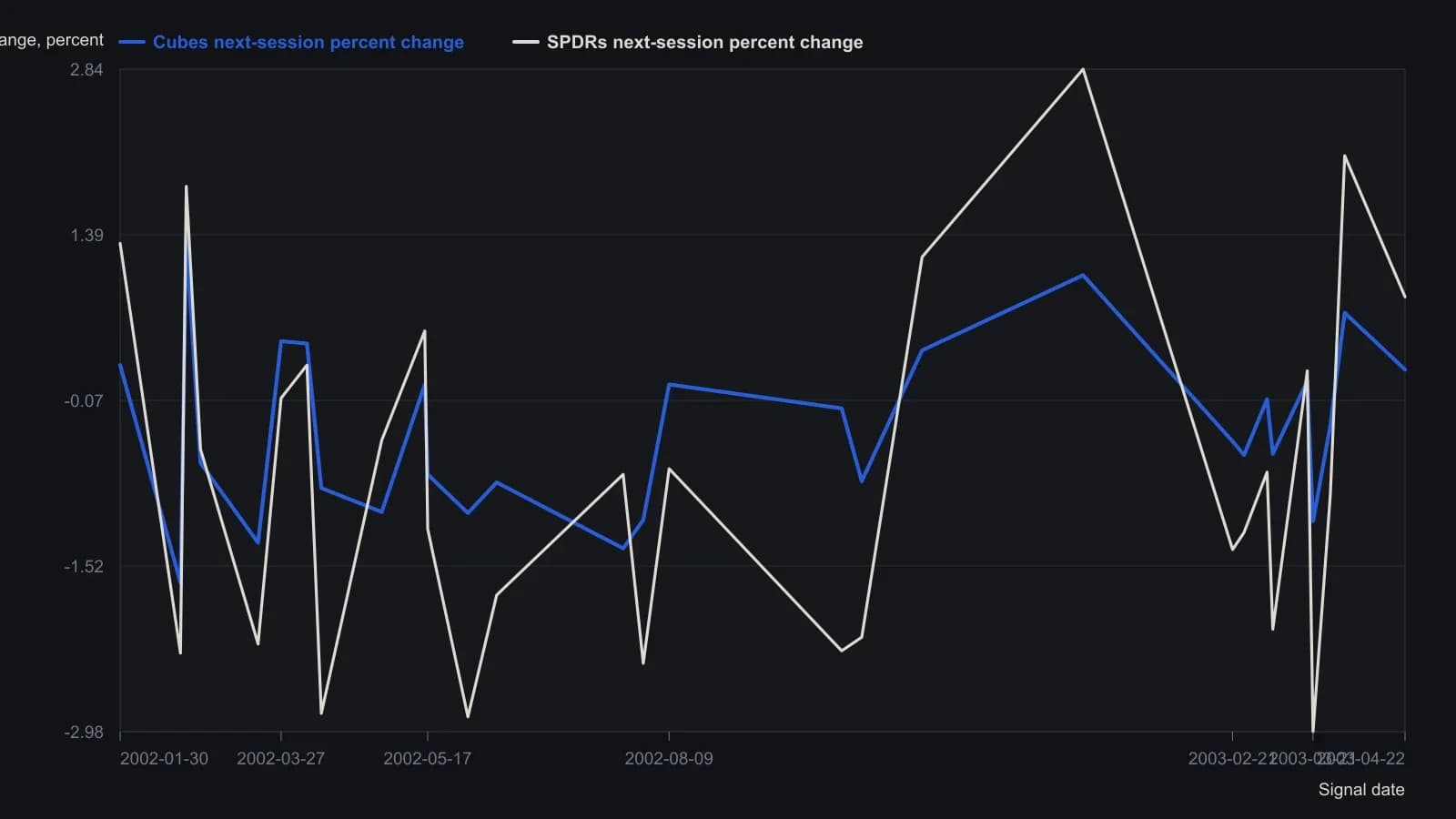
A signal required a higher SPDR close, a larger SPDR close-to-close percentage gain than QQQ, and a larger SPDR closing-volume percentage change than QQQ. Trades are marked from that close to the next session’s close. The source listed the 29 rows newest first; dates here run in calendar order. Sample window is 1 January 2002 through 30 April 2003 (29 of 334 sessions).
A later window and a rising path
Eligible-day frequency rose from 20 of 289 sessions, or 6.92 percent, through February 20, 2003 to 9 of 48 sessions, or 18.75 percent, from February 21 through April 30, 2003, with the later window's tabulated success rate at 66.67 percent versus 55.55 percent earlier.
While the narrower basket rose 12.56 percent from 24.37 on December 31, 2002 to 27.43 on April 22, 2003, the short-the-narrower-basket rule was still tabulated at a 2 percent figure. The archive used that window as a case that the same abstention-plus-signal sequence can be examined when the underlying path is higher.
All readings on this track · 17 readings
- 1994Evaluating rsi-ratio bands on a linked currency-spread
- 2001Control over capital in the trader decision process
- 2004Three after-close filters on a two-basket pairs procedure
- 2005Constructing pairs trades with capitalization-adjusted spreads
- 2005Sequential pairs execution with liquidity leans
- 2007Constructing pair-spreads as one testable instrument
- 2007Hybrid tape sweeps, pairs triggers, and fair-value cash-and-carry
- 2010Neural-net pairs from a prediction spread
- 2010Rebate parking fails a private-fund checklist
- 2013Ranked pre-trade checklist for pairs and moving averages
- 2014Long-only ETF sleeves for trend-switch construction
- 2014Isolated setups versus a testable pre-trade procedure
- 2017Macro theme ETF pairs and the nightly review
- 2018October as a regime worksheet for pairs, seasonals, and bands
- 2019A pair system checklist for entry, hold, and abort
- 2019Failed-break rules for pairs and supervised systems
- 2020Deal structure sets the residual in a cash-and-stock mega-deal