1989issue C051-4
Evaluating public versus member short-sale breadth
Headline short-sale totals mix public and member activity. Splitting those totals, then smoothing a public-to-member ratio and a three-part composite, turns who is shorting into a testable breadth reading.
- Member short sales are the sum of specialist, floor-trader, and other-member short sales; public short sales are the published total minus that sum.
- A high public-to-member ratio means the public is more pessimistic than members and is treated as a constructive breadth signal.
- A high reading on the three-part short-sales composite means heavier professional shorting relative to public shorting and is treated as a negative regime signal.
- Both constructions use a two-week reporting lag and named exponential moving averages applied to the participant split.
Split the published total
Editorial reading: evaluate short-sale breadth by who is shorting, not by the headline total. The published total is only the starting figure.
Published exchange short-sale totals can be split into specialist, floor-trader, and other-member components. Summing those three isolates member short sales. Subtracting that sum from the published total isolates public short sales.
The public-to-member ratio
A ratio of public short sales to member short sales is constructed so that a high reading means the public is more pessimistic than exchange members. That high reading is treated as a constructive breadth signal.
The public-to-member ratio is smoothed with a 22 percent exponential moving average. Each new average combines 22 percent of the newest observation with 78 percent of the prior average.
The three-part short-sales composite
A three-part short-sales composite is defined as (A+B)/C, where A is an 18 percent exponential average of specialist shorts as a share of total shorts, B is a 29 percent exponential average of member shorts as a share of total shorts, and C is an 18 percent exponential average of public shorts as a share of total volume.
In that composite, a high reading means heavier professional shorting relative to public shorting and is treated as a negative regime signal.
Historical readings as described
On the New York public-to-specialist series, the first half of 1983 was described as a negative reading associated with the 1984 industrial-average decline, the last half of 1986 as a constructive reading ahead of the 1987 advance, and the first half of 1987 as a downturn to a four-year low before the August peak.
The American public-to-specialist series was described as offering no useful lead before the 1985-86 advance or before the 1987 crash, while remaining strongly constructive through 1988.
The three-part composite was described as negative in the middle of 1983 ahead of the 1984 decline, constructive in the last half of 1986 ahead of the 1987 industrial-average rise, unhelpful before the 1985 advance and the 1987 crash, and constructive through 1988.
Editorial reading: those descriptions are mixed. The participant split and the named smoothers are the objects under evaluation, not a settled lead time.
NYSE public/specialist short-sale ratio, 1983–1988
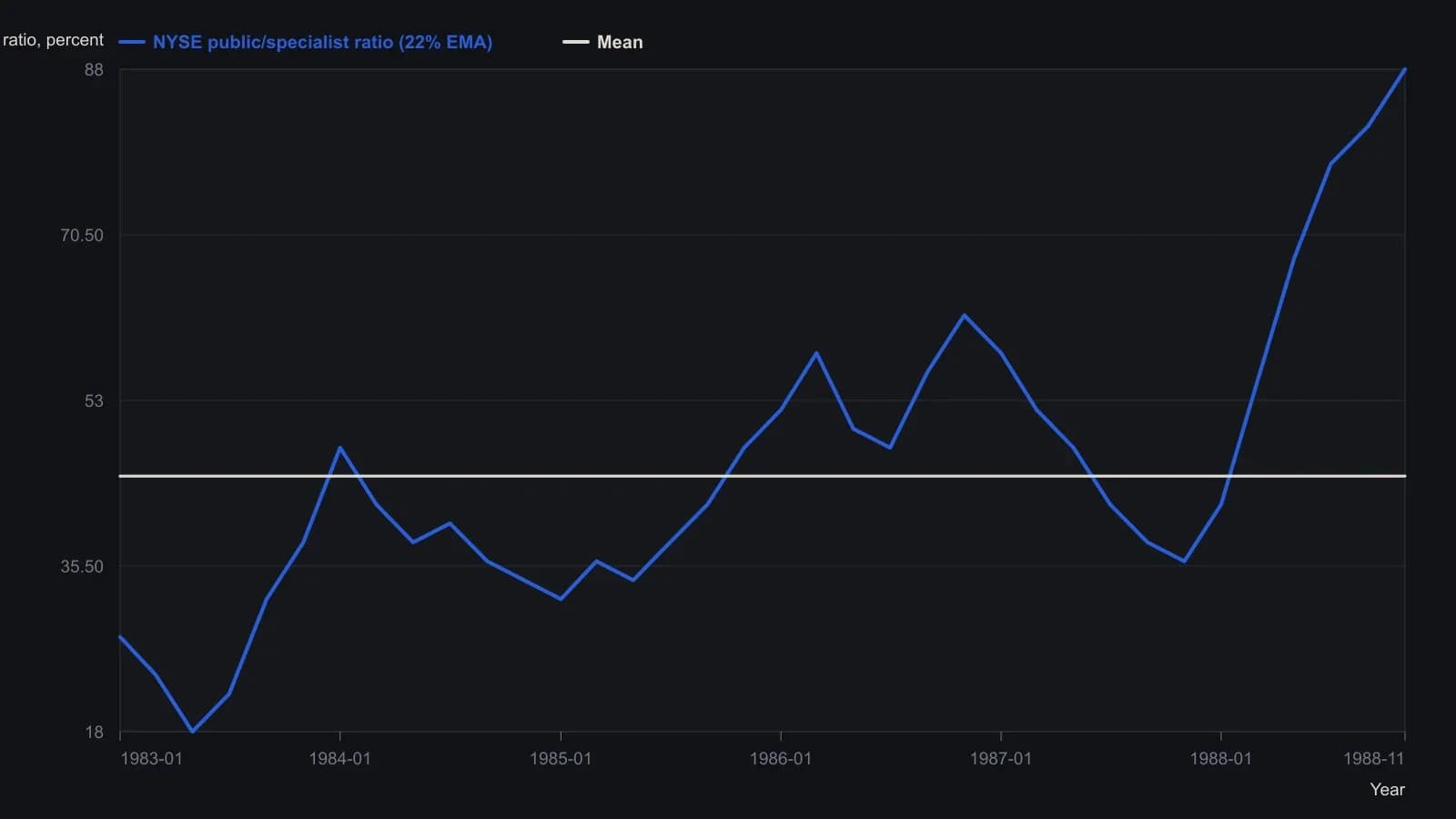
Merrill applies a 22% exponential moving average (new value = 0.22 × latest statistic + 0.78 × prior average). High readings mean the public is more pessimistic than specialists and are treated as bullish; dashed lines mark the mean and ±1 standard deviation.
All readings on this track · 21 readings
- 1988Classifying primary futures for regime-aware trades
- 1989Odd-lot short interest as a constructed breadth series
- 1989Volume-scaled member versus public short sales as a two-class classroom test
- 1989Evaluating public versus member short-sale breadth
- 1989Lock smoothing inside each short-share before the breadth ratio
- 1989Headline intensity as a three-horizon contrarian filter
- 1989Evaluating technical-fund open interest and daily volatility
- 1990Constructing fund cash and manager-preference filters
- 1990Stock-style futures rules miss index-spread drivers
- 1991Constructing short-squeeze pain from interest and margin
- 1995Contrary sentiment and put-call premiums around large Dow swings
- 1995Act on a pattern change, not on formula signals
- 2002Single-stock futures: contract selection and the margin box
- 2003A crowd fade needs an insider-pattern divergence gate
- 2005A quiet insider tape as a seasonal regime case
- 2006Unwritten pit cues need testable rules
- 2010A gold corrective-phase case after the 1265 high
- 2014Ticket charges, margin carry, and bank liquidity limits
- 2014A liquidity filter for majors, crosses, and exotics
- 2017Test a high-low forecast as one procedure, then cut the book
- 2020Follow or fade as one trading procedure