1991issue C121-3
Constructing short-squeeze pain from interest and margin
The archive treats a latest-versus-prior-month short-interest print as incomplete. A longer short-interest history is joined to price and volume, then current price is scaled to the margin-rule must-cover price. Editorial note: those two inputs are taught here as a construction that lets crowded losers be compared across names and groups.
- A latest-versus-prior-month short-interest print is treated as incomplete. A crowded, losing book is judged from a longer short-interest history joined to price and volume.
- Short-interest intensity locates the current ratio between that name or group's own historical low and high, with a new high at 100 percent and a new low at 0 percent.
- A squeeze prospect is treated as minor unless a sizable short book exists and price has already moved against it.
- Level of pain is current price as a fraction of the must-cover price. The farther price has advanced against a historically significant short book, the more covering pressure is inferred.
A single short-interest print is incomplete
A latest-versus-prior-month short-interest print is treated as incomplete. Judging a crowded, losing book requires a longer short-interest history joined to price and volume.
A standalone short-interest ratio is less informative than the same ratio placed in that stock or group's own short-selling history. A 3.65 group ratio is presented as more informative when it is also the highest reading in more than four years.
Short-interest intensity
Short-interest intensity is the current short-interest ratio located between that name or group's own historical low and high. A new high sits at the top of the scale. A new low sits at the bottom.
A current ratio of 2 between a high of 3 and a low of 1 is a 50 percent reading. A new high is a 100 percent reading. A new low is a 0 percent reading. Any reading above 30 percent is treated as a material short book if price then rises sharply.
Squeeze prospect and short-book opinion
A squeeze prospect is the joint reading of a historically large short book and price already advancing against it. The prospect is treated as minor unless a sizable short book exists and price has already moved against it.
A relatively high short book is read as bearish participant opinion. A light short book is read as optimism. That short-book opinion is the crowded-short stance, not a price forecast on its own. Rising pain is expected to bring covering-related buying as shorts exit.
Level of pain against the must-cover price
Level of pain is current price expressed as a fraction of the theoretical price at which exchange margin rules would force most established shorts to cover. That theoretical price is the must-cover price: the margin-implied price at which most shorts in the book would have to close, given where those shorts were established.
With shorts established near 130, a must-cover price at 160, and a current price of 140, the reading is 0.87. The farther price has advanced against a historically significant short book, the higher the constructed pain reading and the more covering pressure is inferred.
Worked example of short level of pain versus the must-cover price
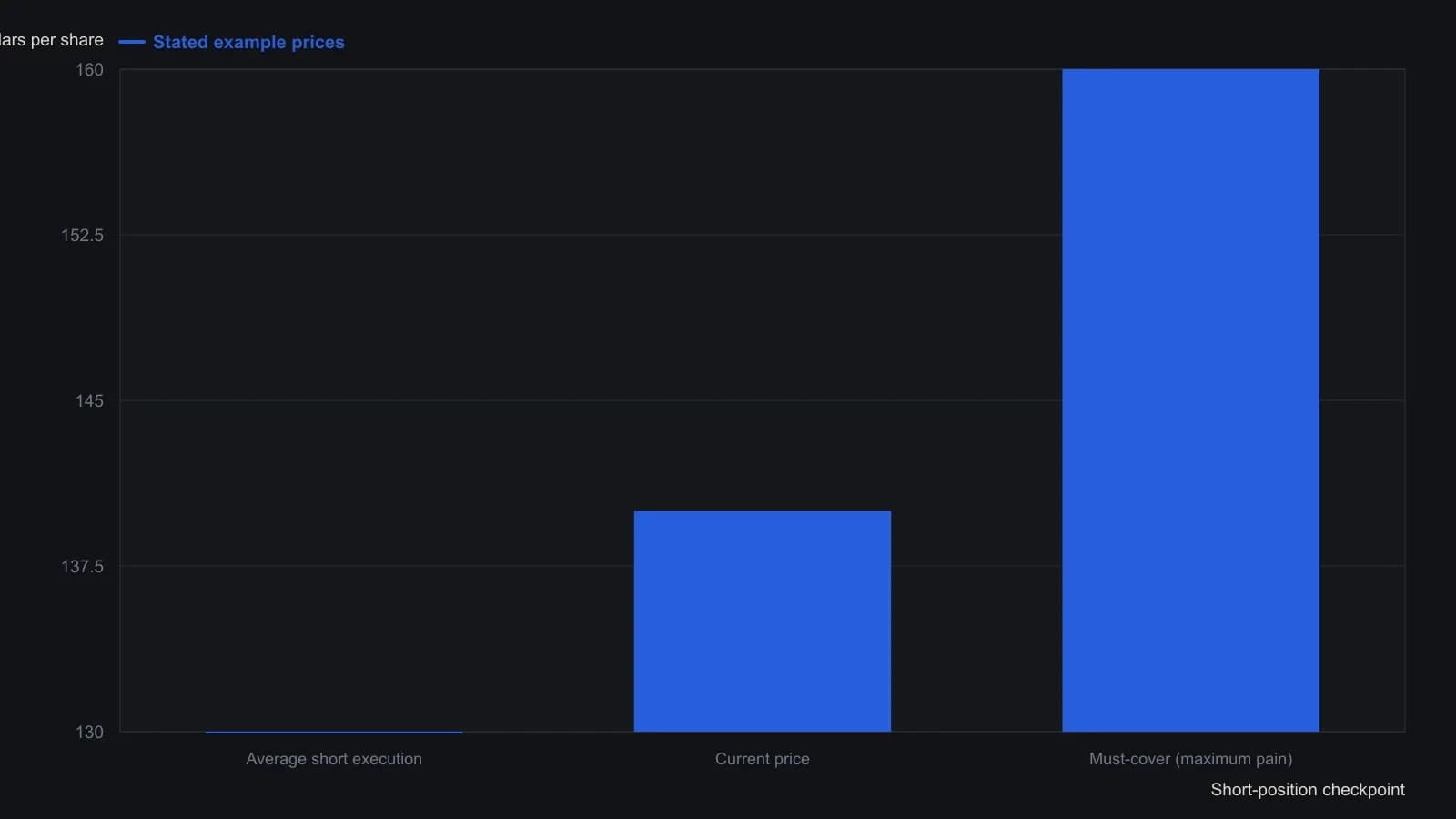
Level of pain is current price divided by the theoretical NYSE-margin must-cover price; the sidebar computes 140/160 = 0.87. The dollars are a teaching example, not a named stock.
All readings on this track · 21 readings
- 1988Classifying primary futures for regime-aware trades
- 1989Odd-lot short interest as a constructed breadth series
- 1989Volume-scaled member versus public short sales as a two-class classroom test
- 1989Evaluating public versus member short-sale breadth
- 1989Lock smoothing inside each short-share before the breadth ratio
- 1989Headline intensity as a three-horizon contrarian filter
- 1989Evaluating technical-fund open interest and daily volatility
- 1990Constructing fund cash and manager-preference filters
- 1990Stock-style futures rules miss index-spread drivers
- 1991Constructing short-squeeze pain from interest and margin
- 1995Contrary sentiment and put-call premiums around large Dow swings
- 1995Act on a pattern change, not on formula signals
- 2002Single-stock futures: contract selection and the margin box
- 2003A crowd fade needs an insider-pattern divergence gate
- 2005A quiet insider tape as a seasonal regime case
- 2006Unwritten pit cues need testable rules
- 2010A gold corrective-phase case after the 1265 high
- 2014Ticket charges, margin carry, and bank liquidity limits
- 2014A liquidity filter for majors, crosses, and exotics
- 2017Test a high-low forecast as one procedure, then cut the book
- 2020Follow or fade as one trading procedure