1989issue C081-7
Evaluating mechanical seasonal date rules for commodity spreads
A commodity spread can be treated as one mechanical procedure whose fixed calendar dates decide entry, exit, and sitting out. The evaluation question is whether date pairs that passed a perfect multi-year seasonal screen still produce a result in the next year after costs.
- A commodity spread pairs a long futures position with a short in the same or a related market so the legs offset and intended risk is lower than an outright position.
- The calendar-date screen kept only entry and exit pairs that were profitable in every year of the in-sample window, then applied those dates to the year-ahead holdout.
- Date pairs that were always profitable in the prior window did not reliably stay profitable the next year after costs, and no group mean was significantly greater than zero.
- The evaluation did not test stop-loss exits or an extra technical confirmation as conditions for initiating a spread.
A commodity spread is a paired position
A commodity spread is a long futures position paired with a short in the same or a related market. The legs are taken so they offset each other rather than expressing a one-sided directional bet, and intended risk is lower than an outright position.
The archive workflow treated that pair as one mechanical procedure. Fixed calendar dates set entry and exit. Date pairs that failed the historical profit rule were not used.
Three spread classes
Three classes are distinguished. An intramarket spread is a long in one contract month and a short in another month of the same commodity. An intercommodity spread is a long in one product and a short in a related product. An intermarket spread is a long in a commodity on one exchange and a short in the same commodity on another exchange.
Dollar value versus one-to-one
When contract units differ, the legs are compared as dollar values rather than raw prices. That dollar spread is used when the two legs are not the same size or unit.
Most tests still used a one-to-one spread, holding one contract against one contract, despite disagreement over hedge ratios.
How the calendar-date screen worked
The mechanical procedure scanned fixed calendar entries and exits. It kept only date pairs that were profitable in every year of a five-year in-sample window. Those dates were then applied to the following year, the year-ahead holdout.
Candidate dates were the 7th, 15th, 22nd, and last session of each month, rolled to the next trading day when needed. The scan used closing prices over the seven months before the nearer contract expired.
Sample, costs, and the group mean-profit test
The sample was 50 spreads, 10 each from grains, meats, metals, interest rates, and currencies. Limited history shortened Eurodollar and Treasury-note screens to three years instead of five.
Net results subtracted an assumed 120 dollars per spread round turn, 60 dollars per leg, for commission and slippage. Close-only trades in thin contracts could cost more.
A group mean-profit test, run as a two-tailed t-test, asked whether each 10-spread group mean differed from zero after costs.
What the year-ahead holdout showed
Date pairs that were always profitable over the prior five years did not reliably stay profitable the next year. No group mean was significantly greater than zero. Year-to-year results varied widely, and drawdowns were described as large.
Holdout-year net profit by commodity group
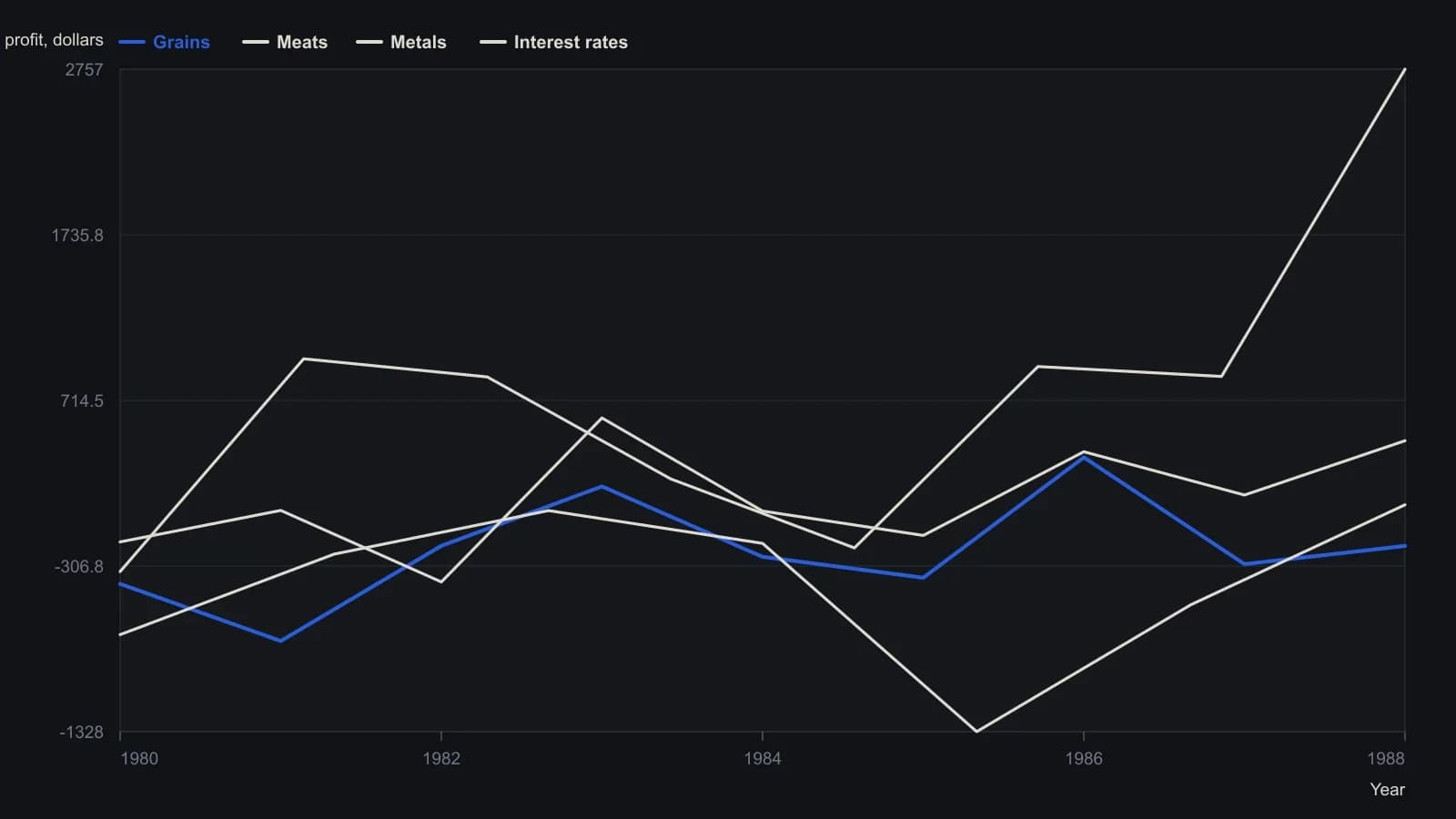
Each year’s dates are those that made money in all five preceding years, then simulated only on the next year. Commission is $120 per spread. Metals have no 1980 row; interest-rate spreads start in 1982. Currencies are omitted because only four series can be drawn; that group’s table values average −74 dollars over 1982–1988.
Conditions that were not tested
The evaluation did not test stop-loss exits or an extra technical confirmation as conditions for initiating a spread.
All readings on this track · 17 readings
- 1987Seasonal commodity spreads as portfolio slots
- 1987Underwriting a seasonal livestock calendar spread
- 1987Calendar gates for outright seasonal portfolios
- 1988Relative strength spreads against a commodity index
- 1989Evaluating mechanical seasonal date rules for commodity spreads
- 1991Regime gates for intermarket and spread trades
- 1997A decision-logic filter for the July-November soybean spread
- 1997Seasonal wheat and corn spread windows
- 1997Seasonal filters for corn-wheat spread breakouts
- 1998Be rich or be right: when only a written checklist counts as a system
- 1998Seasonal stock-index windows beyond the January effect
- 1999Same-maturity quality sleeves from a credit tunnel
- 2002Intraday sector pairs hedged as one spread
- 2006Seasonal regimes versus one-off news in commodity and rate spreads
- 2006Calendar spreads as an unknown-fundamentals regime filter
- 2008Placing early 2008 grain futures on a historical range map
- 2017Quiet tape as a construction window for multi-leg energy spreads