2002issue C031
Intraday sector pairs hedged as one spread
A historical pairs-trading case treated the gap between two sector names as the only position. Entry waited on a leanable-book, a hedging-strategy completed the second leg, and every add or cover was managed as one spread-ticket.
- Pairs-trading booked a correlated price gap as one instrument: sell the richer name, buy the cheaper name, and flatten when the prices meet.
- A first leg was initiated only against a leanable-book. If that bid or offer was missing, the setup was left untouched.
- If the first name failed in a short window, the hedging-strategy sold the second name on the bid so the book became one marked differential.
- Adds, covers, and stands were worked from an order-envelope on that differential, the same commodity-spread-trading habit as fading a channel edge.
Two sector names, one gap
The archive describes a pairs-trading case that used two highly capitalized pharmaceutical names in the same sector, MRK and LLY, because their historical prices tracked each other and had crossed the same level more than once.
The starter pairs-trading construction sold the richer name and bought the cheaper name, then planned to close both legs when the two prices met. Both legs were marked as one spread-ticket, not as two separate stock opinions.
No leanable-book, no first leg
A first leg was initiated only if a bid or offer in the other name could be leaned on. That live second-name bid or offer is the leanable-book. If it was not present, the pairs-trading setup was left untouched.
The hedging-strategy is the completion rule for the second leg. If the first name did not move as expected in a short window, that hedge was hit: the second name was sold on the bid so the book became a sold pair marked as one differential, illustrated at 5.00, instead of an unhedged single name.
That marked spread could then be scaled near 5.50 or covered near 4.50. Adds and exits were decided from the differential, not from either name's story.
Channel edges as one instrument
A pair that stayed inside a 4.00 to 6.00 channel was handled like support and resistance on a single instrument. That is the commodity-spread-trading habit of working the differential at the channel edges, so fade or scale decisions stay one signal rather than two outright views.
AOL versus VIA as a sold spread
One watched pair, AOL versus VIA, had a printed gap between 3.50 and 6.80. As that gap approached 6.00 while the broader tape weakened, the harder-to-borrow name, the hard-side, was sold short and later covered at a lower price, more than once.
When that short could not be bought back and the gap widened, the other name was bought so the position remained a sold spread near 6.00.
The recounted case scaled to three 2000-share spread units with sells near 5.80, 6.31, and 6.88, then bought the 6.88 unit near 6.25 and the remaining two near 5.00 after the gap began to narrow.
A full-session order-envelope
Working the book required a full-session order-envelope of buy and sell orders so entry, add, cover, and abstention stayed one procedure.
AOL versus VIA: three sold spread units and their covers
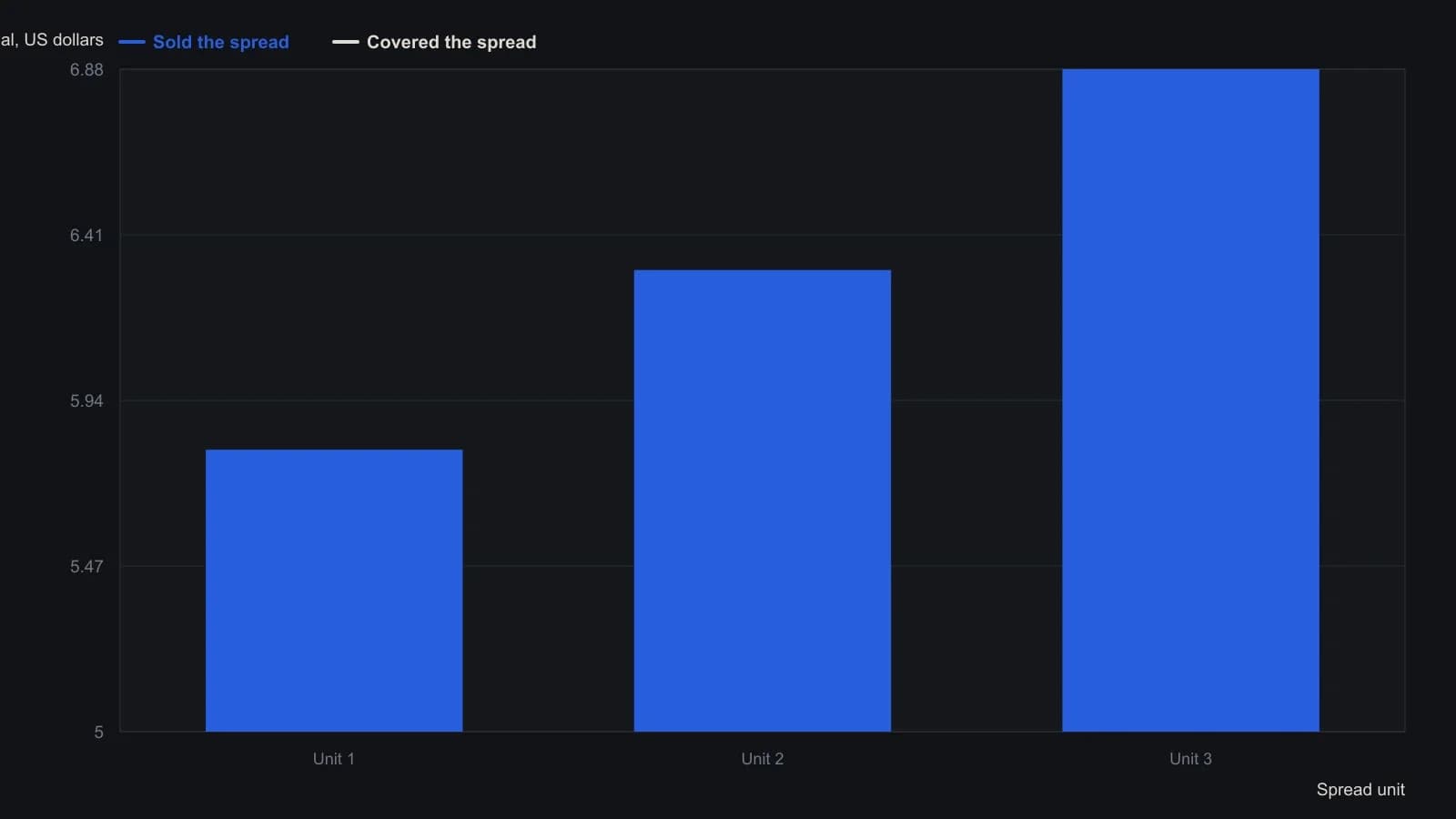
Sale prints were given from memory (“if I recall”). Covers on the first two units were stated only as around $5.00.
All readings on this track · 17 readings
- 1987Seasonal commodity spreads as portfolio slots
- 1987Underwriting a seasonal livestock calendar spread
- 1987Calendar gates for outright seasonal portfolios
- 1988Relative strength spreads against a commodity index
- 1989Evaluating mechanical seasonal date rules for commodity spreads
- 1991Regime gates for intermarket and spread trades
- 1997A decision-logic filter for the July-November soybean spread
- 1997Seasonal wheat and corn spread windows
- 1997Seasonal filters for corn-wheat spread breakouts
- 1998Be rich or be right: when only a written checklist counts as a system
- 1998Seasonal stock-index windows beyond the January effect
- 1999Same-maturity quality sleeves from a credit tunnel
- 2002Intraday sector pairs hedged as one spread
- 2006Seasonal regimes versus one-off news in commodity and rate spreads
- 2006Calendar spreads as an unknown-fundamentals regime filter
- 2008Placing early 2008 grain futures on a historical range map
- 2017Quiet tape as a construction window for multi-leg energy spreads