1991issue C111-12
Regime gates for intermarket and spread trades
Before a related-market or spread position is allowed, label the regime from moving-average-direction and require intermarket-confirmation from a second series. Editorial reading: a failed risk-reward-screen, or a structure that cannot carry a stop, is a valid stand-aside output.
- Read a moving average by slope to label trend or range, and do not mix those two rule sets.
- Accept a primary setup only when a second market, yield, or related-contract difference agrees.
- Assign trend-following rules to persistent trend markets and support-resistance rules to range markets.
- Withhold the trade when expected reward fails a stated multiple of planned loss, and treat that withheld state as a finished output.
Two gates, not one trigger
Unlabeled computer buy and sell points plotted onto price charts were identified as coming from a simple moving-average rule with no extra filters. That moving-average baseline was later extended with price envelopes, multiple averages, and early volatility overlays in an attempt to improve the original rule.
Editorial reading: those later overlays still sit on a first gate that only labels the regime. A related-market or spread position is taught here as a two-gate checklist. First assign moving-average-direction so trend rules and range rules are not mixed. Then require intermarket-confirmation from a second series, a yield, a foreign index, or a related-contract difference.
Label the regime from slope
Each followed market was tested for trend character against a chosen horizon. Moving averages were tuned to that horizon or slightly longer and read by direction rather than by crossover. That slope is moving-average-direction: a regime label, not an entry trigger. A preferred operating window was a few weeks, and even broad secular views were still handled inside that same holding period.
Match the method to the regime
Trend-following methods were assigned to currencies treated as persistent trend markets. Precious metals were assigned a range method of buying support and selling resistance, including a gold example that required selling near the top of a defined range. That assignment is regime-matched-strategy.
In a metals example, a narrowing range into support made new shorts unattractive on a risk-reward basis until that level broke. After downward momentum faded, the chosen procedure was to sell resistance and cover support, including selling a momentum extreme and covering the opposite extreme.
S&P 500 weekly with 50-week moving average, 1989–1991
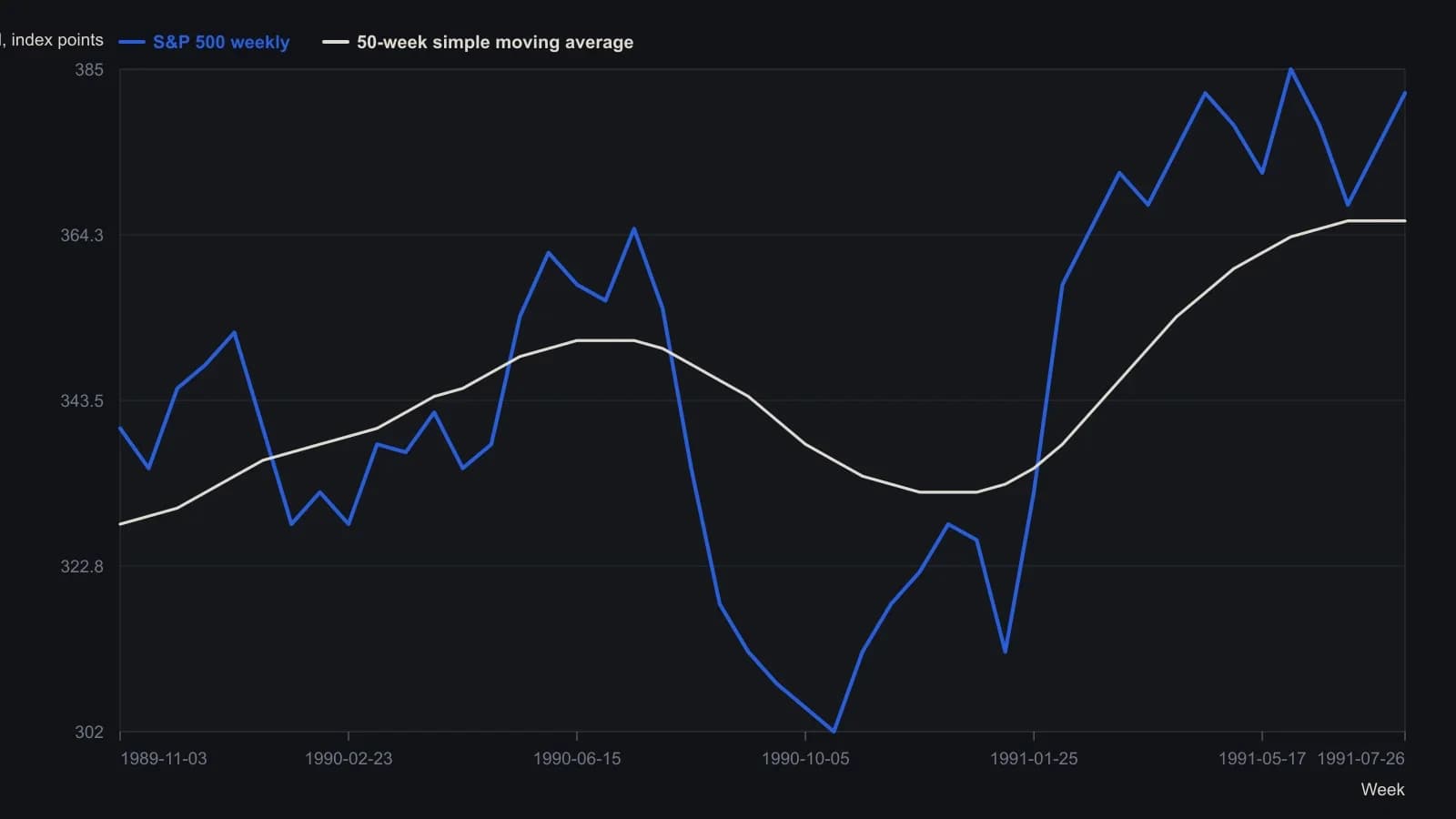
Y-values are approximate weekly closes and the 50-week average read off a scanned raster; ticks are not exact printed quotes. The source labels the series as a 50-week simple moving average.
Require a second series
Cross-market review covered equity-to-equity, currency-to-equity, and interest-rate-to-equity links. One case recorded a foreign equity index failing to confirm a United States equity-index high before a sharp break, then leading that index to new highs later. Bond futures were examined in both price and yield because the two pictures can diverge and because more participants think in yield than in the futures price.
Editorial reading: the second series is not optional color. It is intermarket-confirmation, and a primary setup is withheld until it agrees.
Confirm a spread with a yield comparison
A municipal-bond versus Treasury-bond daily settlement-price spread was tracked with a simple moving average. A parallel municipal-yield versus Treasury-yield comparison was used so a turn in the price spread could be confirmed by a turn in the yield-ratio. A commodity-spread is a position defined by the difference or ratio between related contracts instead of a single outright price.
Editorial reading: that related-contract difference can be the confirming series for the second gate.
Stand aside is a valid output
A trade was withheld unless expected reward was at least three times the amount placed at risk. That pre-entry test is the risk-reward-screen. Standing stops were used whenever the structure could accept them, with an explicit exception for certain spreads and intermarket trades.
Editorial reading: a failed risk-reward-screen is a finished system output of stand aside. The same editorial reading treats a structure that cannot carry a stop as stand aside, rather than as a reason to enter without one.
All readings on this track · 17 readings
- 1987Seasonal commodity spreads as portfolio slots
- 1987Underwriting a seasonal livestock calendar spread
- 1987Calendar gates for outright seasonal portfolios
- 1988Relative strength spreads against a commodity index
- 1989Evaluating mechanical seasonal date rules for commodity spreads
- 1991Regime gates for intermarket and spread trades
- 1997A decision-logic filter for the July-November soybean spread
- 1997Seasonal wheat and corn spread windows
- 1997Seasonal filters for corn-wheat spread breakouts
- 1998Be rich or be right: when only a written checklist counts as a system
- 1998Seasonal stock-index windows beyond the January effect
- 1999Same-maturity quality sleeves from a credit tunnel
- 2002Intraday sector pairs hedged as one spread
- 2006Seasonal regimes versus one-off news in commodity and rate spreads
- 2006Calendar spreads as an unknown-fundamentals regime filter
- 2008Placing early 2008 grain futures on a historical range map
- 2017Quiet tape as a construction window for multi-leg energy spreads