1999issue C051-10
Walk-forward endpoint Fourier construction as a same-day mechanical procedure
A full-window Fourier overlay on later-known prices can appear to lead a peak that a same-day window does not signal. Endpoint flattening and a walk-forward indicator that keeps only each day's last noise-filtered Fourier point turn that overlay into a real-time curve a mechanical trading system can test.
- A full-window Fourier overlay on later-known prices can appear to lead a peak that a same-day window does not signal.
- The discrete Fourier construction treats a sampled window as periodic, so unremoved trend and mean create spurious frequencies that swamp real ones.
- Endpoint flattening forces the first and last window values to zero so wraparound jumps do not dominate the spectrum.
- The walk-forward indicator joins each day's last noise-filtered Fourier point into a real-time curve that lagged major turns by zero to four days rather than leading the price series.
The full-window overlay problem
A full-window Fourier overlay on later-known prices can appear to lead a peak that a same-day window does not signal. Fourier analysis of a completed window therefore uses prices that a same-day window does not have, and the same-day window does not produce that leading overlay.
Full-window noise-filtered FFT on S&P 500 futures through the 1998 peak
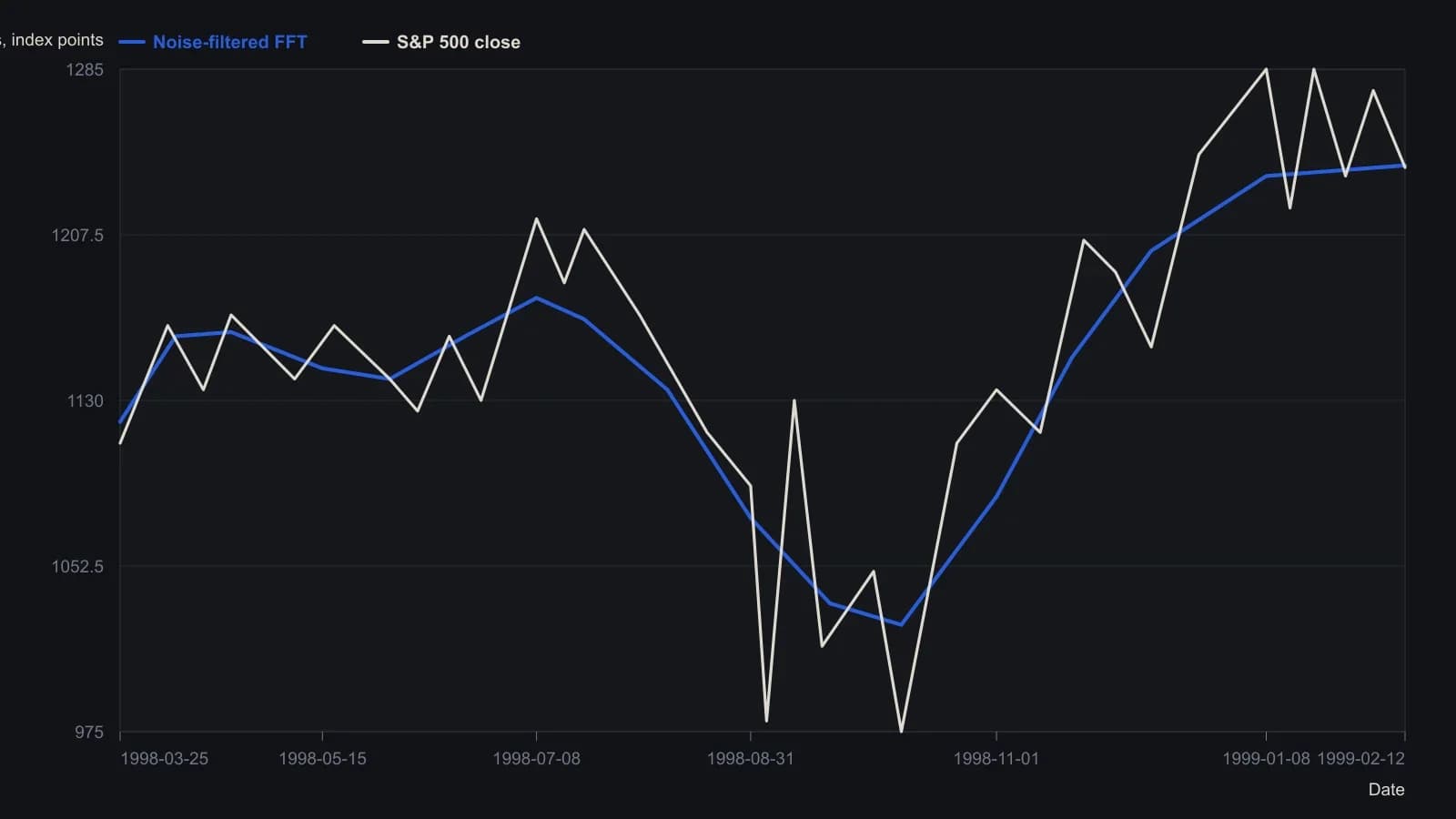
Meyers computed the FFT on the 16 January 1998–22 January 1999 window; the screenshot is dated 12 February 1999 with a printed close of 1239.27. Intra-month dates follow the monthly axis labels; 20 July is the closing high named in the text. Digitized levels are to the nearest five index points.
Periodic windows and spurious frequencies
The discrete Fourier construction treats a sampled window as periodic, so unremoved trend and mean create spurious frequencies that swamp real ones. The window has to be prepared before the Fast Fourier Transform, or those wraparound artifacts dominate the spectrum.
Endpoint flattening
Endpoint flattening forces the first and last window values to zero so wraparound jumps do not dominate the spectrum. With those ends pinned, the Fast Fourier Transform is less occupied by the artificial jump created when the sampled window is treated as a loop.
The walk-forward endpoint curve
The walk-forward indicator keeps only each day's last noise-filtered Fourier point and joins those endpoints into a real-time curve. Each new day brings a new window, a new flattened transform, and a single retained endpoint.
That endpoint curve lagged major turns by zero to four days rather than leading the price series. The same-day construction does not reproduce the apparent lead of the full-window overlay.
All readings on this track · 16 readings
- 1982Building FFT spectra to size cycle filters
- 1988Fourier cycle models break in major swings
- 1988Constructing moving average filters from price Fast Fourier Transforms
- 1989Staging Fast Fourier construction under memory limits
- 1993Constructing forecast inputs with moving averages, Fourier transforms and intermarket spreads
- 1994Preprocessing prices so Fourier peaks set moving-average lengths
- 1994Constructing a spreadsheet FFT power spectrum from daily prices
- 1994Building dominant-cycle spectra with FFT preprocessing
- 1994Constructing labeled cycle lengths from FFT spectra
- 1999Fast Fourier Transform reconstruction is not a walk-forward decision tool
- 1999Walk-forward endpoint Fourier construction as a same-day mechanical procedure
- 2002From the power spectrum to indicator windows
- 2003Endpoint Fast Fourier Transform evaluation with walk-forward mechanical rules
- 2004Constructing signal and noise from market waveforms
- 2012A two-stage case study in market cycle analysis
- 2015Whitening pink noise to build a near-zero-lag cycle oscillator