2008issue C061-2
Net time-value ranking for conversion spreads
Strip each listed option to leftover premium, add the signed leftovers across a conversion-spread or option-spread, and let that net-time-value score rank which cash-and-carry package the chain is offering.
- Time-value is leftover option premium after intrinsic-value is removed from the listed price, and any negative intrinsic amount is set to zero.
- Signed leftover premiums on each option-spread leg add into a net-time-value score that ranks competing constructions.
- Leftover premium generally increases when more time remains until expiration and when volatility is higher.
- A conversion-spread with positive net leftover premium is read from the chain as a cash-and-carry-arbitrage candidate without a greek stack.
Start with leftover premium
Option-premium-analysis decomposes each listed price into intrinsic-value and leftover premium so one package can be compared across strikes and spread structures. Leftover option premium equals the listed price minus intrinsic-value, and any negative intrinsic amount is set to zero.
Time-value is that leftover option premium after intrinsic-value is removed from the listed price. Intrinsic-value is the immediately exercisable portion of an option, floored at zero when the strike sits on the unexercisable side of the cash price. Leftover premium generally increases when more time remains until expiration and when volatility is higher.
One signed score ranks constructions
Signed leftover premiums on each option-spread leg can be added into a net-time-value score that ranks competing constructions. Net-time-value is that signed sum across every leg of an option-spread or conversion package, used as a construction ranking score.
An option-spread, in this workflow, is a multi-leg option package whose competing versions are ranked by one signed leftover-premium total.
Conversion-spread as cash-and-carry
A conversion pairs the cash instrument with a same-strike short call and long put, or reverses all three legs. A conversion-spread is that same-strike cash-and-carry package: long cash with a short call and long put, or short cash with a long call and short put.
Cash-and-carry-arbitrage is a conversion or reverse-conversion whose net leftover premium is positive and is therefore treated as a locked residual rather than a directional bet. A conversion with positive net leftover premium is read from the chain as a cash-and-carry-arbitrage candidate without requiring a greek stack.
Archive illustrations
In a 100 cash-price illustration, three conversion packages produced net leftover premiums of 0.2, 0.1, and 0.3.
On an SPY print of 130.91 for options expiring 15 September 2006, net leftover premium peaked at 0.19 on the 122 strike and troughed at -0.26 on the 134 strike. Conversion packages built at those 122 and 134 strikes both showed positive net leftover premium and were classified as no-loss cash-and-carry constructions.
Net time value across the September 2006 SPY conversion chain
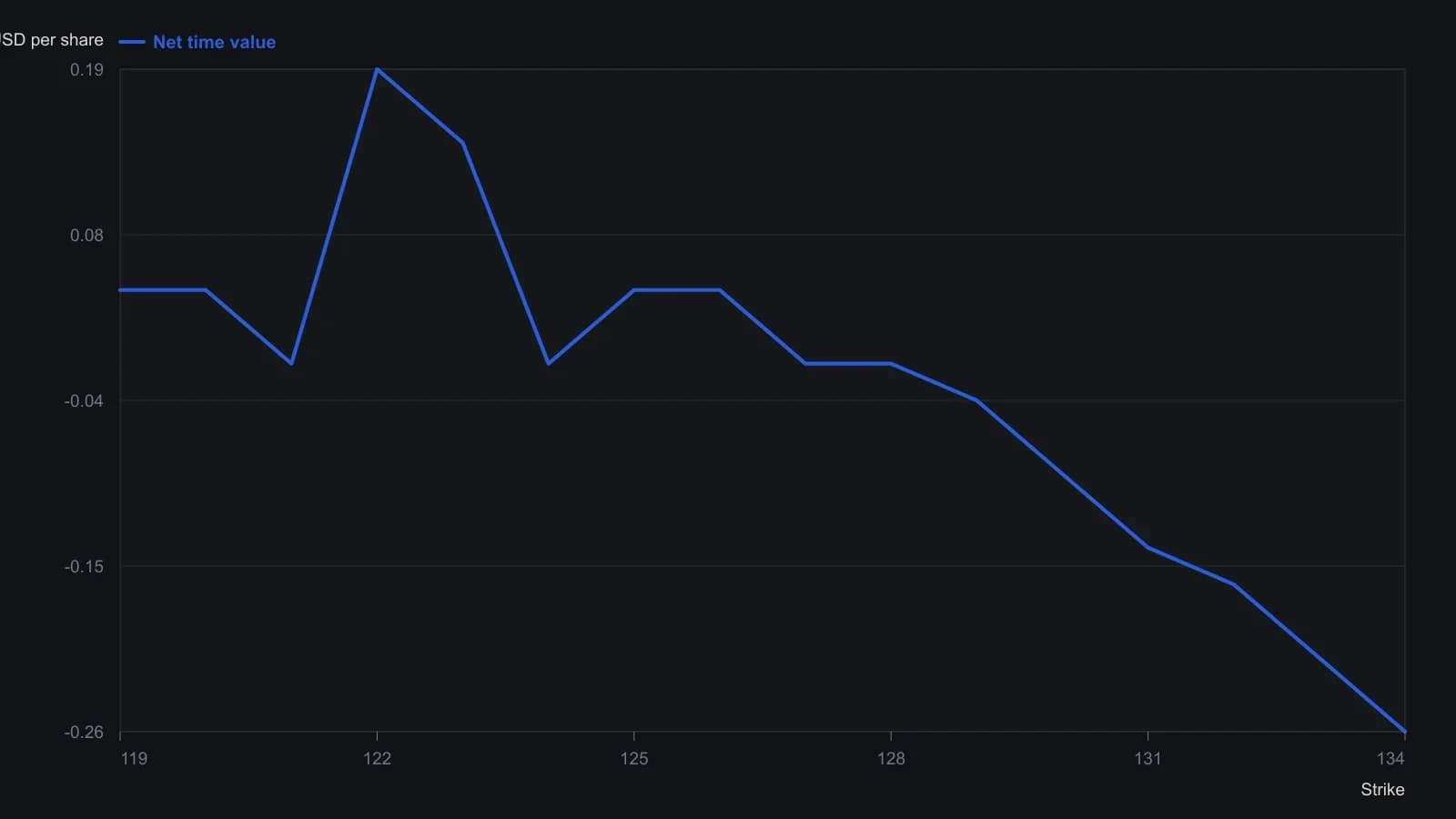
Snapshot is SPY at 130.91 on 30 August 2006, options expiring 15 September 2006. Parentheses in the source net-value column are negatives.
All readings on this track · 10 readings
- 1998Strike selection from a return distribution and implied volatility
- 2004Constructing an index-options overlay with dividend premiums and open interest
- 2005Implied volatility and price divergence as a sentiment regime filter
- 2007Ranking short options by premium, margin, time, and delta
- 2008Bull put spread construction under elevated implied volatility
- 2008Net time-value ranking for conversion spreads
- 2008Out-of-the-money commodity credit spreads in a volatility regime
- 2012Far-spot option-elasticity and percent-theta limits
- 2012Weekly debit spreads and volatility regime matching
- 2018Constructing option strikes from intrinsic and time premium