1995issue C121-6
Constructing range-compression breakout procedures
Range construction begins by locating a quiet trading-range, then uses that same width to arm a breakout, place the stop, and decide when to stand aside.
- Locating a trading-range is the first construction step, because price is treated as alternating between bounded two-way trade and directional stretches.
- Range-compression below an average-range-threshold marks buyer-seller equilibrium and later arms a prior-day-range-entry or a three-day-range-trigger.
- A half-range-stop is taken from the same high-low span that qualified the entry, while several very wide days are a reason to stand aside.
- Triggering a stop-cluster is not the same as classifying the move; a pierce can still fail as a false-breakout and fall back inside the band.
Start from the range, not the breakout
The construction starts from the observation that price alternates between bounded two-way ranges and directional stretches. Locating the range is the first step in defining later breakout or return-to-range rules.
A trading-range is a stretch of two-way trade between a recent low treated as support and a recent high treated as resistance, with little net progress. A narrow range is treated as buyer-seller equilibrium in that band, with buy stops resting above the high and sell stops resting below the low.
Classify the move after the band is pierced
Those resting orders form a stop-cluster. Once they are triggered, the procedure still has to classify the move. If participants treat the cause as meaningful, the expansion can continue. If they do not, price can collapse back into the prior band. That failed push through the boundary is a false-breakout.
Measure width and mark compression
Daily width is measured two ways. Simple-range is the session high minus the session low and is treated as adequate when gaps are rare and openings rarely jump away from the prior session. True-range is preferred in frequently gapping markets such as currencies. It is a gap-aware span that reaches back to the prior high or low when the new session opens outside the previous day's band.
An average-range line is the volatility filter. That average-range-threshold is drawn so prints fall below it only in unusually quiet conditions. Construction examples use 0.50 for currencies such as the Swiss franc or yen, and 3.00 points for the S&P 500. Range-compression is a run of sessions whose daily span stays below that line. It is treated as equilibrium and as a setup for a later expansion.
Specify a prior-day-range-entry
The first specified entry is a prior-day-range-entry. It buys a break of the prior day's high, or sells a break of the prior day's low, only when that day's range is 3.00 or lower. The protective exit is a half-range-stop, placed half the signal day's high-low distance from the entry.
That prior-day-range-entry is specified as closable on the same session's close, or keepable as the start of a longer holding period.
S&P 500 daily range vs 3-point compression line, May–June 1995
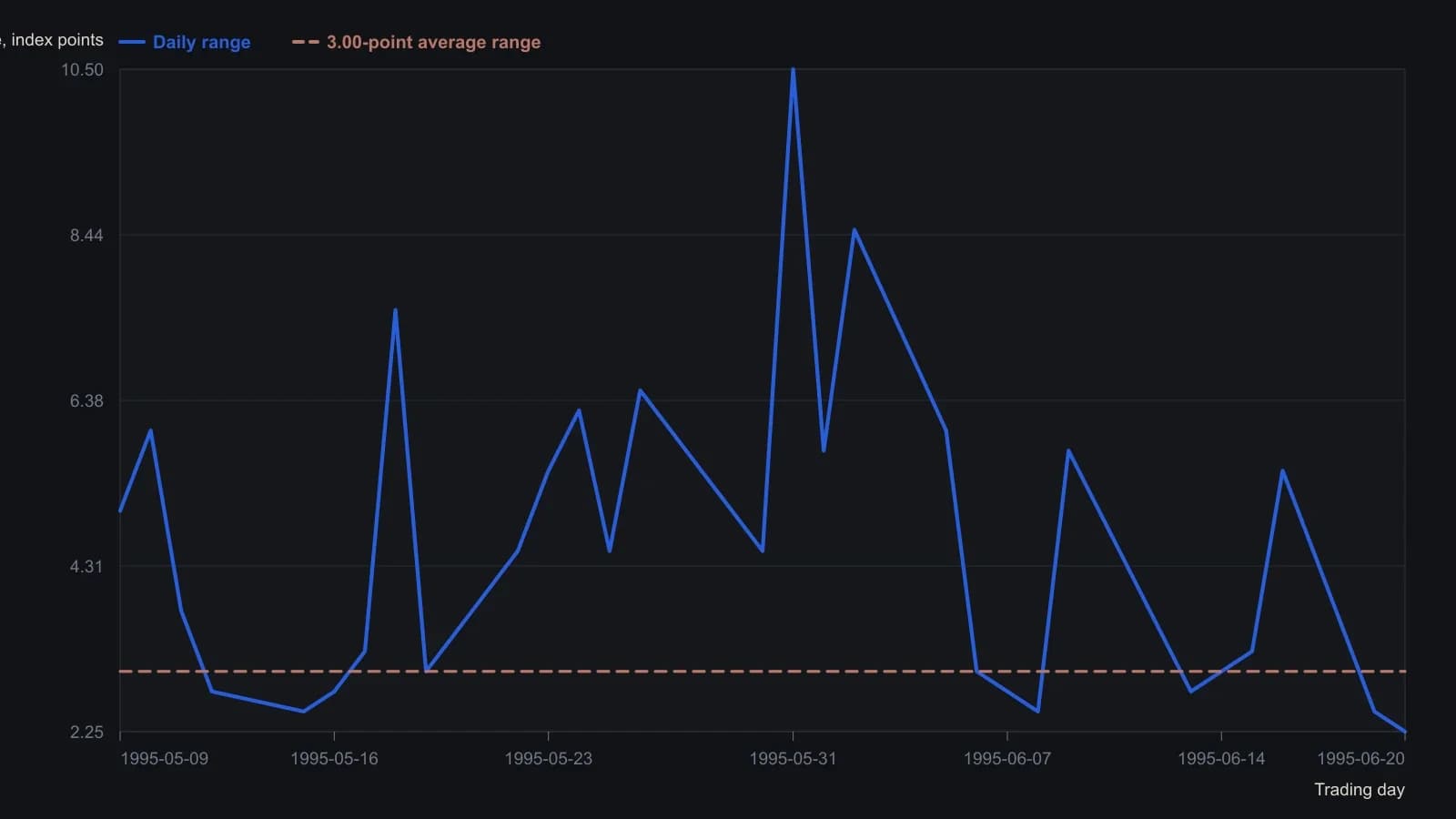
Range values are approximate readings from the published raster. Y-axis ticks are 2 points; readings are given to the nearest 0.25, which is as fine as the print will support. The 3.00 line is the article’s stated S&P average-range cutoff, not a fitted statistic.
Wait for a multi-day-compression-filter
A second procedure waits on a multi-day-compression-filter. Several consecutive sessions must print below the average-range-threshold before a breakout is eligible. The entry is then a three-day-range-trigger: a break of the high or low of the latest three sessions after that filter is met. The procedure exits on the close or with a trailing stop.
Scale the stop or stand aside
Stop distance is scaled to current width, so the same statistic that armed the entry also sets the exit and the abstention rule. Compressed ranges allow closer stops. Several days of very high range are treated as a reason to stand aside or change risk control, because the required stops widen.
Use a recorded sequence as a construction check
A Swiss franc sequence is used as a construction check, not as a claim about later results. Six sessions print with daily range below 0.50, an upside break occurs on the seventh session, and price returns into the band on the following session.
All readings on this track · 11 readings
- 1995A tight-range volatility breakout as one classroom procedure
- 1995Constructing range-compression breakout procedures
- 1996Volatility contraction and narrow-range breakout rules
- 1998Gold volatility breakout as one written entry and exit procedure
- 2005Evaluating next-day range expansion breakouts
- 2006Combining BandWidth extremes with a Stochastic oscillator and a Volatility breakout
- 2007Gating currency volatility breakouts with ADX and trailing stops
- 2010Closing half-hour longs after late bear rallies
- 2013Bollinger Bands, volatility breakout, and breakout confirmation as one testable procedure
- 2014Confirming swing breakouts after wide-range cups and gaps
- 2019Extreme-seeking volatility with bands, breakouts, and chandelier exits