1995issue C041-8
A tight-range volatility breakout as one classroom procedure
A range-breakout built as one closed procedure: name a tight-narrow range, store its extremes, require a range-expansion before any entry, and hand the exit to a separate moving-average rule.
- A tight-narrow range is named from a five-bar window high and window low when unused-ticks are large relative to the window span.
- Long and short triggers are the stored-range-high and stored-range-low of the last accepted episode, not the current five-bar extremes.
- A close through a stored extreme is allowed only when the current bar also shows range-expansion versus an eight-bar average span.
- The exit is a separate average-low-exit or average-high-exit, and the constriction lookback is written as a replaceable parameter.
One procedure for entry, exit and stand-aside
The archive workflow builds a range-breakout from three separable parts. First it names a tight-narrow range from a short lookback. Then it allows an entry only after a range-expansion through a stored extreme. Then it hands the exit to a moving-average rule that does not reuse the contraction test.
Name the contraction first
A five-bar window high and window low are the first inputs used to define a tight-narrow range. Unused-ticks equal the sum of each bar's gap from the window high plus each bar's gap from the window low. The same quantity is five times the window span plus the sum of each bar's low minus high.
A tight-narrow range is a short lookback window whose unused interior ticks are large relative to the window high-low span.
Accept the reading with one of two tests
One encoding accepts a tight-narrow range when twice the five-bar span exceeds that unused-tick sum. Another encoding accepts it when unused ticks as a percentage of the span fall below 200.
Store the extremes and require expansion
Long and short entry prices are the high and low of the most recently accepted tight-narrow window. Those prices are recovered from that earlier episode rather than always taken from the current five-bar extremes. The stored-range-high is the window high from the most recent accepted tight-narrow episode and is the long trigger. The stored-range-low is the matching window low and is the short trigger.
An entry is allowed only when the close breaks the stored range extreme and the current bar span is larger than 1.25 times an eight-bar average span. That second condition is the range-expansion: a current bar whose high-low span exceeds a stated multiple of a recent average span.
One encoding further requires that a tight-narrow reading occurred on at least one of the prior three bars before an expansion break can open a position.
Keep the exit on a moving average
Several encodings exit a long on a close below an eight-bar average of lows. That close through the average of lows is the average-low-exit. They exit a short on a close above a ten-bar average of highs. That close through the average of highs is the average-high-exit. One encoding uses eight-bar averages of both highs and lows.
Swap the lookback and retire a used contraction
The constriction lookback is written as a replaceable parameter, with four-bar and eight-bar windows named as alternatives to the five-bar default. After a position is open, one encoding resets the stored range high and low so a later entry cannot reuse the same contraction.
Tight-range breakout cumulative profit, 1984–1993
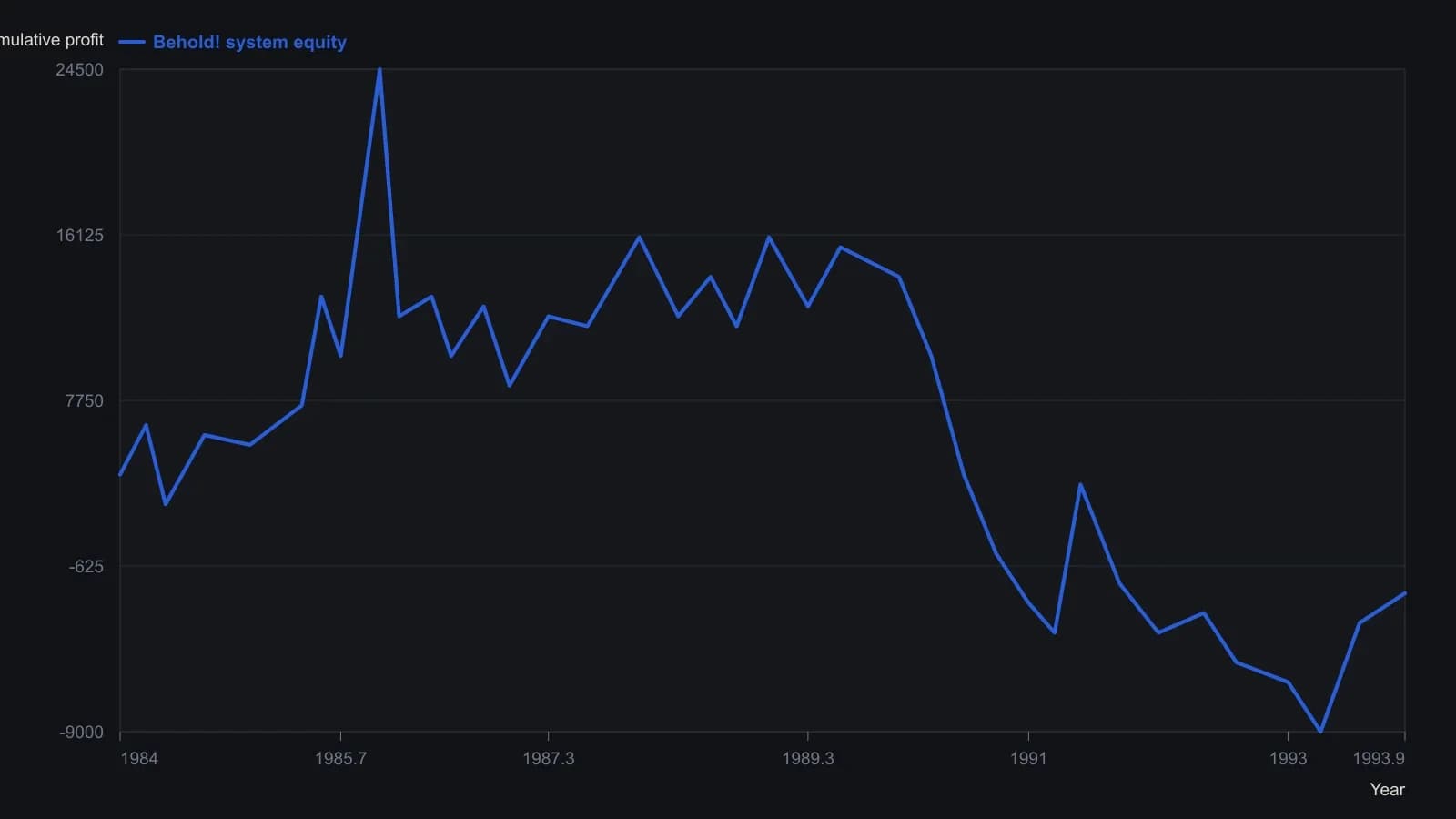
Visual readings from a 2,500-unit grid on a magazine scan, rounded to the nearest 500. The figure does not print a profit unit.
All readings on this track · 11 readings
- 1995A tight-range volatility breakout as one classroom procedure
- 1995Constructing range-compression breakout procedures
- 1996Volatility contraction and narrow-range breakout rules
- 1998Gold volatility breakout as one written entry and exit procedure
- 2005Evaluating next-day range expansion breakouts
- 2006Combining BandWidth extremes with a Stochastic oscillator and a Volatility breakout
- 2007Gating currency volatility breakouts with ADX and trailing stops
- 2010Closing half-hour longs after late bear rallies
- 2013Bollinger Bands, volatility breakout, and breakout confirmation as one testable procedure
- 2014Confirming swing breakouts after wide-range cups and gaps
- 2019Extreme-seeking volatility with bands, breakouts, and chandelier exits