1996issue C081-7
Volatility contraction and narrow-range breakout rules
Quiet historical-volatility versus the long-term reading, plus an inside-day or a narrow-range-four bar, is required before next-session-stop-entry. The same procedure specifies the entry-day-opposite-stop, a later trailing-stop, and standing aside when the two-part filter is absent.
- Markets are treated as cycling between quiet and active volatility, with an extreme quiet spell as the condition after which volatility often expands and price can travel quickly.
- A setup-session requires the six-to-one-hundred-volatility-ratio under 50 percent and, on that same session, either an inside-day or a narrow-range-four bar.
- Next-session-stop-entry places buy and sell stops one tick beyond the setup extremes, so the first breakout chooses direction.
- The entry-day-opposite-stop is live only on the fill day and expires at that close; any remaining position is then managed with a trailing-stop.
Quiet spells as a precondition
The procedure treats markets as cycling between quiet and active volatility. It treats an extreme quiet spell as the condition after which volatility often expands and price can travel quickly.
A setup-session is withheld until that quietness is measured and the daily range itself is compressed. When those conditions are absent, the procedure does not place next-session-stop-entry.
Historical-volatility and the ratio
Historical-volatility is an annualized percentage that measures how much closes have been fluctuating, computed from the standard deviation of day-to-day logarithmic close changes. A six-day lookback is described as more variable than a 100-day lookback.
The six-to-one-hundred-volatility-ratio is the quietness screen. It flags compression when the six-day historical-volatility reading is below 50 percent of the 100-day reading.
Inside-day and narrow-range-four
A narrow-range-four is a daily bar whose high-to-low span is narrower than each of the three preceding daily spans when those spans are compared one by one. An inside-day is a daily bar whose high is below the prior high and whose low is above the prior low, so the entire session sits inside the previous range.
One procedure for entry, exit, and standing aside
A setup-session exists only when the six-to-one-hundred-volatility-ratio is under 50 percent and that same session is also either an inside-day or a narrow-range-four day.
On the session after the setup-session, next-session-stop-entry places a buy stop one tick above the setup high and a sell stop one tick below the setup low, so the first breakout chooses direction. After a fill, the entry-day-opposite-stop sits one tick beyond the unused setup extreme. It is used on the entry session only and expires at that close. Any remaining position is then managed with a trailing-stop.
The same filter on two contracts
Worked examples apply the same two-part filter to a heating-oil contract that printed both an inside-day and a narrow-range-four bar, and to a coffee contract that printed a narrow-range-four bar. Each was followed by a next-session directional expansion.
May 1996 coffee: six-day versus 100-day historical volatility
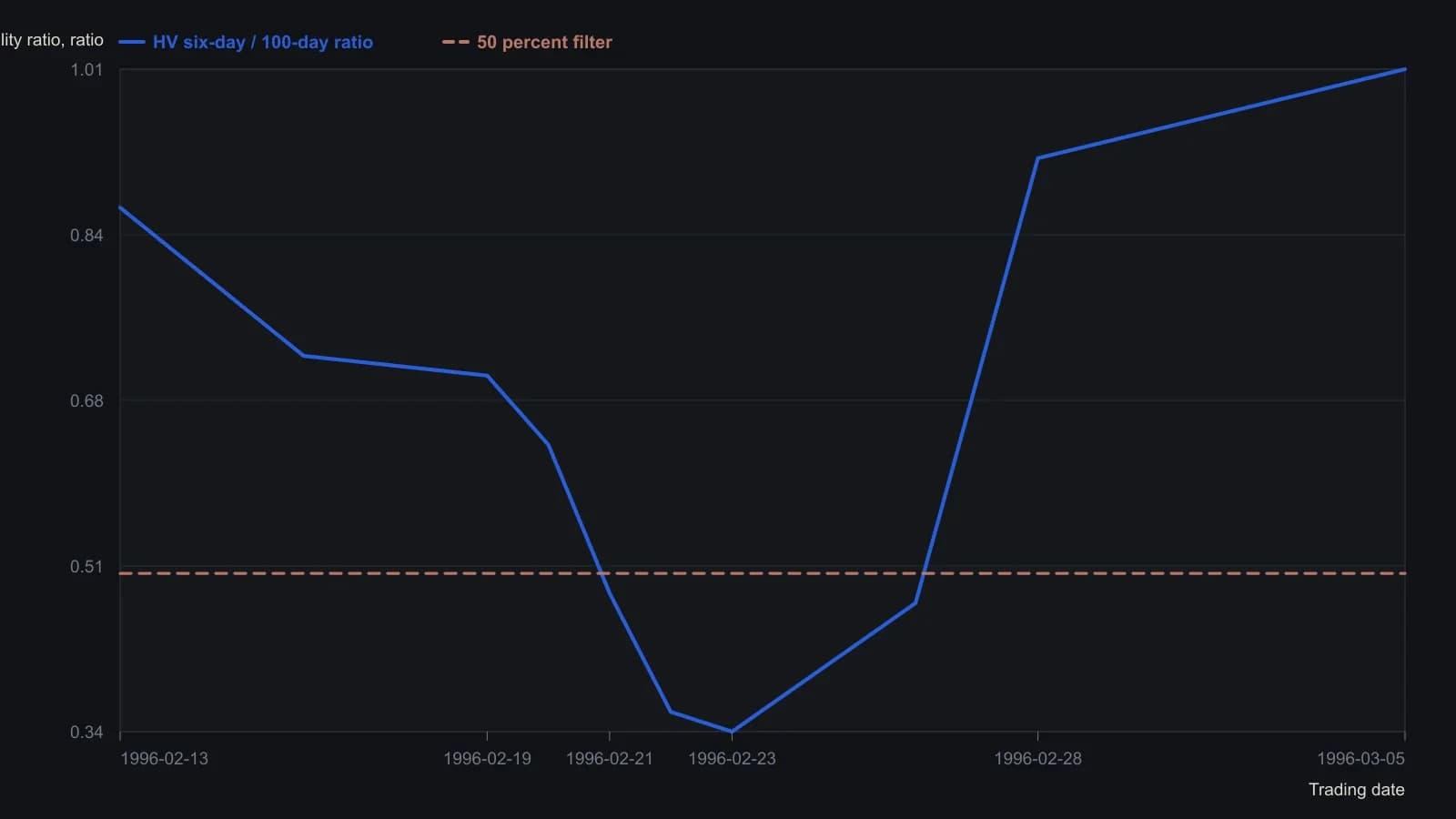
The source fixes the short lookback at six sessions and the long lookback at 100 sessions. Y is read to about 0.02 on a 0.2-tick scale from a 1990s screenshot. Session dates are aligned to the February 20 and February 28 axis marks and to the article’s February 22–23 coffee example.
All readings on this track · 11 readings
- 1995A tight-range volatility breakout as one classroom procedure
- 1995Constructing range-compression breakout procedures
- 1996Volatility contraction and narrow-range breakout rules
- 1998Gold volatility breakout as one written entry and exit procedure
- 2005Evaluating next-day range expansion breakouts
- 2006Combining BandWidth extremes with a Stochastic oscillator and a Volatility breakout
- 2007Gating currency volatility breakouts with ADX and trailing stops
- 2010Closing half-hour longs after late bear rallies
- 2013Bollinger Bands, volatility breakout, and breakout confirmation as one testable procedure
- 2014Confirming swing breakouts after wide-range cups and gaps
- 2019Extreme-seeking volatility with bands, breakouts, and chandelier exits