2010issue C0430-32
Closing half-hour longs after late bear rallies
A last-half-hour long after a late bounce is taught as one gated procedure: clock the prior-window trigger, enter at 15:30, hold to the 16:00 close, and leave the book unused when the decline regime or the volume floor fails.
- Clock a prior-window trigger in the 15:00-15:30 window, then consider a long at 15:30 and apply a closing-hold exit at 16:00.
- A regime gate confines the procedure to a defined multi-month decline and keeps the book idle outside that state.
- Low-volume abstention excludes 15:30-16:00 sessions below five million shares, treated here as preholiday days.
- A volatility cluster of large late-session displacements is an activity check, not a forecast of a new trend.
The clock, the entry, and the hold
The archive asked whether a 15:00-15:30 rally should be followed by a long at 15:30 held until the 16:00 close. That question already binds three pieces: a prior-window trigger that must print in the first half of the final hour, a rule-based long at 15:30, and a closing-hold exit that keeps an accepted long until the 16:00 regular-session close rather than managing it tick by tick.
Sessions with 15:30-16:00 ET volume below five million shares were excluded as preholiday days. That exclusion is the low-volume abstention. Two filters can leave the whole book unused: the volume floor and a regime gate that requires a defined multi-month decline.
The ETF window and the single-name proxy
The case used a Nasdaq-100 ETF window from 31 October 2007, last close $55.02, through 9 March 2009, lowest close $25.70, spanning 340 sessions of the prior bear market.
The ETF was treated as a single-security proxy for 100 names, typically a one-cent bid-ask, nearly aligned with the e-mini Nasdaq-100 future, 62.5% information-technology weight, and no energy, finance, or utility exposure, with one futures contract mapped to 814 ETF shares.
Net-positive, then net-negative, inside the last hour
Across that 340-session decline of $29.21, or 53%, the first half of the final hour was net positive and the last 30 minutes were net negative, with late-hour volume averaging 20 million shares.
Closing-half-hour outcomes about $0.50 away from the 15:30 price appeared on 27 days, or about once every 12.5 sessions, while later readings clustered more tightly near the 10 March 2009 regime change.
Editorial: the pairing of a late bounce with a net-negative last half hour is the mean-reversion read of this clock. It is not a claim about other hours or later markets.
Raising the prior-window trigger
Prior-window advances were bucketed at $0.00, $0.05, $0.10, $0.20, and $0.25, with 166, 129, 99, 39, and 30 days, and the mean 15:30-16:00 result rose as the 15:00-15:30 threshold increased.
After a 15:00-15:30 move of at least $0.25, the 30-day subset had a $0.44 closing-half-hour standard deviation, six of those 30 days moved $0.50, and late-rally volume reached about 36 million shares.
Editorial: a larger prior-window trigger is the volatility-breakout gate on the same 15:30 entry. It does not create a second system. The accepted long still uses the same closing-hold exit.
QQQQ last-half-hour mean after a 15:00–15:30 bounce
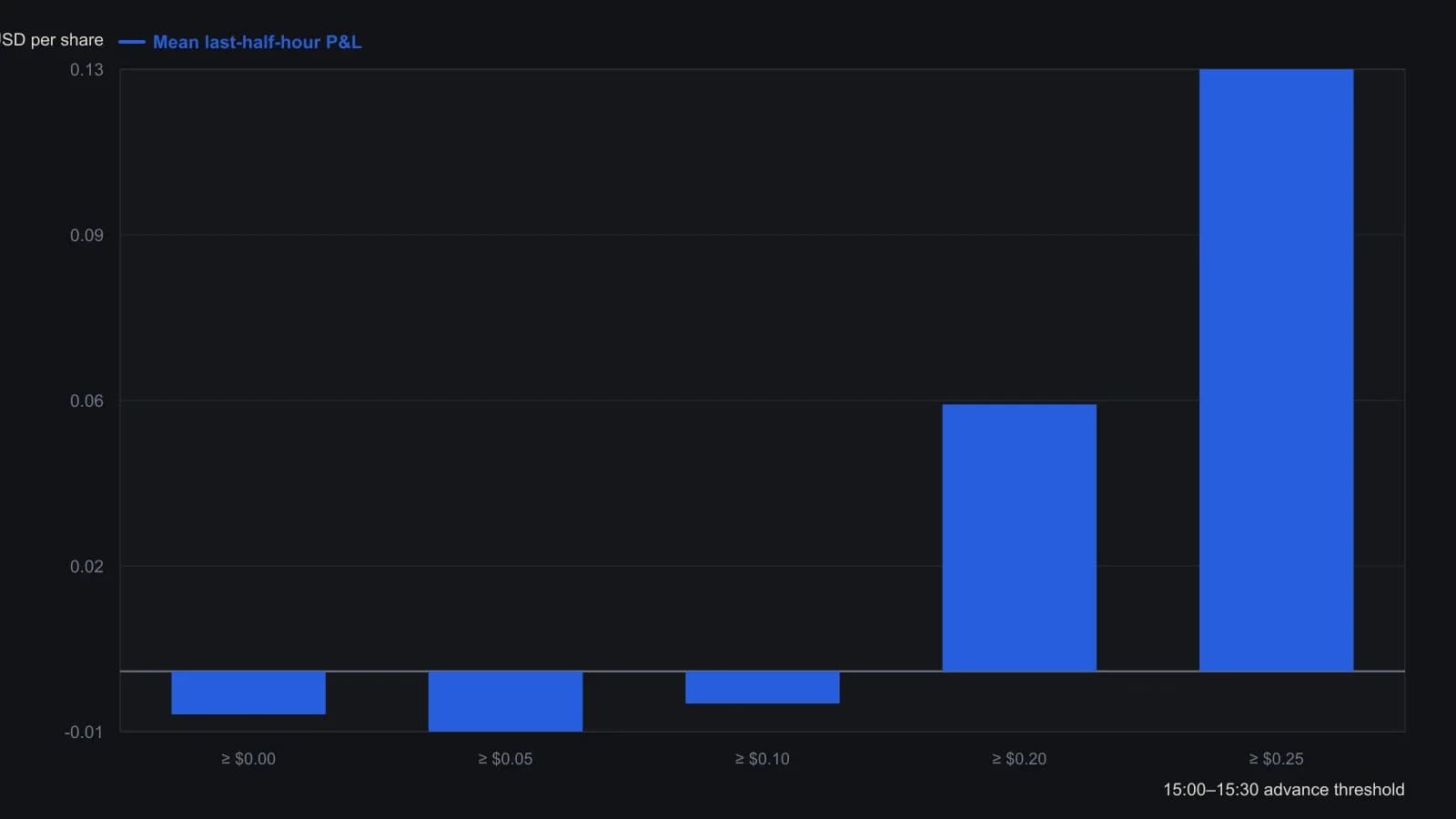
Pre-holiday sessions with 15:30–16:00 ET volume below five million shares are omitted. The $0.20 mean is the article’s $2.23 total over 39 days (2.23/39), correcting a dropped decimal in that table cell.
When the book stays unused
The procedure was framed as regime-bound: clusters of extreme late-session swings marked the active setting, a later volatility slowdown was read as a recovery-stage caution, and the rule set was to be stored until a relentless decline returned.
A volatility cluster is a run of unusually large late-session displacements used as an activity check, not as a forecast of a new trend. The regime gate confines the procedure to a defined multi-month decline and keeps it idle outside that state.
All readings on this track · 11 readings
- 1995A tight-range volatility breakout as one classroom procedure
- 1995Constructing range-compression breakout procedures
- 1996Volatility contraction and narrow-range breakout rules
- 1998Gold volatility breakout as one written entry and exit procedure
- 2005Evaluating next-day range expansion breakouts
- 2006Combining BandWidth extremes with a Stochastic oscillator and a Volatility breakout
- 2007Gating currency volatility breakouts with ADX and trailing stops
- 2010Closing half-hour longs after late bear rallies
- 2013Bollinger Bands, volatility breakout, and breakout confirmation as one testable procedure
- 2014Confirming swing breakouts after wide-range cups and gaps
- 2019Extreme-seeking volatility with bands, breakouts, and chandelier exits